Zhang Di, Ke Li, Ni Zhen, Chen Yu, Zhang Lin-Hui, Zhu Shao-Hua, Li Chan-Juan, Shang Lei, Liang Jie, Shi Yong-Quan
State Key Laboratory of Cancer Biology & Institute of Digestive Diseases, Xijing Hospital, Department of Health Statistics, Fourth Military Medical University, Xi'an, Shaanxi Province, China.
Medicine (Baltimore). 2017 Aug;96(32):e7697. doi: 10.1097/MD.0000000000007697.
Due to increasing antimicrobial resistance, a bismuth-based quadruple regimen has been recommended as an alternative first-line therapy for Helicobacter pylori (H pylori) eradication. However, different results are varied greatly and the availability of bismuth was limited in some countries. We assessed the efficacy and safety of 14-day berberine-containing quadruple therapy as an alternative regimen for H pylori eradication.
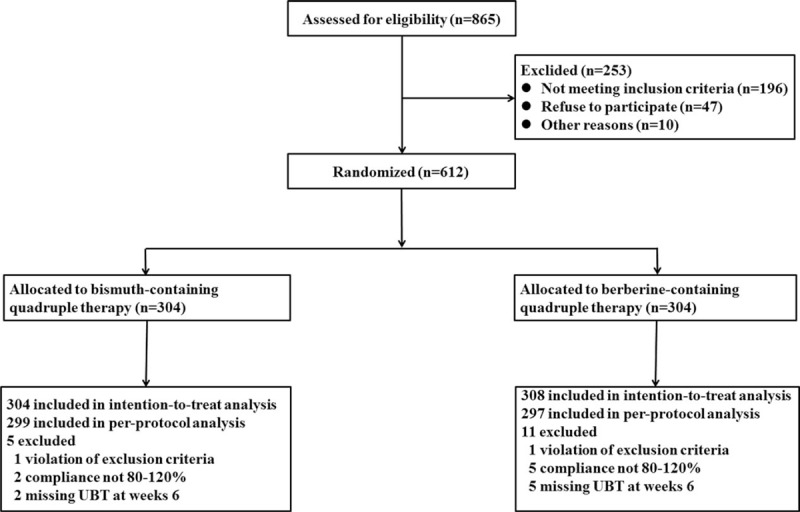
In a randomized, open-label, non-inferiority, phase IV trial between November 25, 2014, and October 15, 2015, 612 treatment-naive patients were randomly assigned to 14-day berberine-containing (n = 308) or 14-day bismuth-containing (n = 304) quadruple therapy. The primary outcomes were eradication rates determined by the C urea breath test (C-UBT) 28 days after the end of treatment. The secondary outcomes were adverse events and compliance.
The baseline demographic data including age, gender, body mass index (BMI), general condition and severity score were not statistically different in both groups. The eradication rates in bismuth and berberine groups were 86.4% (266/308) and 90.1% (274/304) in intention-to-treat (ITT) analysis (P = .149), and 89.6% (266/297) and 91.3% (273/299) in per-protocol (PP) analysis (P = .470), respectively. No statistically significant difference was found in the overall incidence of adverse events between both groups (35.7% vs 28.6%, P = .060).
Both regimens achieved the recommended efficacy for H pylori eradication. The berberine-containing quadruple regimen was not inferior to bismuth-containing quadruple regimen and can be recommended as an alternative regimen for H pylori eradication in the local region.
由于抗菌药物耐药性不断增加,含铋剂的四联疗法已被推荐作为根除幽门螺杆菌(H pylori)的一线替代疗法。然而,不同的结果差异很大,且铋剂在一些国家的可及性有限。我们评估了含小檗碱的14天四联疗法作为根除H pylori替代方案的疗效和安全性。
在2014年11月25日至2015年10月15日进行的一项随机、开放标签、非劣效性IV期试验中,612例初治患者被随机分配至含小檗碱的14天四联疗法组(n = 308)或含铋剂的14天四联疗法组(n = 304)。主要结局为治疗结束后28天通过碳-尿素呼气试验(C-UBT)测定的根除率。次要结局为不良事件和依从性。
两组的基线人口统计学数据,包括年龄、性别、体重指数(BMI)、一般状况和严重程度评分,无统计学差异。意向性分析(ITT)中,铋剂组和小檗碱组的根除率分别为86.4%(266/308)和90.1%(274/304)(P = 0.149),符合方案分析(PP)中分别为89.6%(266/297)和91.3%(273/299)(P = 0.470)。两组不良事件的总体发生率无统计学显著差异(35.7%对28.6%,P = 0.060)。
两种方案均达到了推荐的根除H pylori疗效。含小檗碱的四联疗法不劣于含铋剂的四联疗法,可推荐作为当地根除H pylori的替代方案。