Gu Lihu, Chen Manman, Guo Dongyu, Zhu Hepan, Zhang Wenchao, Pan Junhai, Zhong Xin, Li Xinlong, Qian Haoran, Wang Xianfa
Department of General Surgery, Sir Run Run Shaw Hospital, School of Medicine, Zhejiang University, Hangzhou, Zhejiang, China.
The Second Clinical College, Zhejiang Chinese Medical University, Hangzhou, Zhejiang, China.
PLoS One. 2017 Aug 10;12(8):e0182692. doi: 10.1371/journal.pone.0182692. eCollection 2017.
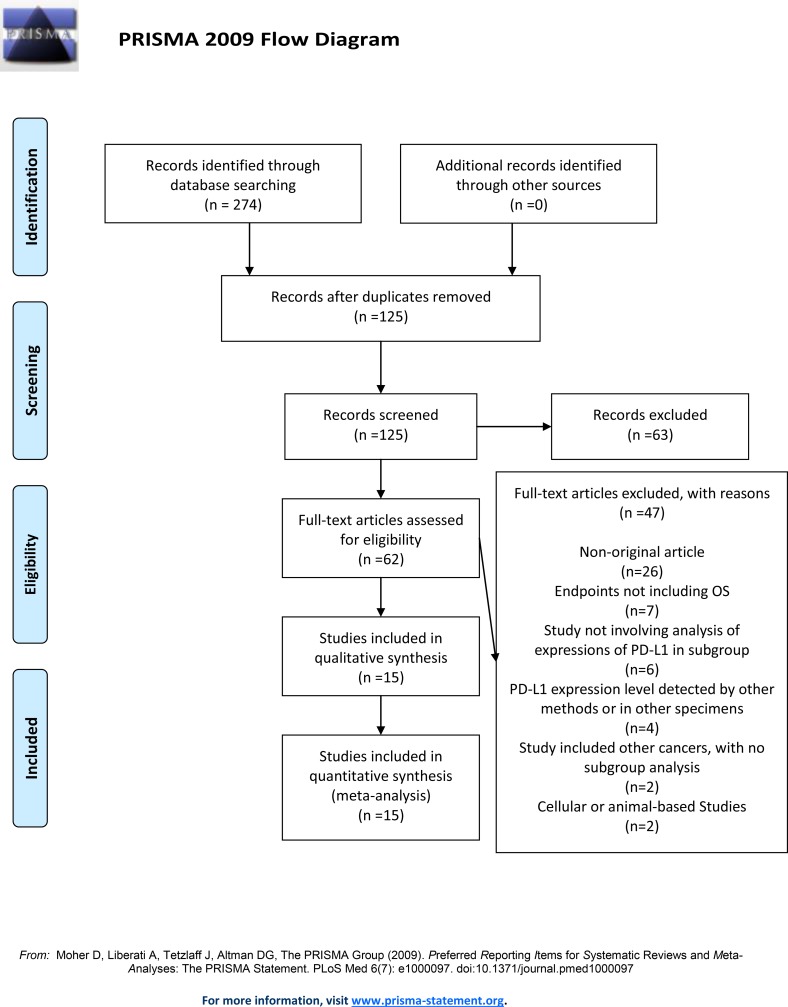
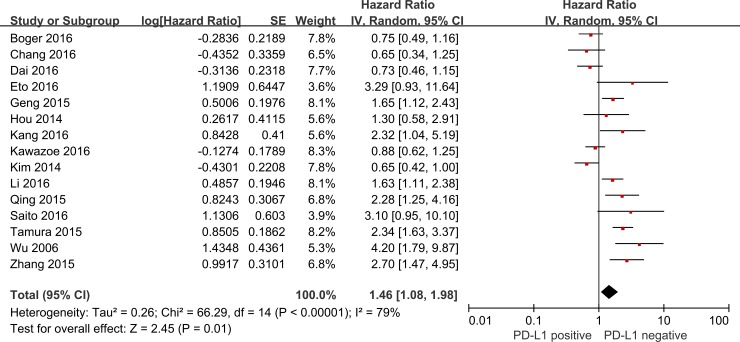
The expression of Programmed cell Death Ligand 1 (PD-L1) is observed in many malignant tumors and is associated with poor prognosis including Gastric Cancer (GC). The relationship between PD-L1 expression and prognosis, however, is controversial in GC. This paper purports to use a meta-analysis to investigate the relationship between PD-L1 expression and prognosis in GC. For this study, the following databases were searched for articles published from June 2003 until February 2017: PubMed, EBSCO, Web of Science and Cochrane Library. The baseline information extracted were: authors, year of publication, country where the study was performed, study design, sample size, follow-up time, baseline characteristics of the study population, pathologic data, overall survival (OS). A total of 15 eligible studies covering 3291 patients were selected for a meta-analysis based on specified inclusion and exclusion criteria. The analysis showed that the expression level of PD-L1 was associated with the overall survival in GC (Hazard Ratio, HR = 1.46, 95%CI = 1.08-1.98, P = 0.01, random-effect). In addition to the above, subgroup analysis showed that GC patients with deeper tumor infiltration, positive lymph-node metastasis, positive venous invasion, Epstein-Barr virus infection positive (EBV+), Microsatellite Instability (MSI) are more likely to expression PD-L1. The results of this meta-analysis suggest that GC patients, specifically EBV+ and MSI, may be prime candidates for PD-1 directed therapy. These findings support anti-PD-L1/PD-1 antibodies as a kind of immunotherapy which is promising for GC.
程序性细胞死亡配体1(PD-L1)在许多恶性肿瘤中均有表达,且与包括胃癌(GC)在内的不良预后相关。然而,在胃癌中,PD-L1表达与预后之间的关系仍存在争议。本文旨在通过荟萃分析来研究PD-L1表达与胃癌预后之间的关系。本研究检索了以下数据库中2003年6月至2017年2月发表的文章:PubMed、EBSCO、科学网和考克兰图书馆。提取的基线信息包括:作者、发表年份、研究开展的国家、研究设计、样本量、随访时间、研究人群的基线特征、病理数据、总生存期(OS)。根据指定的纳入和排除标准,共选择了15项符合条件的研究,涵盖3291例患者进行荟萃分析。分析表明,PD-L1的表达水平与胃癌的总生存期相关(风险比,HR = 1.46,95%CI = 1.08 - 1.98,P = 0.01,随机效应)。除此之外,亚组分析显示,肿瘤浸润更深、有阳性淋巴结转移、有阳性静脉侵犯、爱泼斯坦-巴尔病毒感染阳性(EBV+)、微卫星不稳定性(MSI)的胃癌患者更有可能表达PD-L1。该荟萃分析的结果表明,胃癌患者,特别是EBV+和MSI患者,可能是PD-1导向治疗的主要候选对象。这些发现支持抗PD-L1/PD-1抗体作为一种对胃癌有前景的免疫疗法。