Otto Lars-Gernot, Mondal Prodyut, Brassac Jonathan, Preiss Susanne, Degenhardt Jörg, He Sang, Reif Jochen Christoph, Sharbel Timothy Francis
Apomixis Research Group, Department Plant Breeding Research, Leibniz Institute of Plant Genetics and Crop Plant Research (IPK), Corrensstrasse 3, D-06466, Seeland OT Gatersleben, Germany.
Research Group of Pharmaceutical Biotechnology, Institute of Pharmacy, Martin-Luther University Halle-Wittenberg, Hoher Weg 8, 06120, Halle (Saale), Germany.
BMC Genomics. 2017 Aug 10;18(1):599. doi: 10.1186/s12864-017-3991-0.
Chamomile (Matricaria recutita L.) has a long history of use in herbal medicine with various applications, and the flower heads contain numerous secondary metabolites which are medicinally active. In the major crop plants, next generation sequencing (NGS) approaches are intensely applied to exploit genetic resources, to develop genomic resources and to enhance breeding. Here, genotyping-by-sequencing (GBS) has been used in the non-model medicinal plant chamomile to evaluate the genetic structure of the cultivated varieties/populations, and to perform genome wide association study (GWAS) focusing on genes with large effect on flowering time and the medicinally important alpha-bisabolol content.
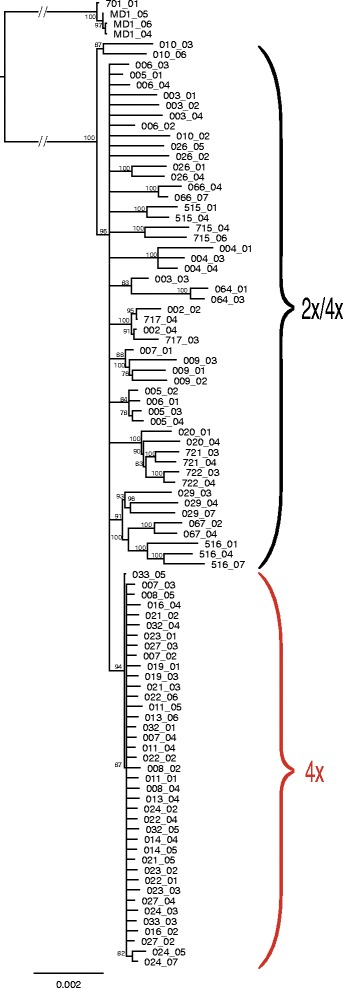
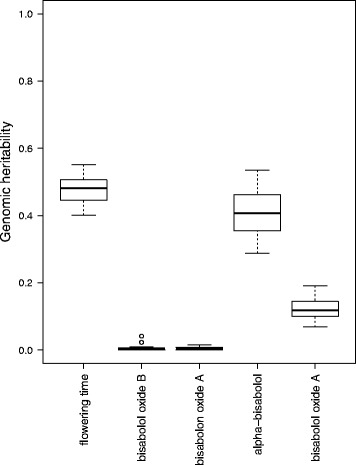
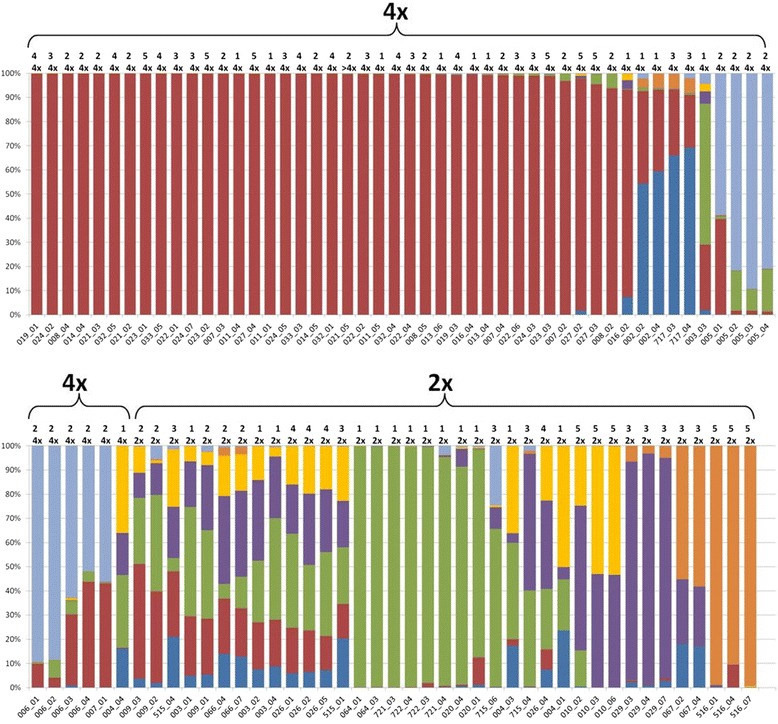
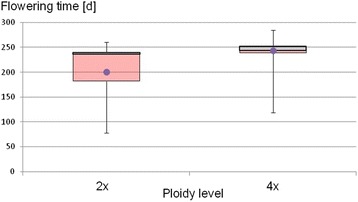
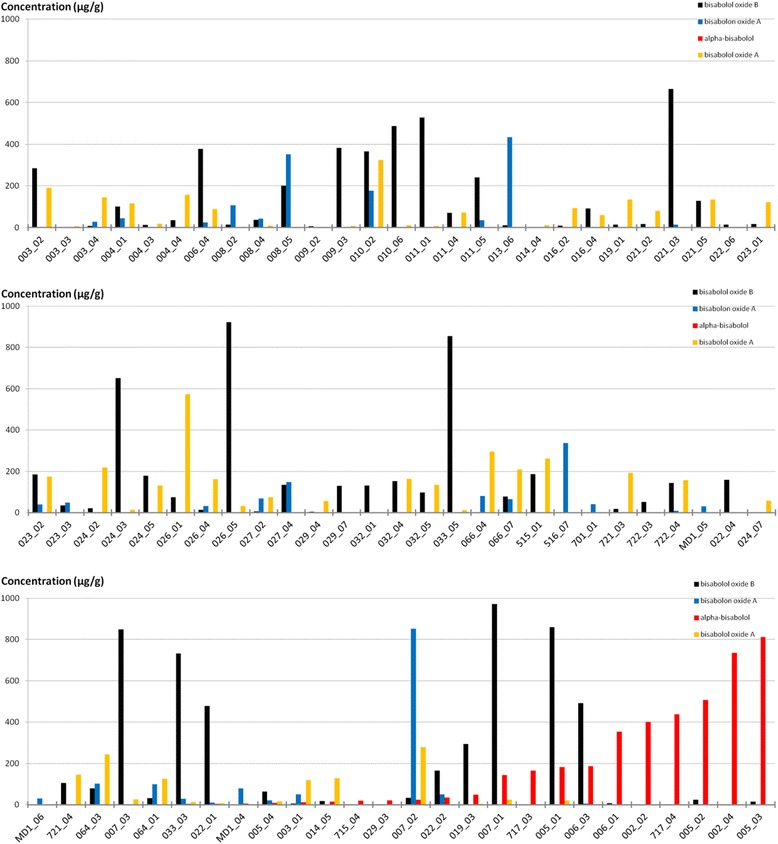
GBS analysis allowed the identification of 6495 high-quality SNP-markers in our panel of 91 M. recutita plants from 33 origins (2-4 genotypes each) and 4 M. discoidea plants as outgroup, grown in the greenhouse in Gatersleben, Germany. M. recutita proved to be clearly distinct from the outgroup, as was demonstrated by different cluster and principal coordinate analyses using the SNP-markers. Chamomile genotypes from the same origin were mostly genetically similar. Model-based cluster analysis revealed one large group of tetraploid genotypes with low genetic differentiation including 39 plants from 14 origins. Tetraploids tended to display lower genetic diversity than diploids, probably reflecting their origin by artificial polyploidisation from only a limited set of genetic backgrounds. Analyses of flowering time demonstrated that diploids generally flowered earlier than tetraploids, and the analysis of alpha-bisabolol identified several tetraploid genotypes with a high content. GWAS identified highly significant (P < 0.01) SNPs for flowering time (9) and alpha-bisabolol (71). One sequence harbouring SNPs associated with flowering time was described to play a role in self-pollination in Arabidopsis thaliana, whereas four sequences harbouring SNPs associated with alpha-bisabolol were identified to be involved in plant biotic and abiotic stress response in various plants species.
The first genomic resource for future applications to enhance breeding in chamomile was created, andanalyses of diversity will facilitate the exploitation of these genetic resources. The GWAS data pave the way for future research towards the genetics underlying important traits in chamomile, the identification of marker-trait associations, and development of reliable markers for practical breeding.
洋甘菊(母菊)在草药医学中的应用历史悠久,其花头含有多种具有药用活性的次生代谢产物。在主要农作物中,新一代测序(NGS)方法被广泛应用于开发遗传资源、构建基因组资源以及加强育种工作。在此,简化基因组测序(GBS)已被用于非模式药用植物洋甘菊,以评估栽培品种/群体的遗传结构,并开展全基因组关联研究(GWAS),重点关注对开花时间和重要药用成分α-红没药醇含量有重大影响的基因。
通过GBS分析,在我们选取的91株来自33个来源地(每个来源地2 - 4个基因型)的母菊植株以及4株作为外类群的 discoidea 母菊植株(种植于德国格特斯莱本的温室中)中,鉴定出了6495个高质量的单核苷酸多态性(SNP)标记。使用SNP标记进行的不同聚类分析和主坐标分析表明,母菊与外类群明显不同。来自同一来源地的洋甘菊基因型在遗传上大多相似。基于模型的聚类分析揭示了一组由39株来自14个来源地的四倍体基因型组成的、遗传分化较低的大群体。四倍体的遗传多样性往往低于二倍体,这可能反映了它们仅通过有限的遗传背景人工多倍化而来的起源方式。开花时间分析表明,二倍体通常比四倍体开花更早,而α-红没药醇分析则鉴定出了几种含量较高的四倍体基因型。GWAS鉴定出了与开花时间相关的9个高度显著(P < 0.01)的SNP以及与α-红没药醇相关的71个高度显著(P < 0.01)的SNP。在拟南芥中,一个含有与开花时间相关SNP的序列被描述为在自花授粉中发挥作用,而在多种植物物种中,鉴定出了四个含有与α-红没药醇相关SNP的序列参与植物的生物和非生物胁迫反应。
创建了首个用于未来洋甘菊育种应用的基因组资源,多样性分析将有助于这些遗传资源的开发利用。GWAS数据为未来研究洋甘菊重要性状的遗传基础、鉴定标记 - 性状关联以及开发用于实际育种的可靠标记铺平了道路。