Schönhals Elske Maria, Ding Jia, Ritter Enrique, Paulo Maria João, Cara Nicolás, Tacke Ekhard, Hofferbert Hans-Reinhard, Lübeck Jens, Strahwald Josef, Gebhardt Christiane
Department of Plant Breeding and Genetics, Max Planck Institute for Plant Breeding Research, Cologne, Germany.
NEIKER, Vitoria-Gasteiz, Spain.
BMC Genomics. 2017 Aug 22;18(1):642. doi: 10.1186/s12864-017-3979-9.
Tuber yield and starch content of the cultivated potato are complex traits of decisive importance for breeding improved varieties. Natural variation of tuber yield and starch content depends on the environment and on multiple, mostly unknown genetic factors. Dissection and molecular identification of the genes and their natural allelic variants controlling these complex traits will lead to the development of diagnostic DNA-based markers, by which precision and efficiency of selection can be increased (precision breeding).
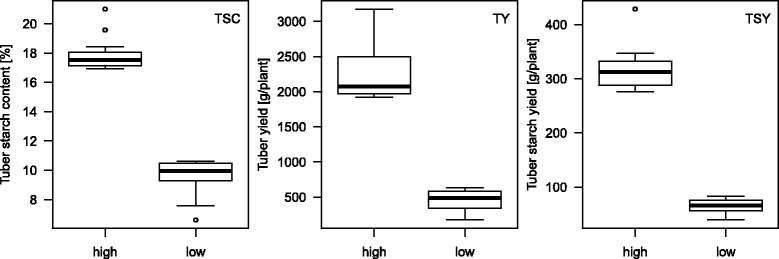
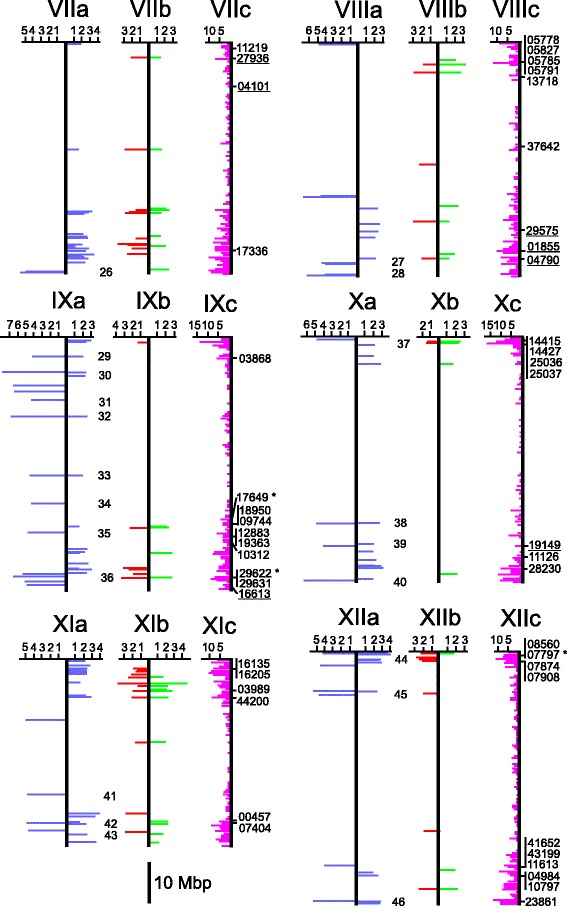
Three case-control populations were assembled from tetraploid potato cultivars based on maximizing the differences between high and low tuber yield (TY), starch content (TSC) and starch yield (TSY, arithmetic product of TY and TSC). The case-control populations were genotyped by restriction-site associated DNA sequencing (RADseq) and the 8.3 k SolCAP SNP genotyping array. The allele frequencies of single nucleotide polymorphisms (SNPs) were compared between cases and controls. RADseq identified, depending on data filtering criteria, between 6664 and 450 genes with one or more differential SNPs for one, two or all three traits. Differential SNPs in 275 genes were detected using the SolCAP array. A genome wide association study using the SolCAP array on an independent, unselected population identified SNPs associated with tuber starch content in 117 genes. Physical mapping of the genes containing differential or associated SNPs, and comparisons between the two genome wide genotyping methods and two different populations identified genome segments on all twelve potato chromosomes harboring one or more quantitative trait loci (QTL) for TY, TSC and TSY.
Several hundred genes control tuber yield and starch content in potato. They are unequally distributed on all potato chromosomes, forming clusters between 0.5-4 Mbp width. The largest fraction of these genes had unknown function, followed by genes with putative signalling and regulatory functions. The genetic control of tuber yield and starch content is interlinked. Most differential SNPs affecting both traits had antagonistic effects: The allele increasing TY decreased TSC and vice versa. Exceptions were 89 SNP alleles which had synergistic effects on TY, TSC and TSY. These and the corresponding genes are primary targets for developing diagnostic markers.
栽培马铃薯的块茎产量和淀粉含量是选育优良品种的决定性重要复杂性状。块茎产量和淀粉含量的自然变异取决于环境以及多种大多未知的遗传因素。对控制这些复杂性状的基因及其天然等位变异进行剖析和分子鉴定,将有助于开发基于DNA的诊断标记,从而提高选择的精度和效率(精准育种)。
基于最大化高低块茎产量(TY)、淀粉含量(TSC)和淀粉产量(TSY,TY与TSC的算术乘积)之间的差异,从四倍体马铃薯品种中组建了三个病例对照群体。通过限制性位点关联DNA测序(RADseq)和8.3k SolCAP SNP基因分型阵列对病例对照群体进行基因分型。比较了病例组和对照组之间单核苷酸多态性(SNP)的等位基因频率。根据数据过滤标准,RADseq鉴定出6664至450个基因,这些基因具有一个或多个针对一个、两个或所有三个性状的差异SNP。使用SolCAP阵列检测到275个基因中的差异SNP。在一个独立的、未选择的群体上使用SolCAP阵列进行全基因组关联研究,鉴定出117个与块茎淀粉含量相关的SNP。对含有差异或相关SNP的基因进行物理定位,并比较两种全基因组基因分型方法和两个不同群体,确定了所有十二条马铃薯染色体上含有一个或多个控制TY、TSC和TSY的数量性状位点(QTL)的基因组片段。
数百个基因控制马铃薯的块茎产量和淀粉含量。它们在所有马铃薯染色体上分布不均,形成宽度为0.5 - 4 Mbp的簇。这些基因中最大比例的功能未知,其次是具有假定信号传导和调控功能的基因。块茎产量和淀粉含量的遗传控制相互关联。影响这两个性状的大多数差异SNP具有拮抗作用:增加TY的等位基因会降低TSC,反之亦然。例外情况是89个SNP等位基因对TY、TSC和TSY具有协同作用。这些以及相应的基因是开发诊断标记的主要目标。