Malaria Consortium, London, UK.
Tropical Health, LLP, Montagut, Spain.
Malar J. 2017 Aug 10;16(1):327. doi: 10.1186/s12936-017-1985-7.
Continuous distribution of insecticide-treated nets (ITNs) is thought to be an effective mechanism to maintain ITN ownership and access between or in the absence of mass campaigns, but evidence is limited. A community-based ITN distribution pilot was implemented and evaluated in Toamasina II District, Madagascar, to assess this new channel for continuous ITN distribution.
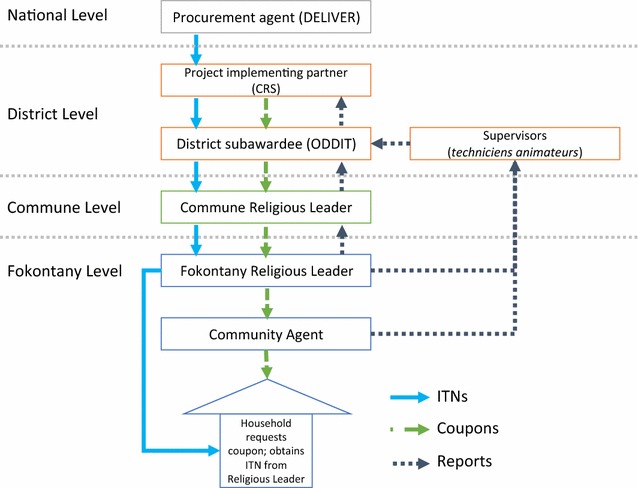
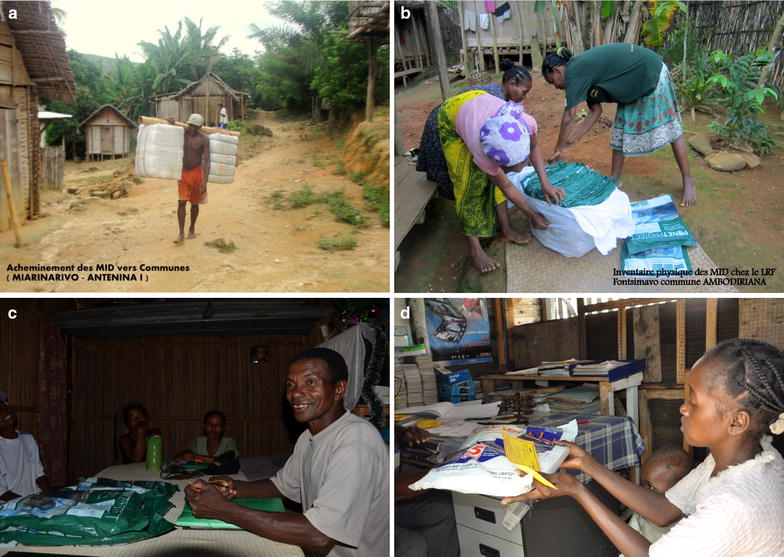
Beginning 9 months after the December 2012 mass campaign, a community-based distribution pilot ran for an additional 9 months, from September 2013 to June 2014. Households requested ITN coupons from community agents in their village. After verification by the agents, households exchanged the coupon for an ITN at a distribution point. The evaluation was a two-stage cluster survey with a sample size of 1125 households. Counterfactual ITN ownership and access were calculated by excluding ITNs received through the community pilot.
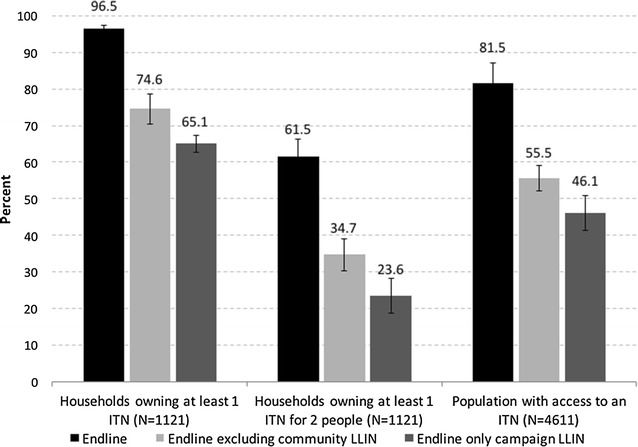
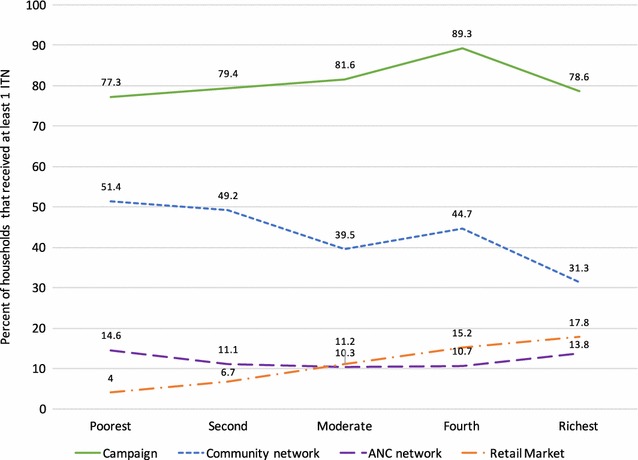
At the end of the pilot, household ownership of any ITN was 96.5%, population access to ITN was 81.5 and 61.5% of households owned at least 1 ITN for every 2 people. Without the ITNs provided through the community channel, household ownership of any ITN was estimated at 74.6%, population access to an ITN at 55.5%, and households that owned at least 1 ITN for 2 people at only 34.7%, 18 months after the 2012 campaign. Ownership of community-distributed ITNs was higher among the poorest wealth quintiles. Over 80% of respondents felt the community scheme was fair and simple to use.
Household ITN ownership and population ITN access exceeded RBM targets after the 9-month community distribution pilot. The pilot successfully provided coupons and ITNs to households requesting them, particularly for the least poor wealth quintiles, and the scheme was well-perceived by communities. Further research is needed to determine whether community-based distribution can sustain ITN ownership and access over the long term, how continuous availability of ITNs affects household net replacement behaviour, and whether community-based distribution is cost-effective when combined with mass campaigns, or if used with other continuous channels instead of mass campaigns.
持续分发经杀虫剂处理的蚊帐(ITN)被认为是一种维持 ITN 拥有率和获取途径的有效机制,特别是在大规模运动期间或之后,但证据有限。马达加斯加 Toamasina II 区实施了一项基于社区的 ITN 分发试点,以评估这一持续分发 ITN 的新渠道。
在 2012 年 12 月大规模运动后 9 个月,从 2013 年 9 月至 2014 年 6 月,实施了一项基于社区的分发试点。家庭向村里的社区代理请求 ITN 优惠券。在代理验证后,家庭可以在分发点用优惠券兑换 ITN。评估采用两阶段聚类调查,样本量为 1125 户家庭。通过排除通过社区试点获得的 ITN,计算了假设不存在 ITN 情况下的 ITN 拥有率和获取率。
试点结束时,家庭拥有任何 ITN 的比例为 96.5%,人口 ITN 使用率为 81.5%,每 2 人拥有至少 1 顶 ITN 的家庭比例为 61.5%。如果没有通过社区渠道提供的 ITN,家庭拥有任何 ITN 的比例估计为 74.6%,人口 ITN 使用率为 55.5%,每 2 人拥有至少 1 顶 ITN 的家庭比例仅为 34.7%,这是在 2012 年运动 18 个月后。在最贫穷的五个财富五分位数中,社区分发的 ITN 拥有率更高。超过 80%的受访者认为社区计划公平、易于使用。
在为期 9 个月的社区分发试点后,家庭 ITN 拥有率和人口 ITN 使用率超过了 RBM 目标。试点成功地向有需求的家庭发放了优惠券和 ITN,特别是对最贫穷的五个财富五分位数家庭,社区对该计划的评价较好。需要进一步研究以确定社区分发是否可以长期维持 ITN 拥有率和获取率,持续提供 ITN 对家庭更换蚊帐行为的影响,以及社区分发与大规模运动相结合是否具有成本效益,或者是否可以与其他持续分发渠道而不是大规模运动结合使用。