Malaria Consortium, London, UK.
Tropical Health LLP, Montagut, Spain.
Malar J. 2017 Sep 11;16(1):363. doi: 10.1186/s12936-017-2020-8.
Continuous distribution of insecticide-treated nets (ITNs) has now been accepted as one way of sustaining ITN universal coverage. Community-based channels offer an interesting means of delivering ITNs to households to sustain universal ITN coverage. The objective of this study was to provide proof of concept for this channel.
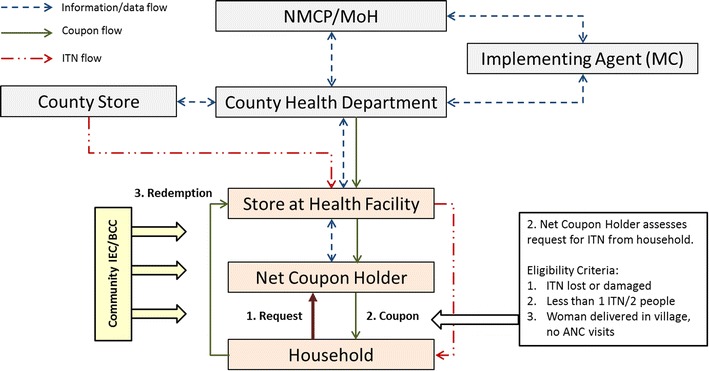
A 9-month, community-based, distribution pilot was implemented beginning 1 year after a mass campaign in Lainya County, South Sudan from 2012 to 2013. Following social mobilization, community members could request an ITN from a net coupon holder. Eligibility criteria included having lost an ITN, giving birth outside of the health facility, or not having enough ITNs for all household members. After verification, households could exchange the coupon for an ITN at a distribution point. The evaluation was a pre/post design using representative household surveys with two-stage cluster sampling and a sample size of 600 households per survey.
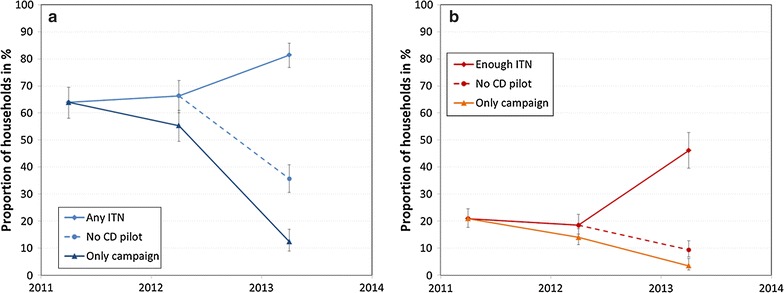
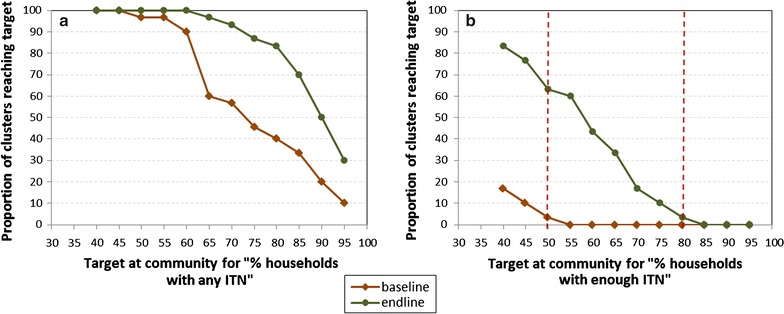
At endline, 78% of respondents were aware of the scheme and 89% of those also received an ITN through community-based distribution. Population access to ITNs nearly doubled, from 38% at baseline to 66% after the pilot. Household ownership of any ITN and enough ITNs (1 for 2 people) also increased significantly, from 66 to 82% and 19 to 46%, respectively. Community-based distribution was the only source of ITNs for 53.4% of households. The proportion of the population using an ITN last night increased from 22.7% at baseline to 53.9% at endline. A logistic regression model indicates that although behaviour change communication was positively associated with an increase in ITN use, access to enough nets was the greatest determinant of use.
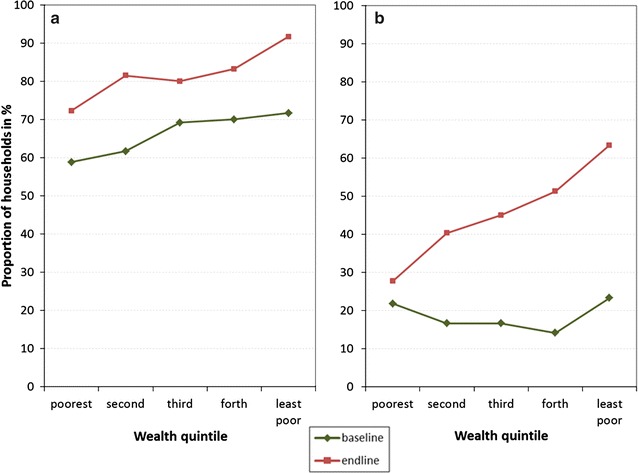
ITN access and use improved significantly in the study area during the pilot, coming close to universal coverage targets. This pilot serves as proof of concept for the community-based distribution methodology implemented as a mechanism to sustain ITN universal coverage. Longer periods of implementation should be evaluated to determine whether community-based distribution can successfully maintain ITN coverage beyond the short term, and reach all wealth quintiles equitably.
连续分发经杀虫剂处理的蚊帐(ITN)现已被视为维持 ITN 普遍覆盖的一种方法。基于社区的渠道提供了一种向家庭提供 ITN 以维持普遍 ITN 覆盖的有趣手段。本研究的目的是为此渠道提供概念验证。
2012 年至 2013 年,在南苏丹莱亚县大规模运动一年后,开展了为期 9 个月的基于社区的分发试点。在社会动员之后,社区成员可以向蚊帐优惠券持有者请求 ITN。符合条件的标准包括失去 ITN、在医疗机构外分娩或家中没有足够的 ITN 供所有家庭成员使用。经过核实,家庭可以在分发点用优惠券换取 ITN。评估采用预/后设计,使用具有两阶段聚类抽样的代表性家庭调查,每个调查的样本量为 600 户。
在期末,78%的受访者知道该计划,89%的人通过社区分发获得了 ITN。人口获得 ITN 的机会几乎翻了一番,从基线时的 38%增加到试点后的 66%。家庭拥有任何 ITN 和足够的 ITN(1 人 2 张)的比例也显著增加,分别从 66%增加到 82%和从 19%增加到 46%。社区分发是 53.4%家庭获得 ITN 的唯一来源。过去一晚使用 ITN 的人口比例从基线时的 22.7%增加到期末的 53.9%。逻辑回归模型表明,尽管行为改变沟通与 ITN 使用的增加呈正相关,但获得足够的蚊帐是使用的最大决定因素。
在试点期间,研究地区的 ITN 获得和使用情况显著改善,接近普遍覆盖目标。该试点为实施社区分发方法提供了概念验证,该方法是维持 ITN 普遍覆盖的机制。应评估更长的实施时间,以确定社区分发是否能够成功维持 ITN 覆盖,而不仅仅是短期的,并公平地覆盖所有财富五分位数。