Dreyer Alexander M, Herrmann Christoph S, Rieger Jochem W
Applied Neurocognitive Psychology Laboratory, Department of Psychology, Center for Excellence "Hearing4all", European Medical School, Carl von Ossietzky UniversityOldenburg, Germany.
Experimental Psychology Laboratory, Department of Psychology, Center for Excellence "Hearing4all", European Medical School, Carl von Ossietzky UniversityOldenburg, Germany.
Front Hum Neurosci. 2017 Jul 26;11:391. doi: 10.3389/fnhum.2017.00391. eCollection 2017.
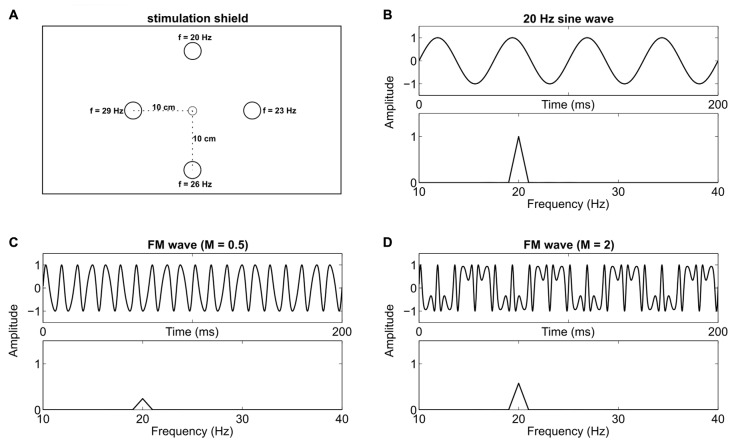
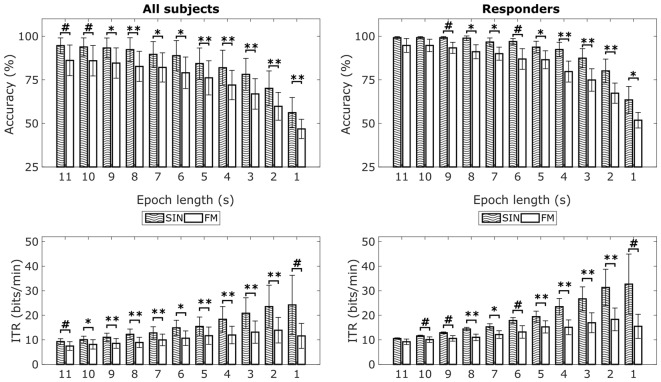
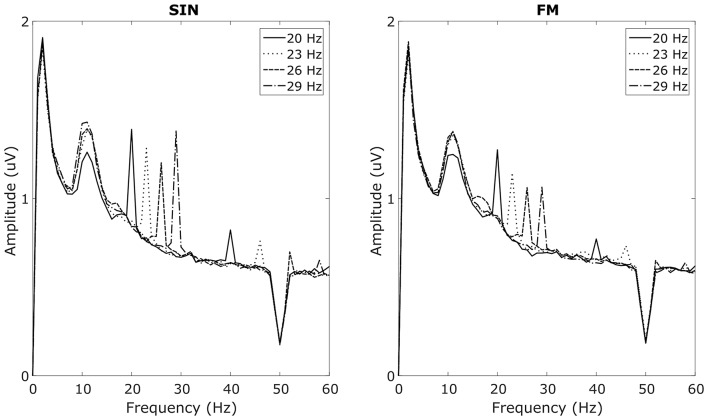
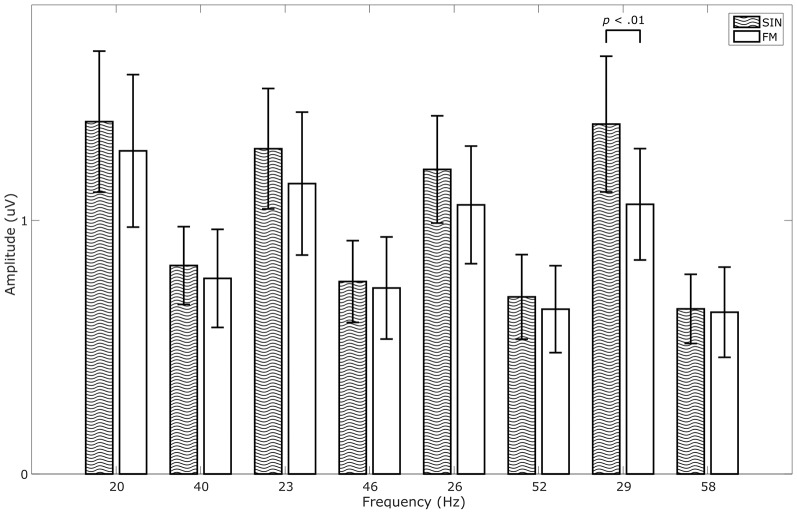
Steady-state visual evoked potentials (SSVEPs) have been widely employed for the control of brain-computer interfaces (BCIs) because they are very robust, lead to high performance, and allow for a high number of commands. However, such flickering stimuli often also cause user discomfort and fatigue, especially when several light sources are used simultaneously. Different variations of SSVEP driving signals have been proposed to increase user comfort. Here, we investigate the suitability of frequency modulation of a high frequency carrier for SSVEP-BCIs. We compared BCI performance and user experience between frequency modulated (FM) and traditional sinusoidal (SIN) SSVEPs in an offline classification paradigm with four independently flickering light-emitting diodes which were overtly attended (fixated). While classification performance was slightly reduced with the FM stimuli, the user comfort was significantly increased. Comparing the SSVEPs for covert attention to the stimuli (without fixation) was not possible, as no reliable SSVEPs were evoked. Our results reveal that several, simultaneously flickering, light emitting diodes can be used to generate FM-SSVEPs with different frequencies and the resulting occipital electroencephalography (EEG) signals can be classified with high accuracy. While the performance we report could be further improved with adjusted stimuli and algorithms, we argue that the increased comfort is an important result and suggest the use of FM stimuli for future SSVEP-BCI applications.
稳态视觉诱发电位(SSVEPs)已被广泛应用于脑机接口(BCIs)的控制,因为它们非常稳健,能带来高性能,并且允许大量的指令。然而,这种闪烁刺激通常也会导致用户不适和疲劳,特别是当同时使用多个光源时。为了提高用户舒适度,人们提出了不同变化形式的SSVEP驱动信号。在这里,我们研究高频载波的频率调制对SSVEP-BCIs的适用性。在一个离线分类范式中,我们比较了调频(FM)和传统正弦波(SIN)SSVEPs的脑机接口性能和用户体验,该范式中有四个独立闪烁的发光二极管,被试需要明显地注视(固定注视)。虽然使用FM刺激时分类性能略有下降,但用户舒适度显著提高。由于没有诱发可靠的SSVEP,所以无法比较对刺激进行隐蔽注意(无固定注视)时的SSVEP。我们的结果表明,几个同时闪烁的发光二极管可用于生成具有不同频率的FM-SSVEP,并且由此产生的枕叶脑电图(EEG)信号可以高精度分类。虽然我们报告的性能可以通过调整刺激和算法进一步提高,但我们认为舒适度的提高是一个重要成果,并建议在未来的SSVEP-BCI应用中使用FM刺激。