INSERM U1015, Equipe Labellisée Ligue Nationale Contre le Cancer, Gustave Roussy Cancer Campus, Villejuif, France.
Département de l'imagerie médicale, Gustave Roussy, Université Paris Saclay, F-94805, Villejuif, France.
Sci Rep. 2017 Aug 11;7(1):7952. doi: 10.1038/s41598-017-08310-5.
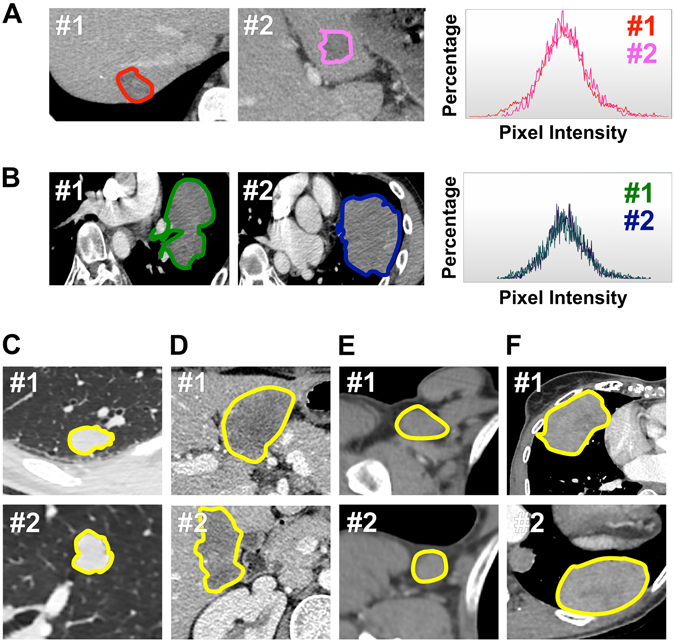
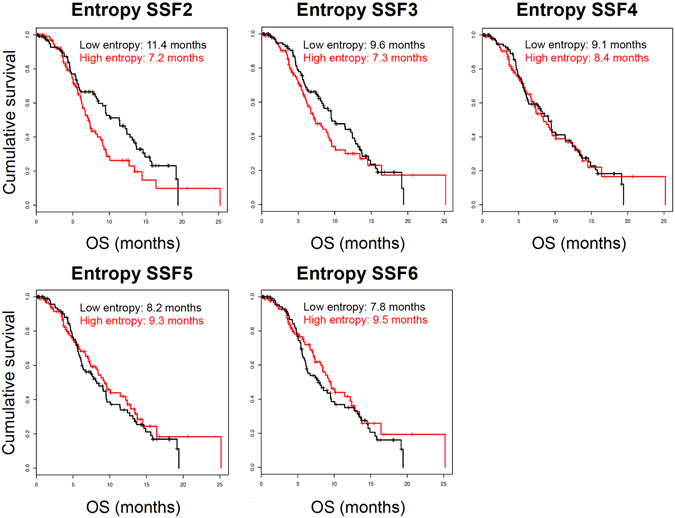
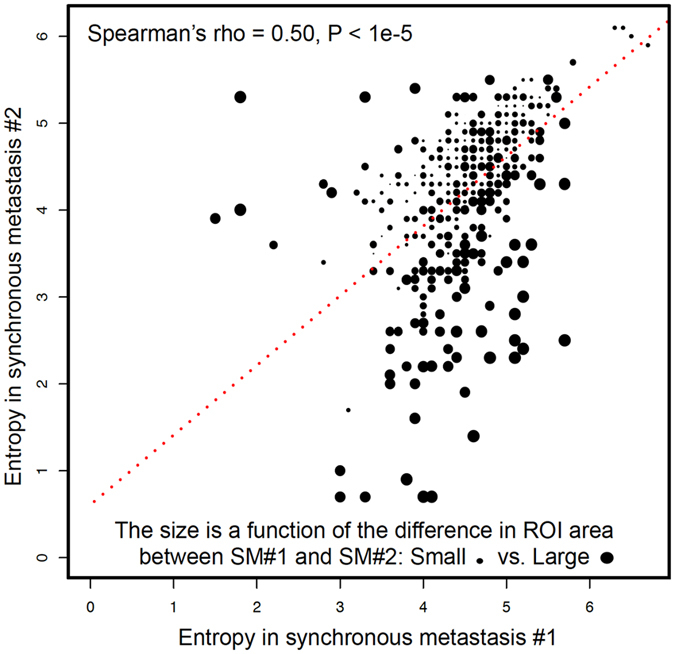
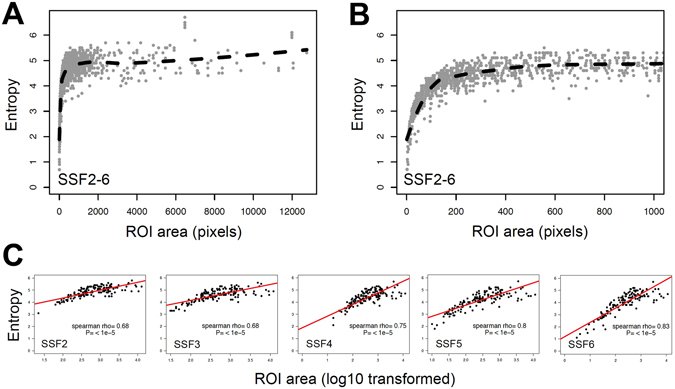
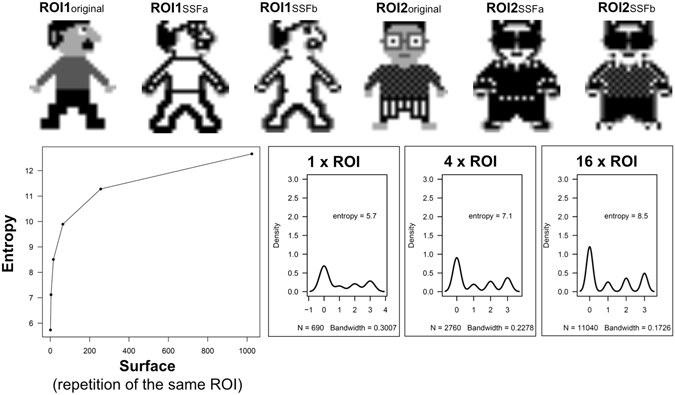
Entropy is a promising quantitative imaging biomarker for characterizing cancer imaging phenotype. Entropy has been associated with tumor gene expression, tumor metabolism, tumor stage, patient prognosis, and treatment response. Our hypothesis states that tumor-specific biomarkers such as entropy should be correlated between synchronous metastases. Therefore, a significant proportion of the variance of entropy should be attributed to the malignant process. We analyzed 112 patients with matched/paired synchronous metastases (SM#1 and SM#2) prospectively enrolled in the MOSCATO-01 clinical trial. Imaging features were extracted from Regions Of Interest (ROI) delineated on CT-scan using TexRAD software. We showed that synchronous metastasis entropy was correlated across 5 Spatial Scale Filters: Spearman's Rho ranged between 0.41 and 0.59 (P = 0.0001, Bonferroni correction). Multivariate linear analysis revealed that entropy in SM#1 is significantly associated with (i) primary tumor type; (ii) entropy in SM#2 (same malignant process); (iii) ROI area size; (iv) metastasis site; and (v) entropy in the psoas muscle (reference tissue). Entropy was a logarithmic function of ROI area in normal control tissues (aorta, psoas) and in mathematical models (P < 0.01). We concluded that entropy is a tumor-specific metric only if confounding factors are corrected.
熵是一种很有前途的定量成像生物标志物,可用于描述癌症的成像表型。熵与肿瘤基因表达、肿瘤代谢、肿瘤分期、患者预后和治疗反应有关。我们的假设是,肿瘤特异性生物标志物(如熵)应该在同步转移的肿瘤之间存在相关性。因此,熵的大部分方差应该归因于恶性过程。我们对 112 名在 MOSCATO-01 临床试验中前瞻性入组的具有匹配/配对同步转移(SM#1 和 SM#2)的患者进行了分析。使用 TexRAD 软件从 CT 扫描的感兴趣区域(ROI)中提取了成像特征。我们发现,同步转移熵在 5 个空间尺度滤波器之间存在相关性:Spearman 相关系数范围为 0.41 至 0.59(P = 0.0001,Bonferroni 校正)。多元线性分析表明,SM#1 中的熵与(i)原发肿瘤类型;(ii)SM#2 中的熵(相同的恶性过程);(iii)ROI 面积大小;(iv)转移部位;以及(v)腰大肌(参考组织)中的熵显著相关。在正常对照组织(主动脉、腰大肌)和数学模型中,熵是 ROI 面积的对数函数(P < 0.01)。我们得出结论,只有在纠正了混杂因素的情况下,熵才是一种肿瘤特异性指标。