Radiology Division, "Istituto Nazionale Tumori IRCCS Fondazione Pascale-IRCCS di Napoli", Naples, Italy.
Department of Radiological Sciences, Diagnostic Imaging Unit, "Azienda Ospedaliera Universitaria Senese," Siena, Italy.
Cancer Control. 2021 Jan-Dec;28:1073274820985786. doi: 10.1177/1073274820985786.
To evaluate the consistency of the quantitative imaging decision support (QIDS) tool and radiomic analysis using 594 metrics in lung carcinoma on chest CT scan.
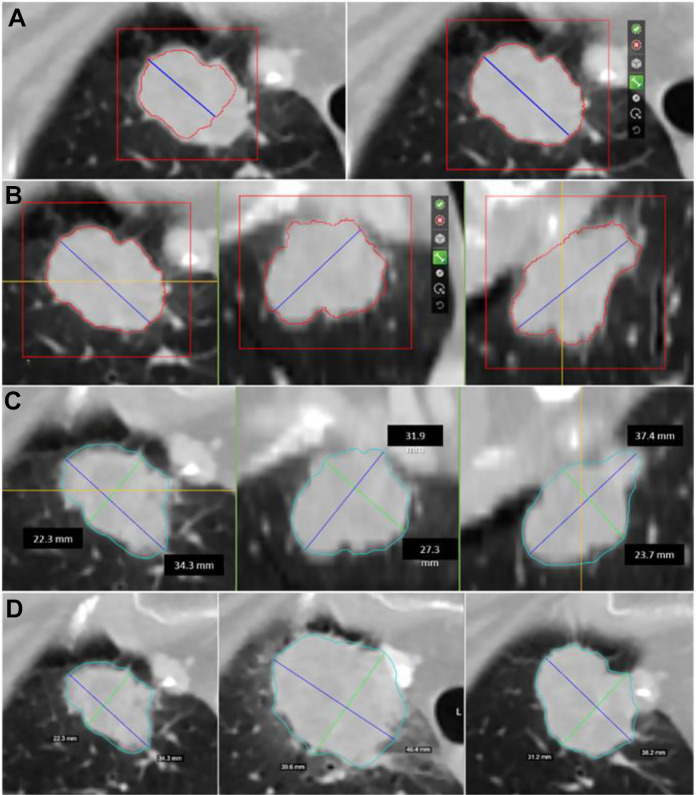
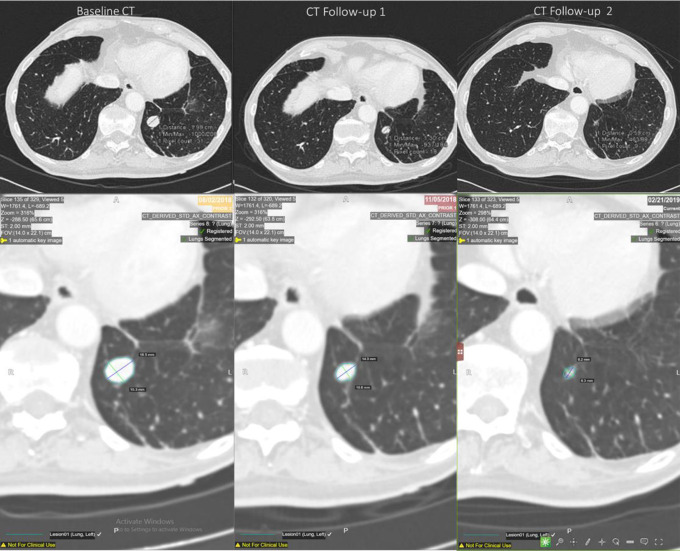
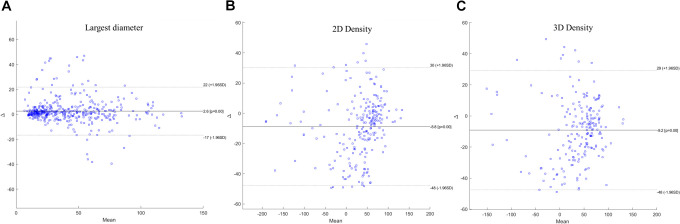
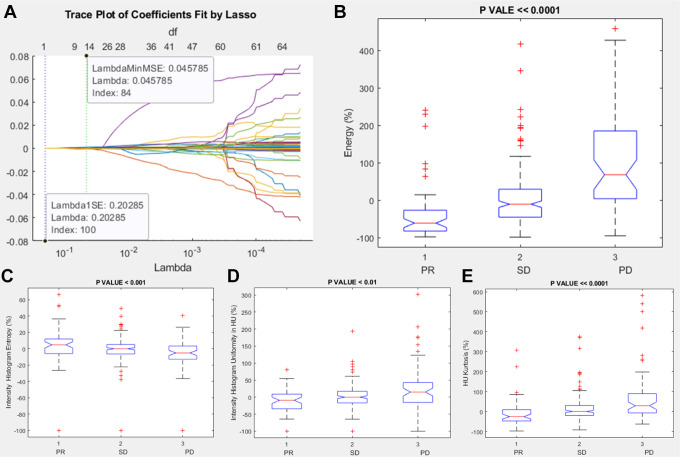
We included, retrospectively, 150 patients with histologically confirmed lung cancer who underwent chemotherapy and baseline and follow-ups CT scans. Using the QIDS platform, 3 radiologists segmented each lesion and automatically collected the longest diameter and the density mean value. Inter-observer variability, Bland Altman analysis and Spearman's correlation coefficient were performed. QIDS tool consistency was assessed in terms of agreement rate in the treatment response classification. Kruskal Wallis test and the least absolute shrinkage and selection operator (LASSO) method with 10-fold cross validation were used to identify radiomic metrics correlated with lesion size change.
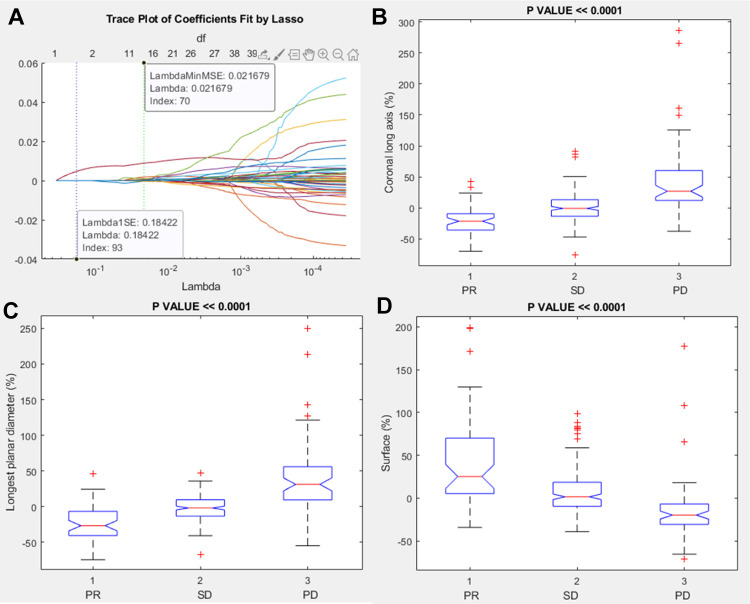
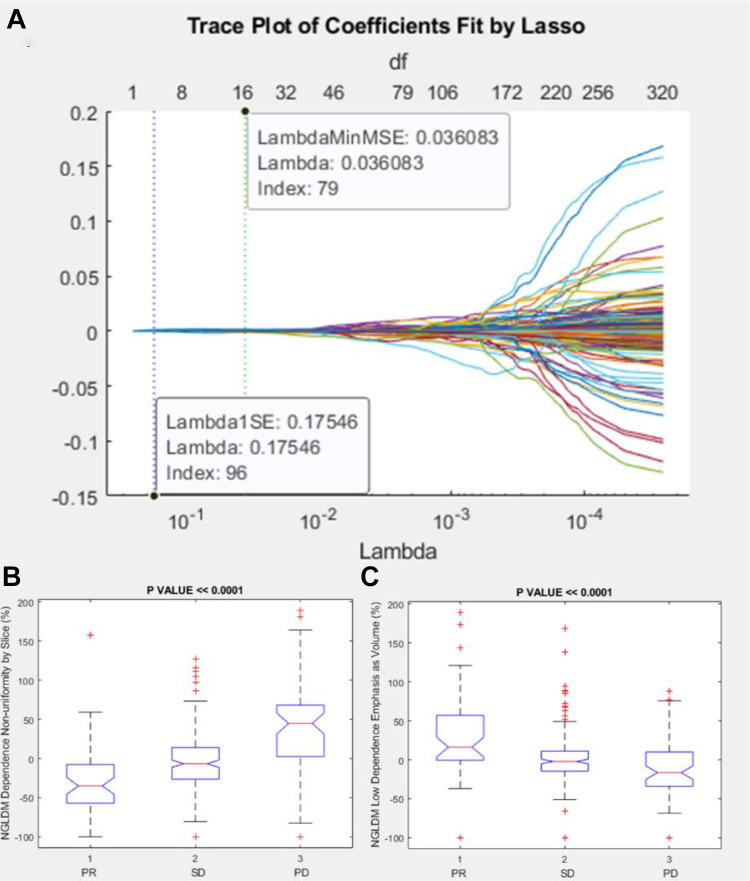
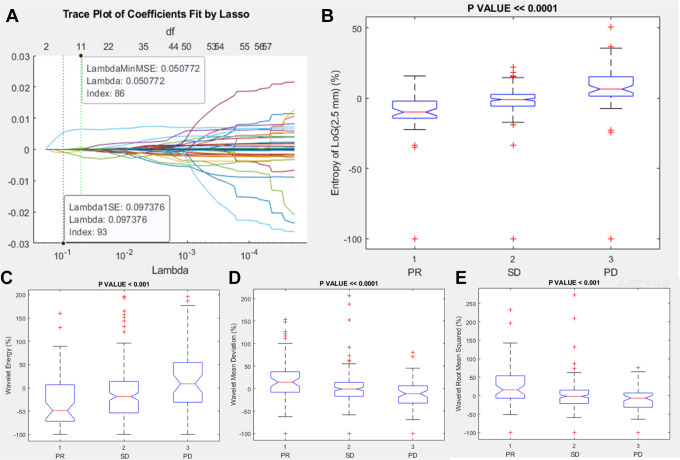
Good and significant correlation was obtained between the measurements of largest diameter and of density among the QIDS tool and the radiologists measurements. Inter-observer variability values were over 0.85. HealthMyne QIDS tool quantitative volumetric delineation was consistent and matched with each radiologist measurement considering the RECIST classification (80-84%) while a lower concordance among QIDS and the radiologists CHOI classification was observed (58-63%). Among 594 extracted metrics, significant and robust predictors of RECIST response were energy, histogram entropy and uniformity, Kurtosis, coronal long axis, longest planar diameter, surface, Neighborhood Grey-Level Different Matrix (NGLDM) dependence nonuniformity and low dependence emphasis as Volume, entropy of Log(2.5 mm), wavelet energy, deviation and root man squared.
In conclusion, we demonstrated that HealthMyne quantitative volumetric delineation was consistent and that several radiomic metrics extracted by QIDS were significant and robust predictors of RECIST response.
评估定量成像决策支持(QIDS)工具与使用 594 项指标对胸部 CT 扫描肺癌的放射组学分析的一致性。
我们回顾性纳入了 150 名经组织学证实患有肺癌且接受化疗以及基线和随访 CT 扫描的患者。使用 QIDS 平台,3 名放射科医生对每个病变进行分割并自动采集最长直径和密度平均值。进行了观察者间变异性、Bland Altman 分析和 Spearman 相关系数分析。QIDS 工具一致性通过治疗反应分类中的一致性率进行评估。Kruskal Wallis 检验和 10 折交叉验证的最小绝对收缩和选择算子(LASSO)方法用于识别与病变大小变化相关的放射组学指标。
QIDS 工具和放射科医生测量的最大直径和密度测量之间获得了良好且显著的相关性。观察者间变异性值超过 0.85。考虑到 RECIST 分类(80-84%),HealthMyne QIDS 工具定量体积描绘是一致的并且与每个放射科医生的测量值相匹配,而 QIDS 和放射科医生 CHOI 分类之间的一致性较低(58-63%)。在提取的 594 项指标中,与 RECIST 反应相关的显著且稳健的预测因子为能量、直方图熵和均匀性、峰度、冠状长轴、最长平面直径、表面、邻域灰度差异矩阵(NGLDM)依赖非均匀性和低依赖强调作为体积、对数(2.5mm)的熵、小波能量、偏差和根均方。
总之,我们证明了 HealthMyne 定量体积描绘是一致的,并且 QIDS 提取的几项放射组学指标是 RECIST 反应的显著且稳健的预测因子。