Fujimoto Tomokazu, Inoue Toshihiro, Ohira Saori, Awai-Kasaoka Nanako, Kameda Takanori, Inoue-Mochita Miyuki, Tanihara Hidenobu
Department of Ophthalmology, Faculty of Life Sciences, Kumamoto University, 1-1-1 Honjo, Kumamoto 860-8556, Japan.
Department of Ophthalmology and Visual Sciences, Kyoto University Graduate School of Medicine, Yoshida-Konoe-cho, Sakyo-ku, Kyoto 606-8501, Japan.
J Ophthalmol. 2017;2017:7598140. doi: 10.1155/2017/7598140. Epub 2017 Jul 19.
To investigate the effect of rho kinase inhibitors on oxidative stress in trabecular meshwork (TM) cells.
TM cells were isolated from the eyes of cynomolgus monkeys. Y-27632 and menadione were used to inhibit rho kinase and induce production of reactive oxygen species (ROS), respectively. The cynomolgus monkey array and 12,613 probes were used in DNA microarray analysis, and the affected genes were categorized using gene ontology analysis. The mRNA levels of the target genes were confirmed by real-time RT-PCR. Intracellular oxidative stress was detected using a fluorescent reagent sensitive to ROS. Cell viability was assessed by the WST-8 assay.
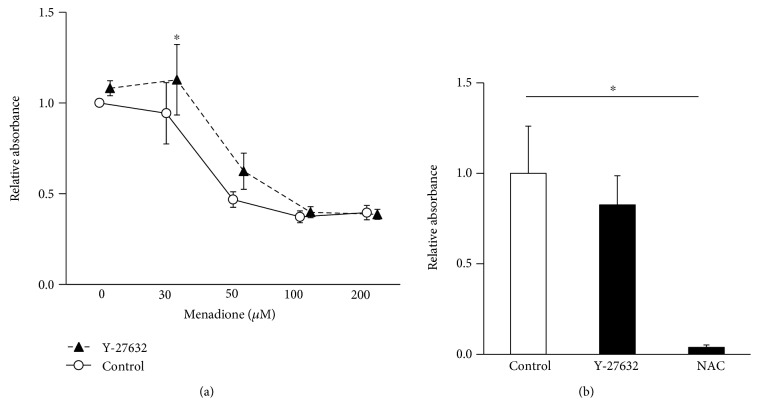
Gene ontology analysis revealed upregulation of genes involved in antioxidant activity, and upregulation of catalase was confirmed by real-time RT-PCR after 30 min treatment with Y-27632. Production of ROS was increased by menadione, and the effect was partly suppressed by pretreatment with Y-27632. At a lower dose of menadione, Y-27632 stimulated TM cells and significantly increased their viability following menadione treatment compared to control cells.
Using microarray analysis, Y-27632 was shown to upregulate antioxidative genes including catalase and partially reduce ROS production and cell death by oxidative stress caused by menadione.
研究Rho激酶抑制剂对小梁网(TM)细胞氧化应激的影响。
从食蟹猴眼中分离出TM细胞。分别使用Y-27632和甲萘醌抑制Rho激酶并诱导活性氧(ROS)的产生。在DNA微阵列分析中使用食蟹猴基因芯片和12,613个探针,并通过基因本体分析对受影响的基因进行分类。通过实时逆转录聚合酶链反应(RT-PCR)确认靶基因的mRNA水平。使用对ROS敏感的荧光试剂检测细胞内氧化应激。通过WST-8法评估细胞活力。
基因本体分析显示参与抗氧化活性的基因上调,在用Y-27632处理30分钟后,通过实时RT-PCR证实过氧化氢酶上调。甲萘醌增加了ROS的产生,而Y-27632预处理部分抑制了该作用。在较低剂量的甲萘醌作用下,与对照细胞相比,Y-27632刺激TM细胞并在甲萘醌处理后显著提高其活力。
通过微阵列分析表明,Y-27632可上调包括过氧化氢酶在内的抗氧化基因,并部分减少由甲萘醌引起的氧化应激导致的ROS产生和细胞死亡。