El Saghir Nagi S, Charara Raghid N, Kreidieh Firas Y, Eaton Vanessa, Litvin Kate, Farhat Rania A, Khoury Katia E, Breidy Juliana, Tamim Hani, Eid Toufic A
American Society of Clinical Oncology, Alexandria, VA; and Katia E. Khoury, University Hospitals, Cleveland, OH.
J Glob Oncol. 2015 Oct 28;1(2):57-64. doi: 10.1200/JGO.2015.000158. eCollection 2015 Dec.
Multidisciplinary tumor boards (MDTBs) are universally recommended, but recent literature has challenged their efficiency.
The American Society of Clinical Oncology (ASCO) conducted a survey of a randomly selected cohort of international ASCO members. The survey was built on SurveyMonkey and was sent via e-mail to a sample of 5,357 members.
In all, 501 ASCO members practicing outside the United States responded, and 86% of them participated in MDTBs at their own institutions. Those who attended represented a variety of disciplines in 70% to 86% of all MDTBs. The majority of MDTBs held weekly specialty and/or general meetings. Eighty-nine percent of 409 respondents attended for advice on treatment decisions. Survey respondents reported changes of 1% to 25% in treatment plans for 44% to 49% of patients with breast cancer and in 47% to 50% of patients with colorectal cancer. They reported 25% to 50% changes in surgery type and/or treatment plans for 14% to 21% of patients with breast cancer and 12% to 18% of patients with colorectal cancer. Of the 430 respondents 96% said overall benefit to patients was worth the time and effort spent at MDTBs, and 96% said that MDTBs have teaching value. Mini tumor boards held with whatever types of specialists were available were considered valid. In all, 94.8% (425 of 448) said that MDTBs should be required in institutions in which patients with cancer are treated.
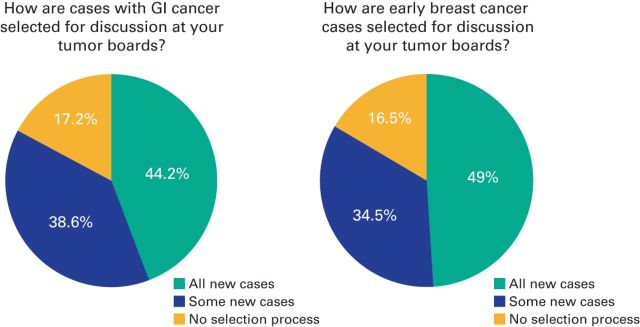
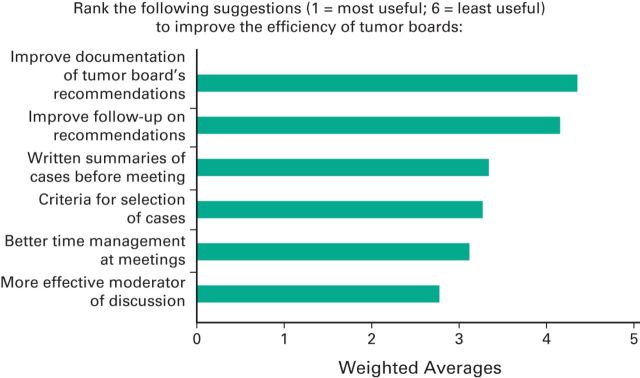
MDTBs are commonplace worldwide. A majority of respondents attend them to obtain recommendations, and they report changes in patient management. Change occurred more frequently with nonmedical oncologists and with physicians who had less than 15 years in practice. MDTBs helped practitioners make management decisions. Mini tumor boards may improve time efficiency and are favored when the full team is not available. Suggestions for improving MDTBs included making them more efficient, better selection and preparation of cases, choosing an effective team leader, and improving how time is used, but more research is needed on ways to improve the efficiency of MDTBs.
多学科肿瘤委员会(MDTBs)得到广泛推荐,但近期文献对其效率提出了质疑。
美国临床肿瘤学会(ASCO)对随机抽取的一组国际ASCO成员进行了调查。该调查基于SurveyMonkey平台,并通过电子邮件发送给5357名成员。
共有501名在美国境外执业的ASCO成员回复,其中86%的人在其所在机构参与了多学科肿瘤委员会。参会人员涵盖了所有多学科肿瘤委员会中70%至86%的各类学科。大多数多学科肿瘤委员会每周召开专科和/或全体会议。409名受访者中有89%参会是为了获取治疗决策方面的建议。调查受访者报告称,44%至49%的乳腺癌患者和47%至50%的结直肠癌患者的治疗方案有1%至25%的变化。他们报告称,14%至21%的乳腺癌患者和12%至18%的结直肠癌患者的手术类型和/或治疗方案有25%至50%的变化。在430名受访者中,96%表示对患者的总体益处值得在多学科肿瘤委员会花费的时间和精力,96%表示多学科肿瘤委员会具有教学价值。与任何可用的专科医生召开的小型肿瘤委员会被认为是有效的。总体而言,94.8%(448人中的425人)表示在治疗癌症患者的机构中应设立多学科肿瘤委员会。
多学科肿瘤委员会在全球很常见。大多数受访者参会是为了获得建议,他们报告称患者管理有变化。非肿瘤内科医生和从业不到15年的医生中变化更频繁。多学科肿瘤委员会帮助从业者做出管理决策。小型肿瘤委员会可能提高时间效率,在无法凑齐完整团队时更受青睐。改进多学科肿瘤委员会的建议包括提高其效率、更好地选择和准备病例、选择有效的团队领导者以及改善时间利用方式,但还需要更多关于提高多学科肿瘤委员会效率方法的研究。