Polymer Biotechnology Lab, Centro de Investigaciones Biologicas (CIB), C/Ramiro de Maeztu, 9, 28040, Madrid, Spain.
Department of Applied Science and Technology (DISAT), Politecnico di Torino, Corso Duca Degli Abruzzi 24, Torino, Italy.
Microb Biotechnol. 2017 Sep;10(5):1216-1225. doi: 10.1111/1751-7915.12805. Epub 2017 Aug 14.
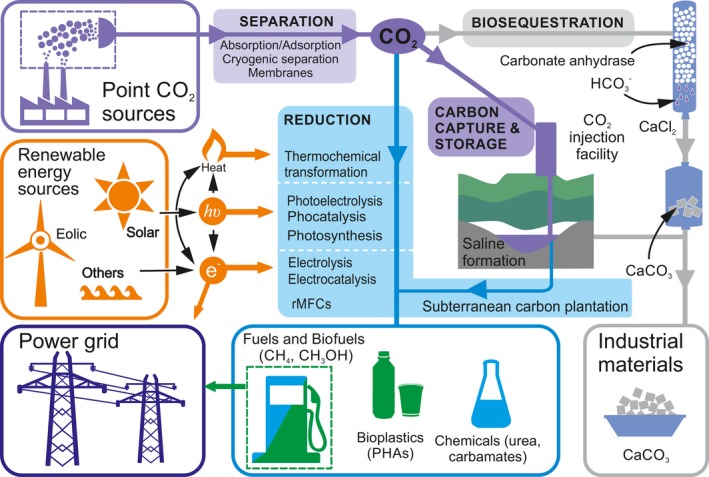
Human activity has been altering many ecological cycles for decades, disturbing the natural mechanisms which are responsible for re-establishing the normal environmental balances. Probably, the most disrupted of these cycles is the cycle of carbon. In this context, many technologies have been developed for an efficient CO removal from the atmosphere. Once captured, it could be stored in large geological formations and other reservoirs like oceans. This strategy could present some environmental and economic problems. Alternately, CO can be transformed into carbonates or different added-value products, such as biofuels and bioplastics, recycling CO from fossil fuel. Currently different methods are being studied in this field. We classified them into biological, inorganic and hybrid systems for CO transformation. To be environmentally compatible, they should be powered by renewable energy sources. Although hybrid systems are still incipient technologies, they have made great advances in the recent years. In this scenario, biotechnology is the spearhead of ambitious strategies to capture CO and reduce global warming.
几十年来,人类活动一直在改变许多生态循环,扰乱了负责重新建立正常环境平衡的自然机制。其中,可能受到破坏最严重的是碳循环。在这种情况下,已经开发出许多技术来从大气中有效去除 CO。一旦被捕获,它可以储存在大型地质构造和海洋等其他储层中。这种策略可能会带来一些环境和经济问题。或者,CO 可以转化为碳酸盐或其他附加值产品,如生物燃料和生物塑料,从化石燃料中回收 CO。目前,该领域正在研究不同的方法。我们将它们分为用于 CO 转化的生物、无机和混合系统。为了具有环境兼容性,它们应该由可再生能源提供动力。尽管混合系统仍处于初期阶段,但近年来已经取得了重大进展。在这种情况下,生物技术是雄心勃勃的 CO 捕获和减少全球变暖策略的先锋。