Richmond-Rakerd Leah S, Slutske Wendy S, Wood Phillip K
Department of Psychological Sciences, University of Missouri.
Psychol Addict Behav. 2017 Sep;31(6):664-675. doi: 10.1037/adb0000304. Epub 2017 Aug 14.
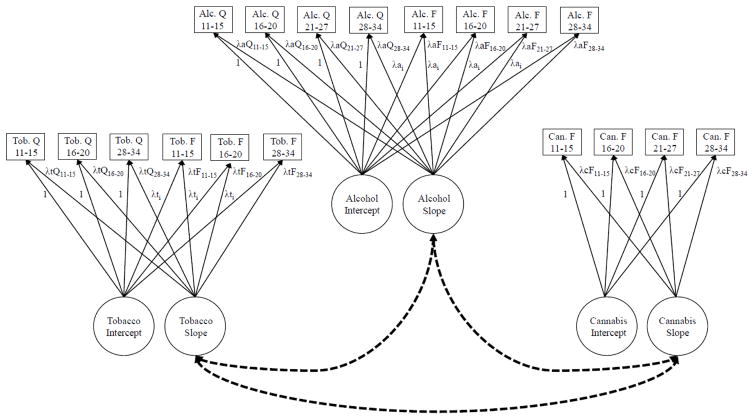
An individual's age at first substance use may be associated with their risk for progression toward heavier substance involvement. To our knowledge, however, no studies within nationally representative samples have examined the relation between the timing of initiation and progression in use of multiple substances. The present study employed a sample of 9,421 participants from the National Longitudinal Study of Adolescent to Adult Health who reported on their ages of tobacco, alcohol, and cannabis initiation; frequency of tobacco, alcohol, and cannabis use; and quantity of tobacco and alcohol use across 4 waves. We fit latent growth models to examine (a) associations between the age of initiation and initial status and rate of change in substance involvement, and (b) the degree to which the timing of first substance use accounted for differences in trajectories. There were significant relations between all ages of initiation and rates of change in tobacco (βs = -0.21 to -0.31, ps < .01) and alcohol use frequency (βs = 0.14 to 0.31, ps < .001), age of cannabis initiation and rate of change in tobacco use quantity (β = 0.23, p < .01), and age of tobacco initiation and rate of change in cannabis use frequency (β = -0.14, p < .01). After adjusting for age of initiation, significant associations were observed between trajectories for tobacco and alcohol (r = .43, p < .0001) and alcohol and cannabis (r = .20, p < .05). Results highlight differences in within- and cross-substance relations between the age of initiation and rate of change in use across substances. They suggest that differences in substance use trajectories are partly accounted for by age at first use. (PsycINFO Database Record
一个人首次使用物质的年龄可能与其向更大量使用物质发展的风险相关。然而,据我们所知,在具有全国代表性的样本中,尚无研究考察多种物质使用的起始时间与使用进展之间的关系。本研究采用了来自全国青少年至成人健康纵向研究的9421名参与者的样本,这些参与者报告了他们开始使用烟草、酒精和大麻的年龄;烟草、酒精和大麻的使用频率;以及在4个时间点上烟草和酒精的使用量。我们拟合了潜在增长模型,以检验:(a)起始年龄与物质使用的初始状态和变化率之间的关联;(b)首次使用物质的时间在多大程度上解释了轨迹差异。所有起始年龄与烟草使用变化率(β值=-0.21至-0.31,p值<.01)和酒精使用频率变化率(β值=0.14至0.31,p值<.001)、大麻起始年龄与烟草使用量变化率(β=0.23,p<.01)以及烟草起始年龄与大麻使用频率变化率(β=-0.14,p<.01)之间均存在显著关系。在调整起始年龄后,观察到烟草和酒精轨迹之间(r=.43,p<.0001)以及酒精和大麻轨迹之间(r=.20,p<.05)存在显著关联。结果突出了起始年龄与不同物质使用变化率之间在物质内部和跨物质关系上的差异。它们表明物质使用轨迹的差异部分可由首次使用年龄来解释。(《心理学文摘数据库记录》