Institute of Environmental Health and Ecological Security, School of Environment and Safety Engineering, Jiangsu University, Zhenjiang 212013, China.
Freshwater Fisheries Research Center, Chinese Academy of Fishery Sciences, Wuxi 214081, China; Key Laboratory of Fishery Eco-environment Assessment and Resource Conservation in Middle and Lower Reaches of the Yangtze River, CAFS, Wuxi 214081, China.
Sci Total Environ. 2018 Jan 1;610-611:291-297. doi: 10.1016/j.scitotenv.2017.08.057. Epub 2017 Aug 11.
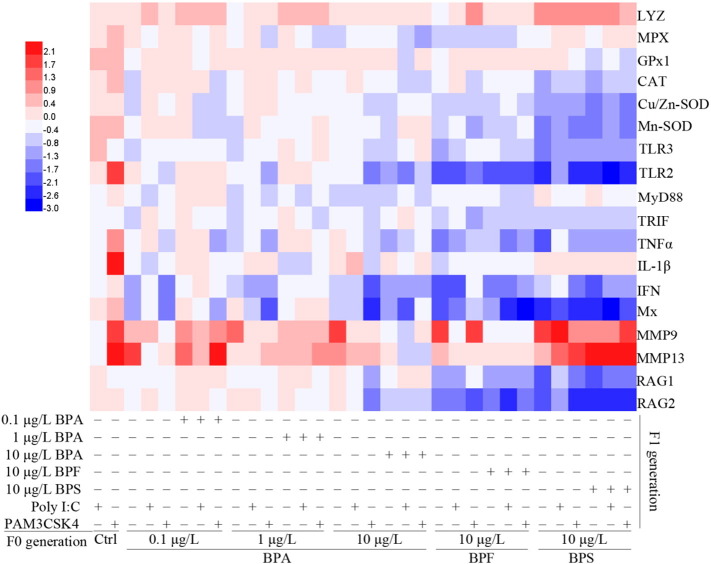
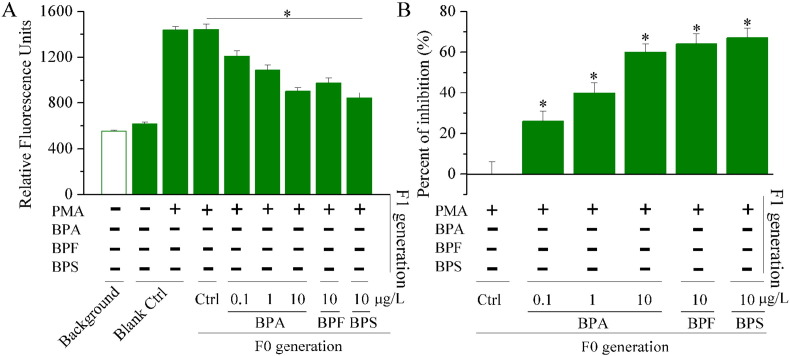
Transgenerational effects of environmental pollutants on humans and animals are complex. Thus, we used zebrafish to evaluate the effects of parental whole-life cycle exposure to bisphenol A and its analogs (bisphenol S and F) on offspring innate immunity. At adulthood, offspring were examined with/without continued chemicals treatment until 72h post-fertilization (hpf). To measure offspring immune function, larvae at 72 hpf were expose for 24h with/without the viral mimic polyinosinic-cytidylic acid (Poly I:C) or the bacterial mimic Pam3Cys-Ser-Lys4 (PAM3CSK4). Data show modified immunity in offspring. Specifically, lysozyme activity was significantly induced in F1 larvae and respiratory burst response and oxidative defense genes were inhibited. Genes of the innate immune system including Toll-like receptors and their downstream molecules and inflammatory cytokines were significantly down-regulated, whereas matrix metalloproteinases were up-regulated in larvae. In addition, recombination-activating genes in the immature adaptive immune system were significantly reduced. Thus, immune defense is diminished by exposing parental generations of zebrafish to environmentally relevant concentration of bisphenols and this suggests that fish chronically exposed to bisphenols in the wild may be vulnerable to pathogens.
环境污染物对人类和动物的跨代效应是复杂的。因此,我们使用斑马鱼来评估双亲全生命周期暴露于双酚 A 及其类似物(双酚 S 和 F)对后代先天免疫的影响。在成年期,对后代进行了持续化学处理直至受精后 72 小时(hpf)的评估。为了测量后代的免疫功能,在 72 hpf 时将幼虫暴露于病毒模拟物聚肌胞苷酸(Poly I:C)或细菌模拟物 Pam3Cys-Ser-Lys4(PAM3CSK4)24 小时。数据显示后代的免疫功能发生了改变。具体而言,F1 幼虫的溶菌酶活性显著增加,呼吸爆发反应和氧化防御基因受到抑制。先天免疫系统的基因,包括 Toll 样受体及其下游分子和炎症细胞因子,显著下调,而幼虫中的基质金属蛋白酶上调。此外,未成熟适应性免疫系统的重组激活基因显著减少。因此,暴露于环境相关浓度双酚的亲代斑马鱼的免疫防御能力降低,这表明在野外长期暴露于双酚的鱼类可能容易受到病原体的侵害。