Cortázar-Chinarro Maria, Lattenkamp Ella Z, Meyer-Lucht Yvonne, Luquet Emilien, Laurila Anssi, Höglund Jacob
Animal Ecology/Department of Ecology and Genetics, Uppsala University, Norbyvägen 18D, 75236, Uppsala, Sweden.
Present address: Department of Neurogenetics of Vocal Communication, Max Planck Institute of Psycholinguistics, Box 310, 6500, Nijmegen, Netherlands.
BMC Evol Biol. 2017 Aug 14;17(1):189. doi: 10.1186/s12862-017-1022-z.
Past events like fluctuations in population size and post-glacial colonization processes may influence the relative importance of genetic drift, migration and selection when determining the present day patterns of genetic variation. We disentangle how drift, selection and migration shape neutral and adaptive genetic variation in 12 moor frog populations along a 1700 km latitudinal gradient. We studied genetic differentiation and variation at a MHC exon II locus and a set of 18 microsatellites.
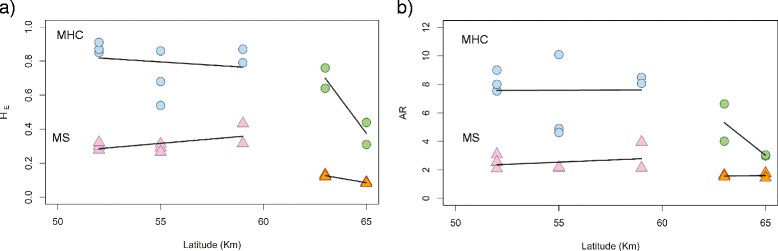
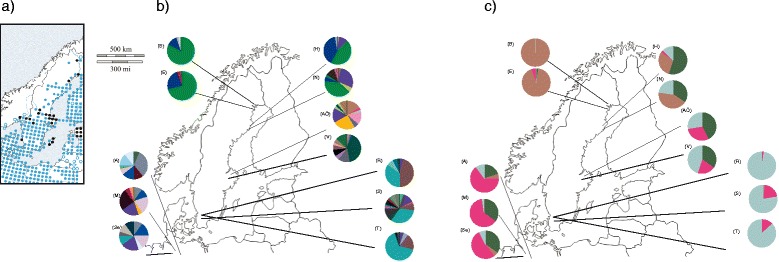
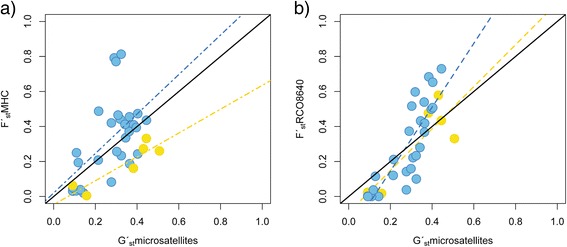
Using outlier analyses, we identified the MHC II exon 2 (corresponding to the β-2 domain) locus and one microsatellite locus (RCO8640) to be subject to diversifying selection, while five microsatellite loci showed signals of stabilizing selection among populations. STRUCTURE and DAPC analyses on the neutral microsatellites assigned populations to a northern and a southern cluster, reflecting two different post-glacial colonization routes found in previous studies. Genetic variation overall was lower in the northern cluster. The signature of selection on MHC exon II was weaker in the northern cluster, possibly as a consequence of smaller and more fragmented populations.
Our results show that historical demographic processes combined with selection and drift have led to a complex pattern of differentiation along the gradient where some loci are more divergent among populations than predicted from drift expectations due to diversifying selection, while other loci are more uniform among populations due to stabilizing selection. Importantly, both overall and MHC genetic variation are lower at northern latitudes. Due to lower evolutionary potential, the low genetic variation in northern populations may increase the risk of extinction when confronted with emerging pathogens and climate change.
过去的事件,如种群大小波动和冰期后殖民化过程,可能会在决定当前遗传变异模式时影响遗传漂变、迁移和选择的相对重要性。我们剖析了漂变、选择和迁移如何塑造沿1700公里纬度梯度分布的12个沼蛙种群的中性和适应性遗传变异。我们研究了主要组织相容性复合体(MHC)外显子II位点和一组18个微卫星的遗传分化和变异。
通过异常值分析,我们确定MHC II外显子2(对应于β-2结构域)位点和一个微卫星位点(RCO8640)受到多样化选择,而五个微卫星位点在种群间显示出稳定选择的信号。对中性微卫星进行的结构分析和判别分析将种群分为北部和南部两个集群,这反映了先前研究中发现的两条不同的冰期后殖民化路线。北部集群的总体遗传变异较低。北部集群中对MHC外显子II的选择特征较弱,这可能是由于种群规模较小且更为分散所致。
我们的结果表明,历史人口统计过程与选择和漂变相结合,导致了沿梯度的复杂分化模式,其中一些位点在种群间的差异比基于漂变预期所预测的更大,这是由于多样化选择,而其他位点由于稳定选择在种群间更为一致。重要的是,在北纬地区,总体遗传变异和MHC遗传变异都较低。由于进化潜力较低,北部种群的低遗传变异可能会增加在面对新出现的病原体和气候变化时灭绝的风险。