Wennberg Patrik, Boraxbekk Carl-Johan, Wheeler Michael, Howard Bethany, Dempsey Paddy C, Lambert Gavin, Eikelis Nina, Larsen Robyn, Sethi Parneet, Occleston Jessica, Hernestål-Boman Jenny, Ellis Kathryn A, Owen Neville, Dunstan David W
Department of Public Health and Clinical Medicine, Umeå University, Umeå, Sweden.
CEDAR, Center for Demographic and Aging Research, Umeå University, Umeå, Sweden.
BMJ Open. 2016 Feb 26;6(2):e009630. doi: 10.1136/bmjopen-2015-009630.
To compare the acute effects of uninterrupted sitting with sitting interrupted by brief bouts of light-intensity walking on self-reported fatigue, cognition, neuroendocrine biomarkers and cardiometabolic risk markers in overweight/obese adults.
Randomised two-condition crossover trial.
Laboratory study conducted in Melbourne, Australia.
19 overweight/obese adults (45-75 years).
After an initial 2 h period seated, participants consumed a meal-replacement beverage and completed (on 2 days separated by a 6-day washout period) each condition over the next 5 h: uninterrupted sitting (sedentary condition) or sitting with 3 min bouts of light-intensity walking every 30 min (active condition).
Self-reported fatigue, executive function and episodic memory at 0 h, 4 h and 7 h.
Neuroendocrine biomarkers and cardiometabolic risk markers (blood collections at 0 h, 4 h and 7 h, blood pressure and heart rate measured hourly and interstitial glucose measured using a continuous glucose monitoring system).
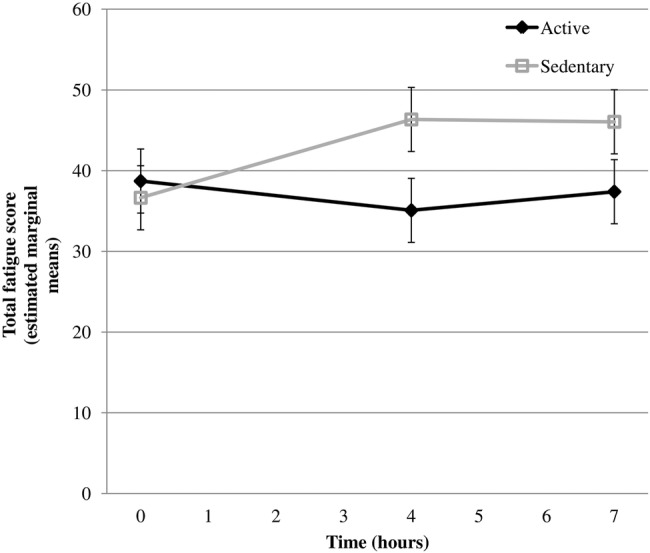
During the active condition, fatigue levels were lower at 4 h (-13.32 (95% CI -23.48 to -3.16)) and at 7 h (-10.73 (95% CI -20.89 to -0.58)) compared to the sedentary condition. Heart rate was higher at 4 h (4.47 (95% CI 8.37 to 0.58)) and at 7 h (4.32 (95% CI 8.21 to 0.42)) during the active condition compared to the sedentary condition. There were no significant differences between conditions by time for other variables. In the sedentary condition, changes in fatigue scores over time correlated with a decrease in heart rate and plasma dihydroxyphenylalanine (DOPA) and an increase in plasma dihydroxyphenylglycol (DHPG).
Interrupting prolonged sitting with light-intensity walking breaks may be an effective fatigue countermeasure acutely. Fatigue levels corresponded with the heart rate and neuroendocrine biomarker changes in uninterrupted sitting in this pilot study. Further research is needed to identify potential implications, particularly for the occupational health context.
ACTRN12613000137796; Results.
比较超重/肥胖成年人中持续久坐与穿插短时间低强度步行的久坐对自我报告的疲劳、认知、神经内分泌生物标志物和心脏代谢风险标志物的急性影响。
随机双条件交叉试验。
在澳大利亚墨尔本进行的实验室研究。
19名超重/肥胖成年人(45 - 75岁)。
在最初2小时的坐姿状态后,参与者饮用代餐饮料,并在接下来的5小时内(在间隔6天洗脱期的2天里)完成每种状态:持续久坐(久坐状态)或每隔30分钟进行3分钟低强度步行的久坐(活跃状态)。
在0小时、4小时和7小时时自我报告的疲劳、执行功能和情景记忆。
神经内分泌生物标志物和心脏代谢风险标志物(在0小时、4小时和7小时采集血液,每小时测量血压和心率,并使用连续血糖监测系统测量组织间液葡萄糖)。
在活跃状态下,与久坐状态相比,4小时时疲劳水平更低(-13.32(95%置信区间 -23.48至 -3.16)),7小时时也是如此(-10.73(95%置信区间 -20.89至 -0.58))。与久坐状态相比,活跃状态下4小时时心率更高(4.47(95%置信区间8.37至0.58)),7小时时也是如此(4.32(95%置信区间8.21至0.42))。其他变量在不同状态和时间之间没有显著差异。在久坐状态下,疲劳评分随时间的变化与心率和血浆二羟基苯丙氨酸(DOPA)的降低以及血浆二羟基苯乙二醇(DHPG)的升高相关。
用低强度步行休息打断长时间久坐可能是一种有效的急性抗疲劳措施。在这项初步研究中,疲劳水平与持续久坐时的心率和神经内分泌生物标志物变化相对应。需要进一步研究以确定潜在影响,特别是在职业健康背景下。
ACTRN12613000137796;结果