Petrillo Jennifer, Bressler Neil M, Lamoureux Ecosse, Ferreira Alberto, Cano Stefan
Biogen, Boston, USA.
Retina Division, Wilmer Eye Institute, Johns Hopkins University School of Medicine, Baltimore, MD, USA.
Health Qual Life Outcomes. 2017 Aug 14;15(1):157. doi: 10.1186/s12955-017-0726-5.
The NEI VFQ-25 has undergone psychometric evaluation in patients with varying ocular conditions and the general population. However, important limitations which may affect the interpretation of clinical trial results have been previously identified, such as concerns with reliability and validity. The purpose of this study was to evaluate the National Eye Institute Visual Functioning Questionnaire (NEI VFQ-25) and make recommendations for a revised scoring structure, with a view to improving its psychometric performance and interpretability.
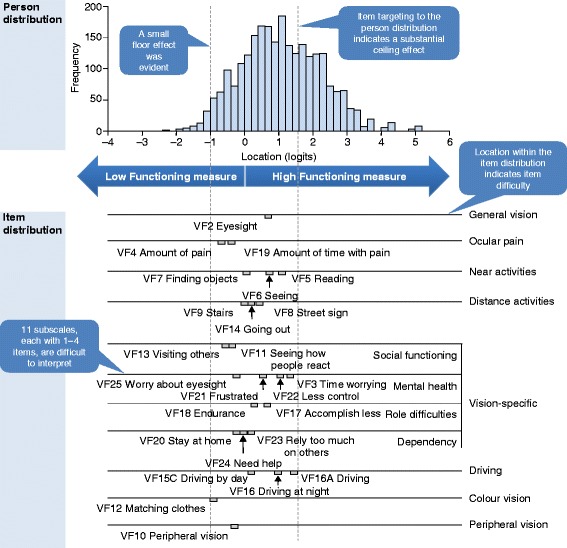
Rasch Measurement Theory analyses were conducted in two stages using pooled baseline NEI VFQ-25 data for 2487 participants with retinal diseases enrolled in six clinical trials. In stage 1, we examined: scale-to-sample targeting; thresholds for item response options; item fit statistics; stability; local dependence; and reliability. In stage 2, a post-hoc revision of the scoring structure (VFQ-28R) was created and psychometrically re-evaluated.
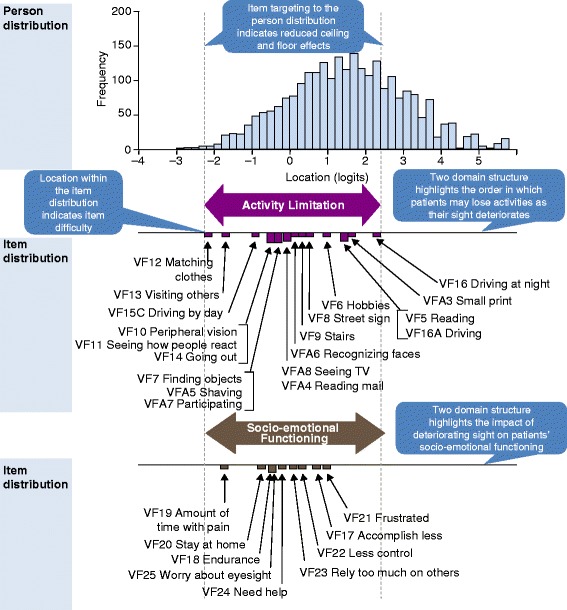
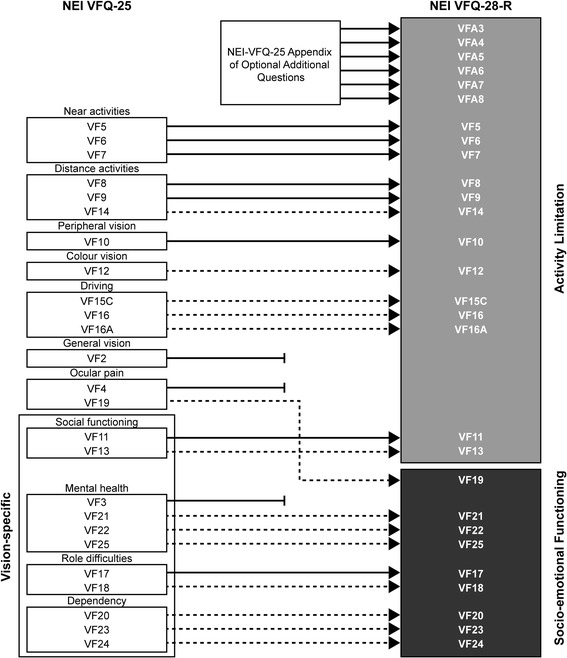
In stage 1, we found that the NEI VFQ-25 was mis-targeted to the sample, and had disordered response thresholds (15/25 items) and mis-fitting items (8/25 items). However, items appeared to be stable (differential item functioning for three items), have minimal item dependency (one pair of items) and good reliability (person-separation index, 0.93). In stage 2, the modified Rasch-scored NEI VFQ-28-R was assessed. It comprised two broad domains: Activity Limitation (19 items) and Socio-Emotional Functioning (nine items). The NEI VFQ-28-R demonstrated improved performance with fewer disordered response thresholds (no items), less item misfit (three items) and improved population targeting (reduced ceiling effect) compared with the NEI VFQ-25.
Compared with the original version, the proposed NEI VFQ-28-R, with Rasch-based scoring and a two-domain structure, appears to offer improved psychometric performance and interpretability of the vision-related quality of life scale for the population analysed.
NEI VFQ - 25已在患有不同眼部疾病的患者和普通人群中进行了心理测量评估。然而,先前已确定了可能影响临床试验结果解释的重要局限性,例如对可靠性和有效性的担忧。本研究的目的是评估美国国立眼科研究所视觉功能问卷(NEI VFQ - 25),并就修订后的评分结构提出建议,以改善其心理测量性能和可解释性。
使用来自六项临床试验的2487名视网膜疾病参与者的汇总基线NEI VFQ - 25数据,分两个阶段进行拉施测量理论分析。在第一阶段,我们检查了:量表与样本的匹配度;项目反应选项的阈值;项目拟合统计量;稳定性;局部依赖性;以及可靠性。在第二阶段,创建了评分结构的事后修订版(VFQ - 28R)并对其心理测量进行重新评估。
在第一阶段,我们发现NEI VFQ - 25与样本不匹配,具有无序的反应阈值(25项中的15项)和不拟合的项目(25项中的8项)。然而,项目似乎是稳定的(三项存在项目功能差异),具有最小的项目依赖性(一对项目)和良好的可靠性(个人分离指数为0.93)。在第二阶段,对修改后的拉施评分NEI VFQ - 28 - R进行了评估。它包括两个广泛的领域:活动受限(19项)和社会情感功能(9项)。与NEI VFQ - 25相比,NEI VFQ - 28 - R表现出更好的性能,无序反应阈值更少(无项目),项目不拟合更少(3项),并且人群匹配度更高(天花板效应降低)。
与原始版本相比,提议的基于拉施评分且具有两个领域结构的NEI VFQ - 28 - R似乎为所分析人群的视力相关生活质量量表提供了更好的心理测量性能和可解释性。