Sorbonne-Universités-INSEAD Behavioural Lab, 75005, Paris, France.
INSERM, U960 Laboratoire de Neuroscience Cognitive, Economic Decision-Making Group, Ecole Normale Supérieure, 75005, Paris, France.
Sci Rep. 2017 Aug 14;7(1):8098. doi: 10.1038/s41598-017-08080-0.
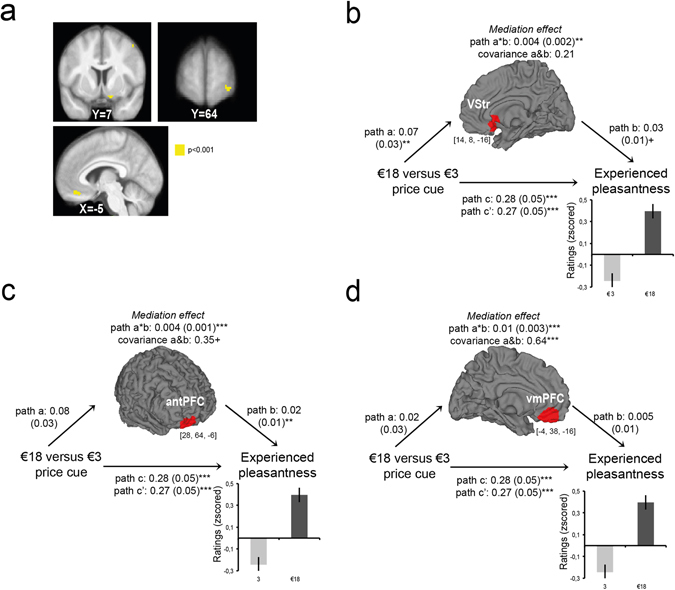
Informational cues such as the price of a wine can trigger expectations about its taste quality and thereby modulate the sensory experience on a reported and neural level. Yet it is unclear how the brain translates such expectations into sensory pleasantness. We used a whole-brain multilevel mediation approach with healthy participants who tasted identical wines cued with different prices while their brains were scanned using fMRI. We found that the brain's valuation system (BVS) in concert with the anterior prefrontal cortex played a key role in implementing the effect of price cues on taste pleasantness ratings. The sensitivity of the BVS to monetary rewards outside the taste domain moderated the strength of these effects. These findings provide novel evidence for the fundamental role that neural pathways linked to motivation and affective regulation play for the effect of informational cues on sensory experiences.
信息提示,如葡萄酒的价格,可以引发对其口感质量的预期,从而在报告和神经水平上调节感官体验。然而,目前尚不清楚大脑如何将这些预期转化为感官愉悦。我们使用全脑多层次中介方法,让健康参与者品尝用不同价格提示的相同葡萄酒,同时使用 fMRI 扫描他们的大脑。我们发现,大脑的估值系统(BVS)与前前额叶皮层一起,在实现价格提示对味觉愉悦度评价的影响方面发挥了关键作用。BVS 对味觉领域以外的金钱奖励的敏感性调节了这些影响的强度。这些发现为与动机和情感调节相关的神经通路在信息提示对感官体验的影响方面所起的基本作用提供了新的证据。