Coates Leighton, Robertson Lee
Oak Ridge National Laboratory, 1 Bethel Valley Road, Oak Ridge, TN 37831, USA.
J Appl Crystallogr. 2017 Jul 26;50(Pt 4):1174-1178. doi: 10.1107/S1600576717010032. eCollection 2017 Aug 1.
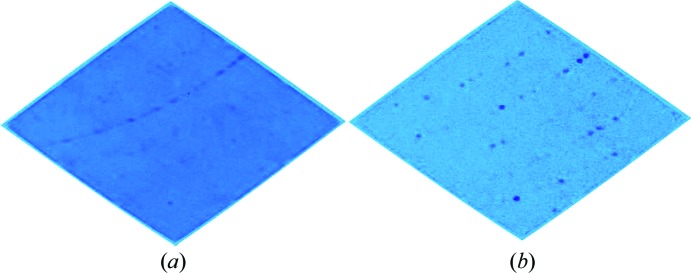
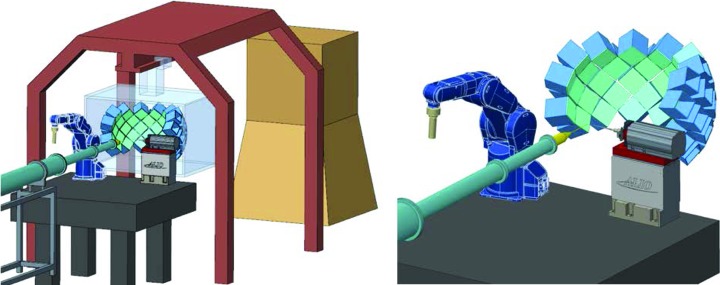
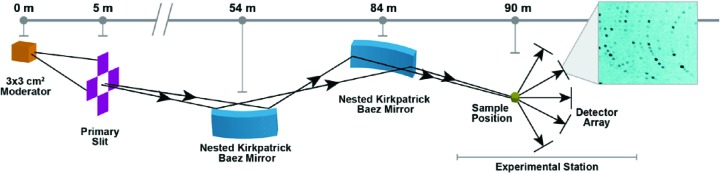
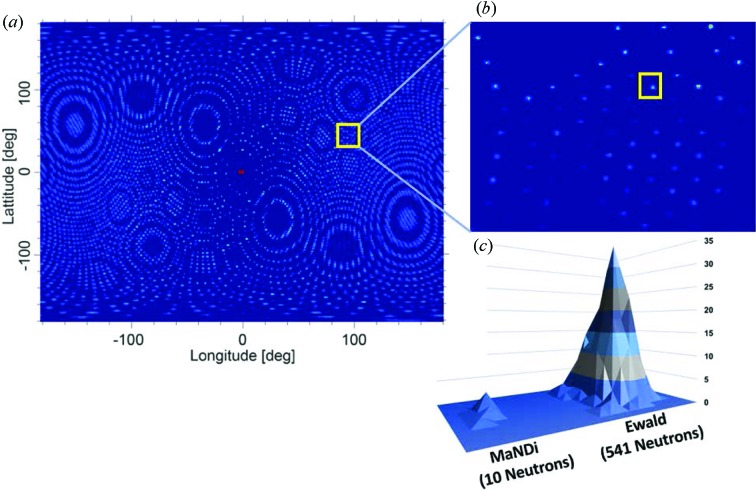
Visualizing hydrogen atoms in biological materials is one of the biggest remaining challenges in biophysical analysis. While X-ray techniques have unrivaled capacity for high-throughput structure determination, neutron diffraction is uniquely sensitive to hydrogen atom positions in crystals of biological materials and can provide a more complete picture of the atomic and electronic structures of biological macromolecules. This information can be essential in providing predictive understanding and engineering control of key biological processes, for example, in catalysis, ligand binding and light harvesting, and to guide bioengineering of enzymes and drug design. One very common and large capability gap for all neutron atomic resolution single-crystal diffractometers is the weak flux of available neutron beams, which results in limited signal-to-noise ratios giving a requirement for sample volumes of at least 0.1 mm. The ability to operate on crystals an order of magnitude smaller (0.01 mm) will open up new and more complex systems to studies with neutrons which will help in our understanding of enzyme mechanisms and enable us to improve drugs against multi resistant bacteria. With this is mind, an extended wide-angle Laue diffractometer, 'Ewald', has been designed, which can collect data using crystal volumes below 0.01 mm.
在生物材料中可视化氢原子是生物物理分析中现存的最大挑战之一。虽然X射线技术在高通量结构测定方面具有无与伦比的能力,但中子衍射对生物材料晶体中的氢原子位置具有独特的敏感性,并且可以提供生物大分子原子和电子结构的更完整图像。这些信息对于提供对关键生物过程的预测性理解和工程控制至关重要,例如在催化、配体结合和光捕获方面,并指导酶的生物工程和药物设计。所有中子原子分辨率单晶衍射仪一个非常常见且较大的能力差距是可用中子束的通量较弱,这导致信噪比有限,从而要求样品体积至少为0.1 mm。能够在尺寸小一个数量级(0.01 mm)的晶体上进行操作,将为中子研究开辟新的、更复杂的系统,这将有助于我们理解酶的机制,并使我们能够改进针对多重耐药细菌的药物。考虑到这一点,设计了一种扩展广角劳厄衍射仪“埃瓦尔德”,它可以使用体积小于0.01 mm的晶体收集数据。