
一项简短行为干预对肯尼亚城市地区有性别暴力史女性心理困扰的有效性:一项随机临床试验。
Effectiveness of a brief behavioural intervention on psychological distress among women with a history of gender-based violence in urban Kenya: A randomised clinical trial.
作者信息
Bryant Richard A, Schafer Alison, Dawson Katie S, Anjuri Dorothy, Mulili Caroline, Ndogoni Lincoln, Koyiet Phiona, Sijbrandij Marit, Ulate Jeannette, Harper Shehadeh Melissa, Hadzi-Pavlovic Dusan, van Ommeren Mark
机构信息
School of Psychology, University of New South Wales, Sydney, New South Wales, Australia.
Westmead Institute for Medical Research, Sydney, New South Wales, Australia.
出版信息
PLoS Med. 2017 Aug 15;14(8):e1002371. doi: 10.1371/journal.pmed.1002371. eCollection 2017 Aug.
BACKGROUND
Gender-based violence (GBV) represents a major cause of psychological morbidity worldwide, and particularly in low- and middle-income countries (LMICs). Although there are effective treatments for common mental disorders associated with GBV, they typically require lengthy treatment programs that may limit scaling up in LMICs. The aim of this study was to test the effectiveness of a new 5-session behavioural treatment called Problem Management Plus (PM+) that lay community workers can be taught to deliver.
METHODS AND FINDINGS
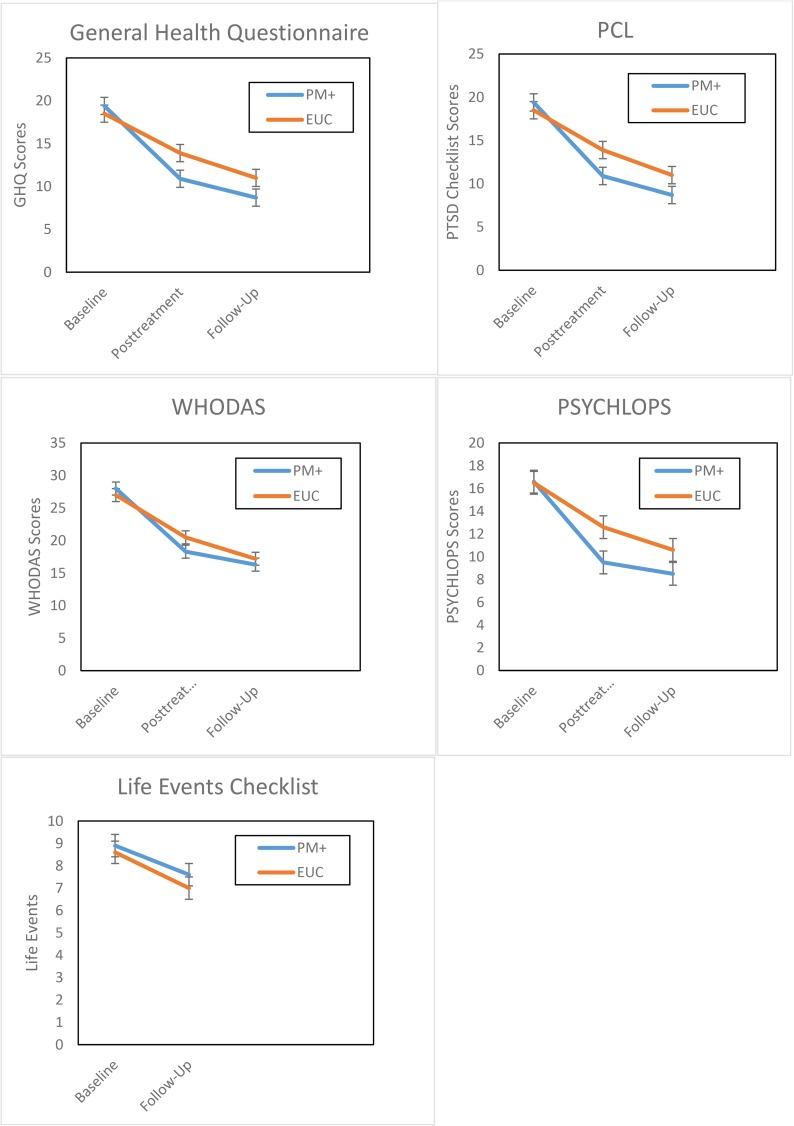
In this single-blind, parallel, randomised controlled trial, adult women who had experienced GBV were identified through community screening for psychological distress and impaired functioning in Nairobi, Kenya. Participants were randomly allocated in a 1:1 ratio either to PM+ delivered in the community by lay community health workers provided with 8 days of training or to facility-based enhanced usual care (EUC) provided by community nurses. Participants were aware of treatment allocation, but research assessors were blinded. The primary outcome was psychological distress as measured by the total score on the 12-item General Health Questionnaire (GHQ-12) assessed at 3 months after treatment. Secondary outcomes were impaired functioning (measured by the WHO Disability Adjustment Schedule [WHODAS]), symptoms of posttraumatic stress (measured by the Posttraumatic Stress Disorder Checklist [PCL]), personally identified problems (measured by Psychological Outcome Profiles [PSYCHLOPS]), stressful life events (measured by the Life Events Checklist [LEC]), and health service utilisation. Between 15 April 2015 and 20 August 2015, 1,393 women were screened for eligibility on the basis of psychological distress and impaired functioning. Of these, 518 women (37%) screened positive, of whom 421 (81%) were women who had experienced GBV. Of these 421 women, 209 were assigned to PM+ and 212 to EUC. Follow-up assessments were completed on 16 January 2016. The primary analysis was intention to treat and included 53 women in PM+ (25%) and 49 women in EUC (23%) lost to follow-up. The difference between PM+ and EUC in the change from baseline to 3 months on the GHQ-12 was 3.33 (95% CI 1.86-4.79, P = 0.001) in favour of PM+. In terms of secondary outcomes, for WHODAS the difference between PM+ and EUC in the change from baseline to 3-month follow-up was 1.96 (95% CI 0.21-3.71, P = 0.03), for PCL it was 3.95 (95% CI 0.06-7.83, P = 0.05), and for PSYCHLOPS it was 2.15 (95% CI 0.98-3.32, P = 0.001), all in favour of PM+. These estimated differences correspond to moderate effect sizes in favour of PM+ for GHQ-12 score (0.57, 95% CI 0.32-0.83) and PSYCHLOPS (0.67, 95% CI 0.31-1.03), and small effect sizes for WHODAS (0.26, 95% CI 0.02-0.50) and PCL (0.21, 95% CI 0.00-0.41). Twelve adverse events were reported, all of which were suicidal risks detected during screening. No adverse events were attributable to the interventions or the trial. Limitations of the study include no long-term follow-up, reliance on self-report rather than structured interview data, and lack of an attention control condition.
CONCLUSIONS
Among a community sample of women in urban Kenya with a history of GBV, a brief, lay-administered behavioural intervention, compared with EUC, resulted in moderate reductions in psychological distress at 3-month follow-up.
TRIAL REGISTRATION
Australian New Zealand Clinical Trials Registry ACTRN12614001291673.
背景
性别暴力(GBV)是全球范围内心理疾病的主要成因,在低收入和中等收入国家(LMICs)尤为突出。虽然针对与GBV相关的常见精神障碍有有效的治疗方法,但这些方法通常需要漫长的治疗疗程,这可能会限制在LMICs中的推广。本研究的目的是测试一种名为问题管理强化疗法(PM+)的新型五节行为治疗法的有效性,这种疗法可以教给非专业社区工作者来实施。
方法与结果
在这项单盲、平行、随机对照试验中,通过社区筛查心理困扰和功能受损情况,在肯尼亚内罗毕确定了有GBV经历的成年女性。参与者以1:1的比例随机分配,要么接受由接受了8天培训的非专业社区卫生工作者在社区实施的PM+治疗,要么接受社区护士提供的基于机构的强化常规护理(EUC)。参与者知晓治疗分配情况,但研究评估人员不知情。主要结局是治疗3个月后通过12项一般健康问卷(GHQ-12)总分测量的心理困扰。次要结局包括功能受损(通过世界卫生组织残疾调整量表[WHODAS]测量)、创伤后应激症状(通过创伤后应激障碍检查表[PCL]测量)、个人确定的问题(通过心理结果概况[PSYCHLOPS]测量)、应激性生活事件(通过生活事件检查表[LEC]测量)以及卫生服务利用情况。在2015年4月15日至2015年8月20日期间,根据心理困扰和功能受损情况对1393名女性进行了资格筛查。其中,518名女性(37%)筛查呈阳性,其中421名(81%)是有GBV经历的女性。在这421名女性中,209名被分配到PM+组,212名被分配到EUC组。随访评估于2016年1月16日完成。主要分析采用意向性分析,包括PM+组中有53名女性(25%)和EUC组中有49名女性(23%)失访。PM+组和EUC组从基线到3个月时GHQ-12的变化差异为3.33(95%CI 1.86 - 4.79,P = 0.001),有利于PM+组。在次要结局方面,对于WHODAS,PM+组和EUC组从基线到3个月随访的变化差异为1.96(95%CI 0.21 - 3.71,P = 0.03),对于PCL为3.95(95%CI 0.06 - 7.83,P = 0.05),对于PSYCHLOPS为2.15(95%CI 0.98 - 3.32,P = 0.001),均有利于PM+组。这些估计差异对应于有利于PM+组的中等效应量,对于GHQ-12评分(0.57,95%CI 0.32 - 0.83)和PSYCHLOPS(0.67,95%CI 0.31 - 1.03),以及对于WHODAS(0.26,95%CI 0.02 - 0.50)和PCL(0.21,95%CI 0.00 - 0.41)的小效应量。报告了12起不良事件,所有这些都是在筛查期间检测到的自杀风险。没有不良事件可归因于干预措施或试验。本研究的局限性包括没有长期随访、依赖自我报告而非结构化访谈数据以及缺乏注意力控制组。
结论
在肯尼亚城市有GBV病史的社区女性样本中,与EUC相比,一种简短的、由非专业人员实施的行为干预在3个月随访时导致心理困扰适度减轻。
试验注册
澳大利亚新西兰临床试验注册中心ACTRN12614001291673。

 Zotero 插件