Li Wenqiang, Li Yun, Sun Ruifang, Zhou Sumei, Li Meifeng, Feng Mingchen, Xie Yingguang
Department of Emergency, Jinan Central Hospital Affiliated to Shandong University, Jinan, Shandong 250013, P.R. China.
Intensive Care Unit, Jining First People's Hospital, Jining, Shandong 272011, P.R. China.
Exp Ther Med. 2017 Aug;14(2):1307-1314. doi: 10.3892/etm.2017.4670. Epub 2017 Jun 26.
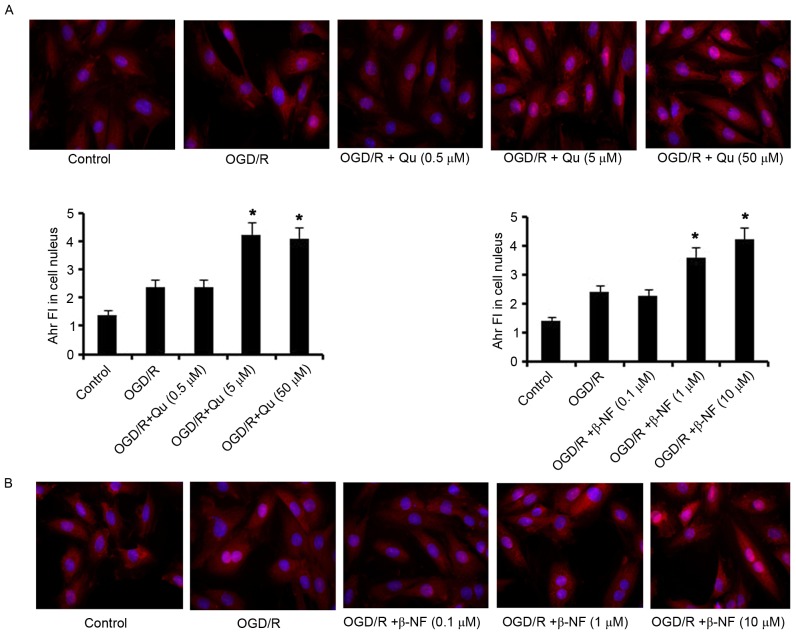
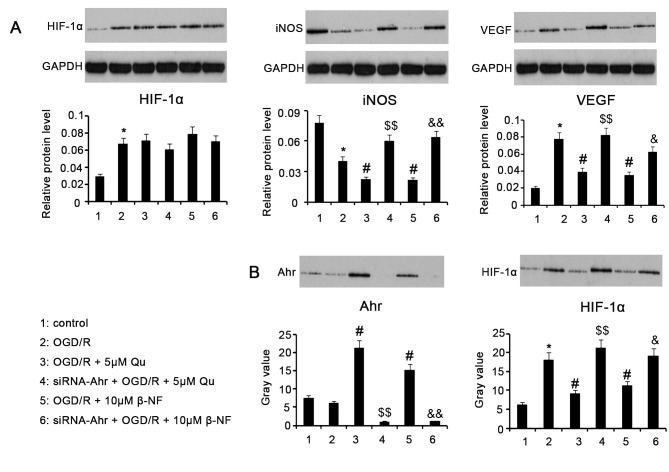
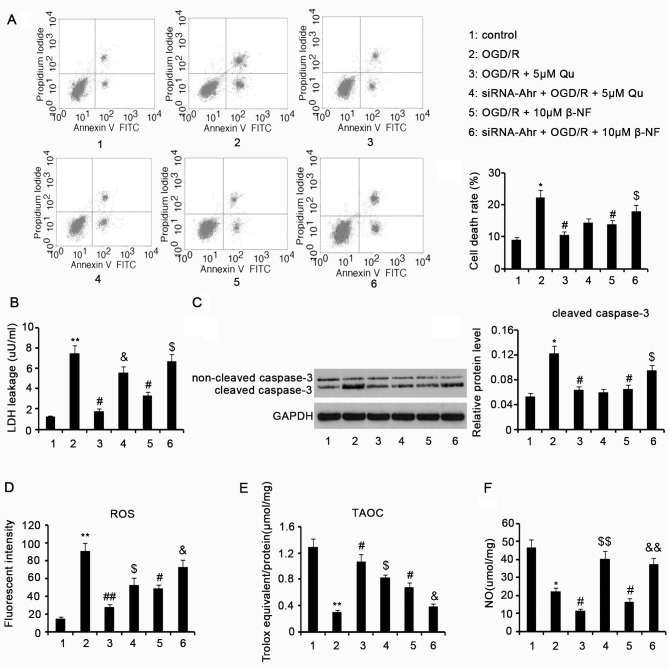
The concept that flavonoids exert cardioprotection against myocardial ischemia-reperfusion (I/R) injury has been acknowledged by a large body of evidence. However, recent studies reported cardiotoxic effects of certain flavonoids, while the underlying mechanisms have remained largely elusive. Flavonoids have been demonstrated to activate aryl hydrocarbon receptor (Ahr), which is implicated in an array of cell signaling processes. The present study examined the cardioprotective roles of quercetin (Qu) and β-naphthoflavone (β-NF) against I/R injury and explored whether the underlying mechanism proceeds via molecular signaling downstream of Ahr. An oxygen glucose deprivation/reoxygenation (OGD/R) model of I/R was established in myocardial H9c2 cells in the absence or presence of Qu or β-NF. Qu as well as β-NF reversed OGD/R-induced overproduction of reactive oxygen species by increasing the anti-oxidative capacity of the cells and protected them from lethal injury, as demonstrated by a decreased cell death rate, lactate hydrogenase leakage and caspase-3 activity as determined by flow cytometry, colorimetric assay and western blot analysis, respectively. Immunocytochemistry, co-immunoprecipitation and western blot assays collectively revealed that Qu and β-NF engendered the translocation of Ahr from the cytoplasm into the cell nucleus, where binding of Ahr with the Ahr nuclear translocator (ARNT) blocked its binding to hypoxia-inducible factor (HIF)-1α, which inhibited the cardioprotection of HIF-1α, including the induction of nitric oxide (NO) and inhibition of vascular endothelial growth factor (VEGF) production. Ahr knockdown recovered the binding of ARNT to HIF-1α and the generation of NO and VEGF. The results of the present study suggested a dual character of Qu and β-NF in the process of myocardial I/R.
大量证据已证实黄酮类化合物对心肌缺血再灌注(I/R)损伤具有心脏保护作用这一概念。然而,最近的研究报道了某些黄酮类化合物的心脏毒性作用,但其潜在机制在很大程度上仍不清楚。黄酮类化合物已被证明可激活芳烃受体(Ahr),该受体参与一系列细胞信号传导过程。本研究检测了槲皮素(Qu)和β-萘黄酮(β-NF)对I/R损伤的心脏保护作用,并探讨其潜在机制是否通过Ahr下游的分子信号传导进行。在心肌H9c2细胞中建立了有无Qu或β-NF存在的I/R氧糖剥夺/复氧(OGD/R)模型。Qu以及β-NF通过提高细胞的抗氧化能力逆转了OGD/R诱导的活性氧过度产生,并保护细胞免受致命损伤,分别通过流式细胞术、比色法和蛋白质印迹分析测定的细胞死亡率降低、乳酸脱氢酶泄漏和半胱天冬酶-3活性来证明。免疫细胞化学、免疫共沉淀和蛋白质印迹分析共同显示,Qu和β-NF促使Ahr从细胞质转移到细胞核,在细胞核中Ahr与芳烃受体核转运蛋白(ARNT)的结合阻止了其与缺氧诱导因子(HIF)-1α的结合,从而抑制了HIF-1α的心脏保护作用,包括一氧化氮(NO)的诱导和血管内皮生长因子(VEGF)产生的抑制。Ahr基因敲低恢复了ARNT与HIF-1α的结合以及NO和VEGF的生成。本研究结果提示Qu和β-NF在心肌I/R过程中具有双重特性。