Hischen Florian, Reiswich Vladislav, Kupsch Desirée, De Mecquenem Ninon, Riedel Michael, Himmelsbach Markus, Weth Agnes, Heiss Ernst, Armbruster Oskar, Heitz Johannes, Baumgartner Werner
Institute of Biomedical Mechatronics, Johannes Kepler University of Linz, Altenbergerstr. 69, 4040 Linz, Austria
Department of Cellular Neurobionics, Institute of Biology II, RWTH-Aachen University, Worringerweg 3, 52056 Aachen, Germany.
Biol Open. 2017 Aug 15;6(8):1209-1218. doi: 10.1242/bio.026070.
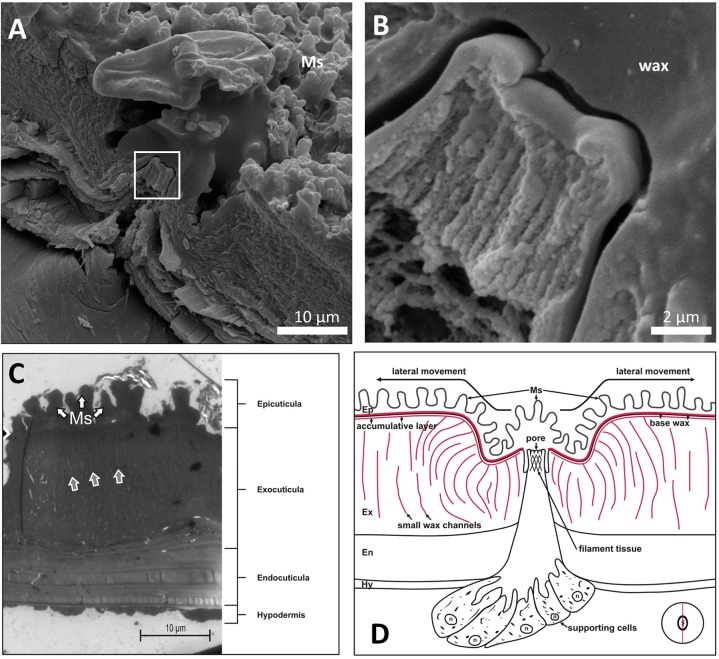
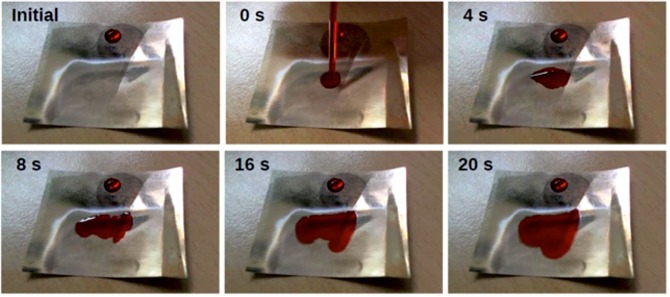
The neotropical flat bug species and show a fascinating camouflage principle, as their appearance renders the animal hardly visible on the bark of trees. However, when getting wet due to rain, bark changes its colour and gets darker. In order to keep the camouflage effect, it seems that some species benefit from their ability to hold a water film on their cuticle and therefore change their optical properties when also wetted by water. This camouflage behaviour requires the insect to have a hydrophilic surface and passive surface structures which facilitate the liquid spreading. Here we show morphological and chemical characterisations of the surface, especially the cuticular waxes of Scanning electron microscopy revealed that the animal is covered with pillar-like microstructures which, in combination with a surprising chemical hydrophilicity of the cuticle waxes, render the bug almost superhydrophilic: water spreads immediately across the surface. We could theoretically model this behaviour assuming the effect of hemi-wicking (a state in which a droplet sits on a rough surface, partwise imbibing the structure around). Additionally the principle was abstracted and a laser-patterned polymer surface, mimicking the structure and contact angle of wax, shows exactly the behaviour of the natural role model - immediate spreading of water and the formation of a thin continuous water film changing optical properties of the surface.
新热带区扁蝽物种 展现出一种迷人的伪装原理,因为它们的外观使得这种动物在树皮上几乎难以被看见。然而,下雨时树皮被打湿后,其颜色会发生变化并变深。为了保持伪装效果,似乎有些物种得益于它们在角质层上保持水膜的能力,因此当被水浸湿时也会改变其光学特性。这种伪装行为要求昆虫具有亲水性表面和有助于液体铺展的被动表面结构。在此我们展示了该表面的形态学和化学特征,尤其是 的表皮蜡质。扫描电子显微镜显示,这种动物覆盖着柱状微结构,这些微结构与表皮蜡质惊人的化学亲水性相结合,使这种扁蝽几乎具有超亲水性:水会立即在其表面铺展。我们在理论上通过假设半芯吸作用(一种液滴位于粗糙表面上,部分浸入周围结构的状态)的效果对这种行为进行了建模。此外,我们提炼出了这一原理,一个模仿蜡质结构和接触角的激光图案化聚合物表面,展现出与天然范例完全相同的行为——水立即铺展并形成一层薄的连续水膜,从而改变表面的光学特性。