School of agriculture and biology, Shanghai Jiao Tong University, Shanghai, People's Republic of China.
Sci Rep. 2017 Aug 15;7(1):8303. doi: 10.1038/s41598-017-08235-z.
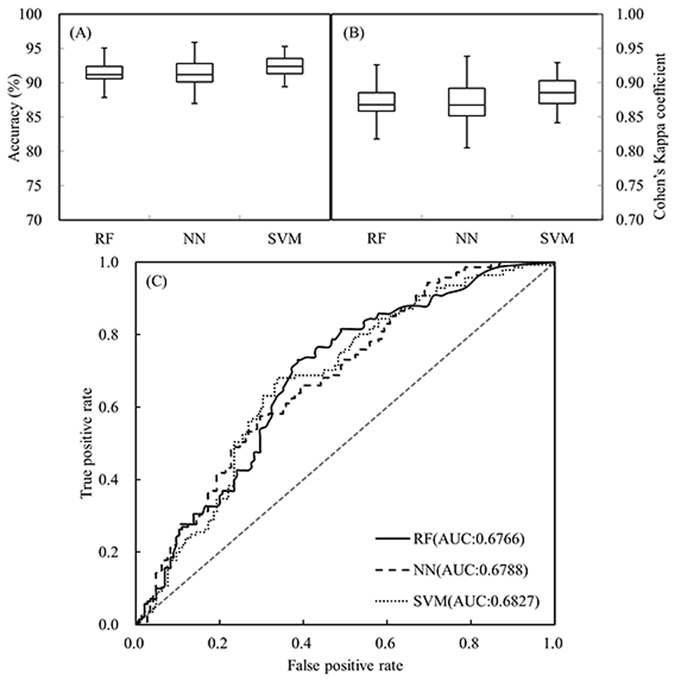
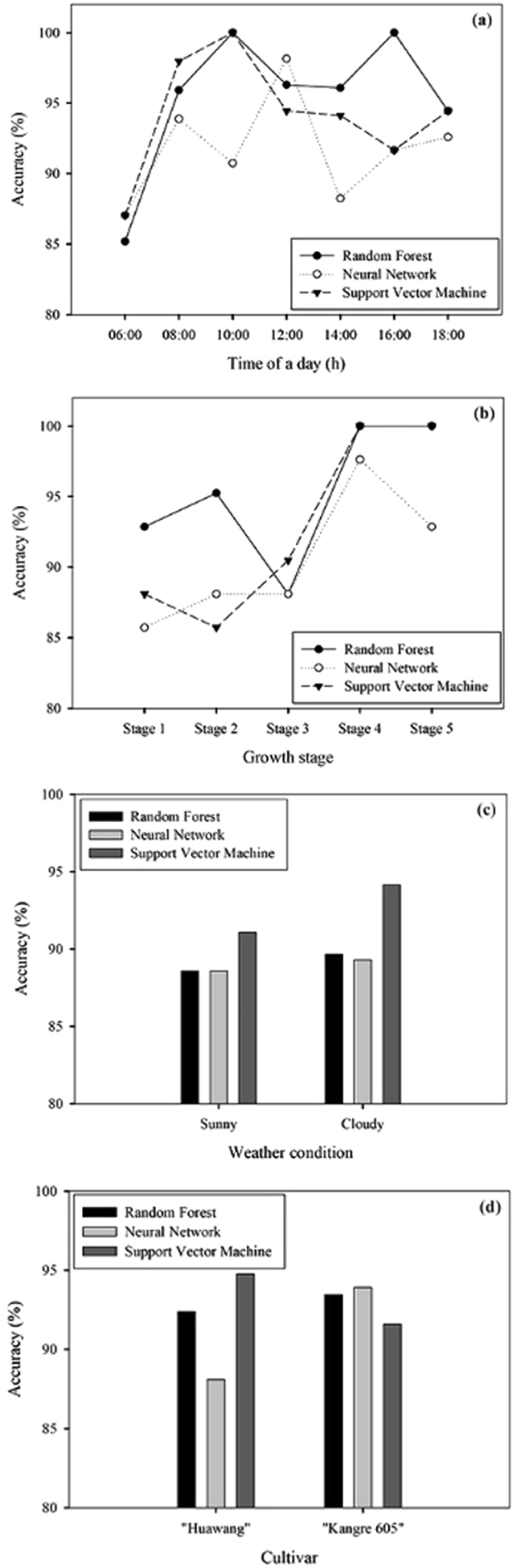
Plant-based sensing on water stress can provide sensitive and direct reference for precision irrigation system in greenhouse. However, plant information acquisition, interpretation, and systematical application remain insufficient. This study developed a discrimination method for plant root zone water status in greenhouse by integrating phenotyping and machine learning techniques. Pakchoi plants were used and treated by three root zone moisture levels, 40%, 60%, and 80% relative water content. Three classification models, Random Forest (RF), Neural Network (NN), and Support Vector Machine (SVM) were developed and validated in different scenarios with overall accuracy over 90% for all. SVM model had the highest value, but it required the longest training time. All models had accuracy over 85% in all scenarios, and more stable performance was observed in RF model. Simplified SVM model developed by the top five most contributing traits had the largest accuracy reduction as 29.5%, while simplified RF and NN model still maintained approximately 80%. For real case application, factors such as operation cost, precision requirement, and system reaction time should be synthetically considered in model selection. Our work shows it is promising to discriminate plant root zone water status by implementing phenotyping and machine learning techniques for precision irrigation management.
基于植物的水分胁迫感知可以为温室精准灌溉系统提供敏感和直接的参考。然而,植物信息的获取、解释和系统应用仍然不足。本研究通过整合表型和机器学习技术,开发了一种用于温室植物根区水分状况的判别方法。选用小白菜植物,采用三种根区水分水平(相对含水量的 40%、60%和 80%)进行处理。在不同的情况下,开发并验证了三种分类模型,即随机森林(RF)、神经网络(NN)和支持向量机(SVM),所有模型的整体准确率均超过 90%。SVM 模型具有最高的准确率,但需要最长的训练时间。所有模型在所有情况下的准确率均超过 85%,RF 模型表现出更稳定的性能。通过前五个最具贡献特征简化的 SVM 模型的准确率降低最大,为 29.5%,而简化的 RF 和 NN 模型仍保持在 80%左右。对于实际案例应用,在模型选择中应综合考虑运营成本、精度要求和系统反应时间等因素。我们的工作表明,通过实施表型和机器学习技术进行精准灌溉管理,对植物根区水分状况进行判别是有前景的。