Department of Breast Surgery, The First Hospital of Jilin University, Changchun, Jilin, 130021, China.
Department of Medical Oncology, Thomas Jefferson University, Philadelphia, PA, 19107, USA.
Sci Rep. 2017 Aug 15;7(1):8135. doi: 10.1038/s41598-017-08240-2.
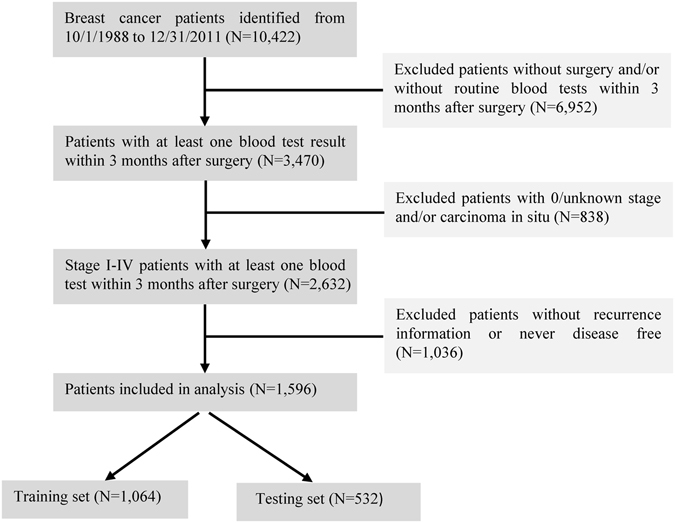
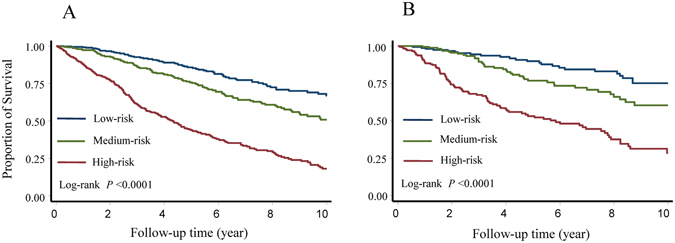
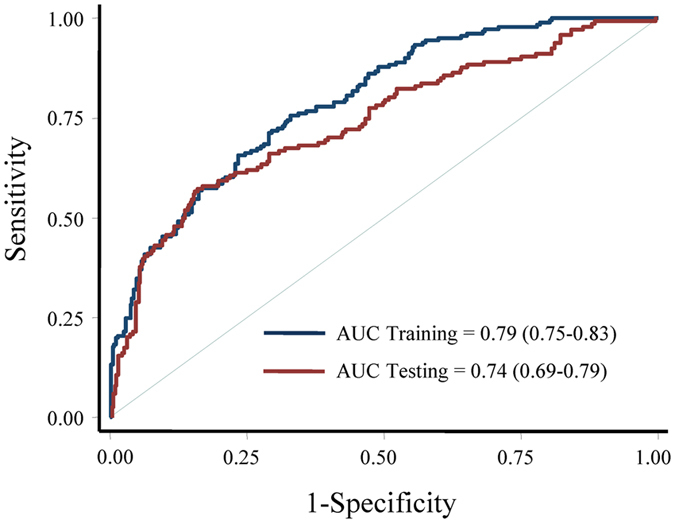
The prognostic value of routine laboratory variables in breast cancer has been largely overlooked. Based on laboratory tests commonly performed in clinical practice, we aimed to develop a new model to predict disease free survival (DFS) after surgical removal of primary breast cancer. In a cohort of 1,596 breast cancer patients, we analyzed the associations of 33 laboratory variables with patient DFS. Based on 3 significant laboratory variables (hemoglobin, alkaline phosphatase, and international normalized ratio), together with important demographic and clinical variables, we developed a prognostic model, achieving the area under the curve of 0.79. We categorized patients into 3 risk groups according to the prognostic index developed from the final model. Compared with the patients in the low-risk group, those in the medium- and high-risk group had a significantly increased risk of recurrence with a hazard ratio (HR) of 1.75 (95% confidence interval [CI] 1.30-2.38) and 4.66 (95% CI 3.54-6.14), respectively. The results from the training set were validated in the testing set. Overall, our prognostic model incorporating readily available routine laboratory tests is powerful in identifying breast cancer patients who are at high risk of recurrence. Further study is warranted to validate its clinical application.
常规实验室变量在乳腺癌中的预后价值在很大程度上被忽视了。基于临床实践中常用的实验室检查,我们旨在开发一种新模型来预测原发性乳腺癌切除术后的无病生存(DFS)。在 1596 例乳腺癌患者队列中,我们分析了 33 个实验室变量与患者 DFS 的关联。基于 3 个显著的实验室变量(血红蛋白、碱性磷酸酶和国际标准化比值)以及重要的人口统计学和临床变量,我们开发了一个预后模型,其曲线下面积为 0.79。根据最终模型开发的预后指数,我们将患者分为 3 个风险组。与低风险组的患者相比,中风险组和高风险组的患者复发风险显著增加,风险比(HR)分别为 1.75(95%置信区间 [CI] 1.30-2.38)和 4.66(95%CI 3.54-6.14)。训练集的结果在测试集中得到了验证。总的来说,我们的预后模型纳入了易于获得的常规实验室检查,可有效识别复发风险较高的乳腺癌患者。需要进一步的研究来验证其临床应用。