Kim Ji-Yeon, Lee Yong Seok, Yu Jonghan, Park Youngmin, Lee Se Kyung, Lee Minyoung, Lee Jeong Eon, Kim Seok Won, Nam Seok Jin, Park Yeon Hee, Ahn Jin Seok, Kang Mira, Im Young-Hyuck
Division of Hematology-Oncology, Department of Medicine, Samsung Medical Center, Sungkyunkwan University School of Medicine, Seoul, South Korea.
Digital Health Business Team, Samsung SDS, Seoul, South Korea.
Front Oncol. 2021 May 4;11:596364. doi: 10.3389/fonc.2021.596364. eCollection 2021.
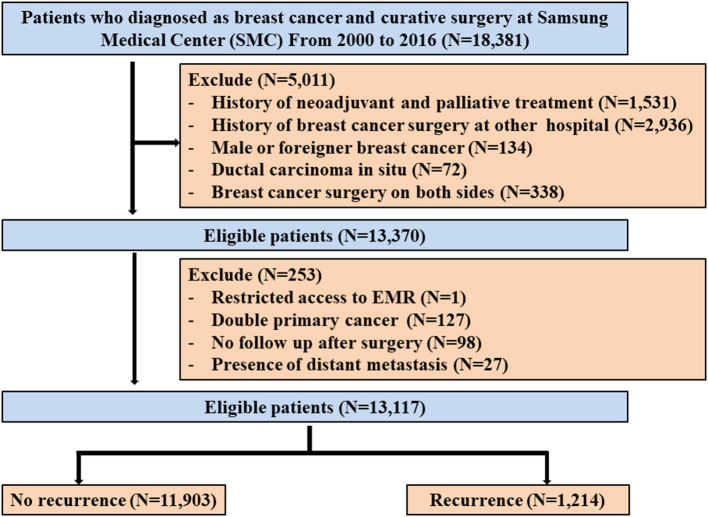
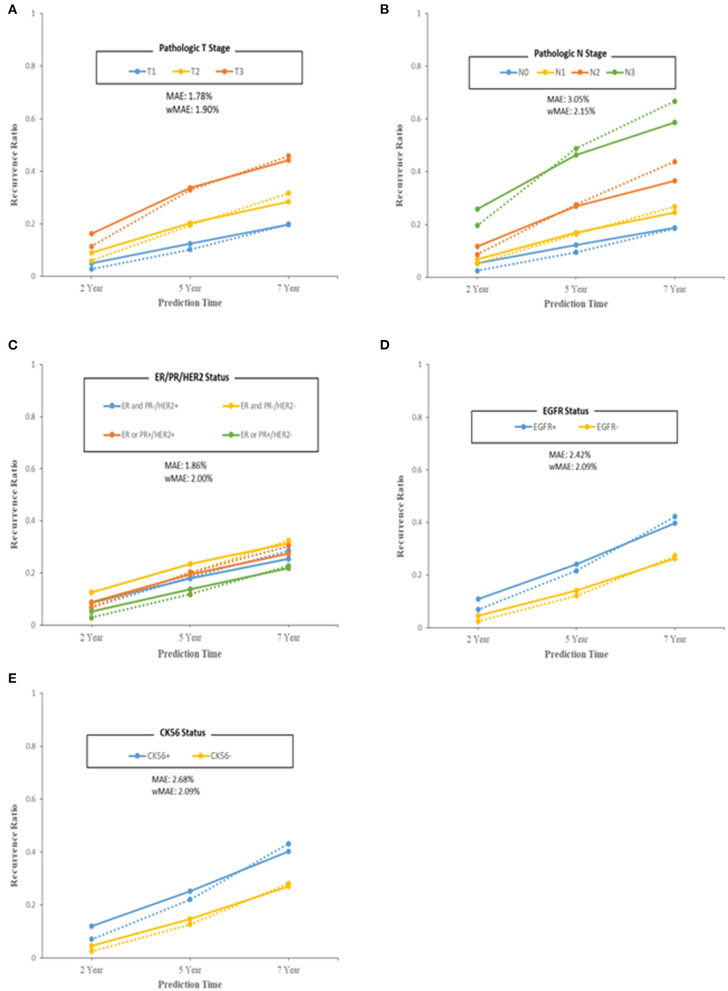
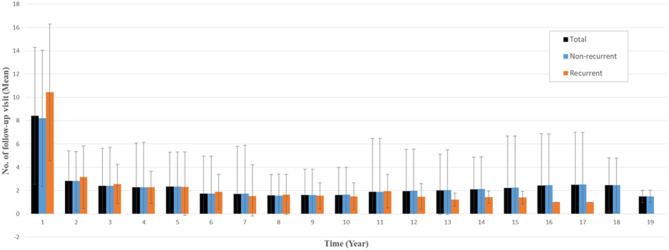
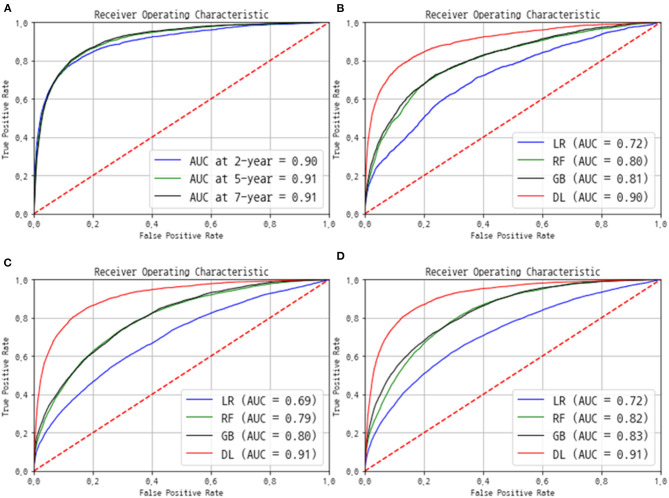
Several prognosis prediction models have been developed for breast cancer (BC) patients with curative surgery, but there is still an unmet need to precisely determine BC prognosis for individual BC patients in real time. This is a retrospectively collected data analysis from adjuvant BC registry at Samsung Medical Center between January 2000 and December 2016. The initial data set contained 325 clinical data elements: baseline characteristics with demographics, clinical and pathologic information, and follow-up clinical information including laboratory and imaging data during surveillance. Weibull Time To Event Recurrent Neural Network (WTTE-RNN) by Martinsson was implemented for machine learning. We searched for the optimal window size as time-stamped inputs. To develop the prediction model, data from 13,117 patients were split into training (60%), validation (20%), and test (20%) sets. The median follow-up duration was 4.7 years and the median number of visits was 8.4. We identified 32 features related to BC recurrence and considered them in further analyses. Performance at a point of statistics was calculated using Harrell's C-index and area under the curve (AUC) at each 2-, 5-, and 7-year points. After 200 training epochs with a batch size of 100, the C-index reached 0.92 for the training data set and 0.89 for the validation and test data sets. The AUC values were 0.90 at 2-year point, 0.91 at 5-year point, and 0.91 at 7-year point. The deep learning-based final model outperformed three other machine learning-based models. In terms of pathologic characteristics, the median absolute error (MAE) and weighted mean absolute error (wMAE) showed great results of as little as 3.5%. This BC prognosis model to determine the probability of BC recurrence in real time was developed using information from the time of BC diagnosis and the follow-up period in RNN machine learning model.
已经为接受根治性手术的乳腺癌(BC)患者开发了几种预后预测模型,但对于实时精确确定个体BC患者的BC预后仍存在未满足的需求。这是一项对三星医疗中心2000年1月至2016年12月期间辅助性BC登记处的数据进行的回顾性收集数据分析。初始数据集包含325个临床数据元素:包括人口统计学、临床和病理信息的基线特征,以及随访临床信息,包括监测期间的实验室和影像数据。采用Martinsson提出的威布尔事件发生时间递归神经网络(WTTE-RNN)进行机器学习。我们将带时间戳的输入作为搜索最优窗口大小。为了开发预测模型,将13117例患者的数据分为训练集(60%)、验证集(20%)和测试集(20%)。中位随访时间为4.7年,中位就诊次数为8.4次。我们确定了32个与BC复发相关的特征,并在进一步分析中予以考虑。使用Harrell's C指数和每2年、5年和7年时间点的曲线下面积(AUC)计算统计点的性能。在批量大小为100的情况下经过200个训练轮次后,训练数据集的C指数达到0.92,验证集和测试数据集的C指数达到0.89。2年时间点的AUC值为0.90,5年时间点为0.91,7年时间点为0.91。基于深度学习的最终模型优于其他三种基于机器学习的模型。在病理特征方面,中位绝对误差(MAE)和加权平均绝对误差(wMAE)显示出非常好的结果,低至3.5%。这个用于实时确定BC复发概率的BC预后模型是利用RNN机器学习模型中BC诊断时和随访期的信息开发的。