Saddhe Ankush Ashok, Jamdade Rahul Arvind, Kumar Kundan
Department of Biological Sciences, Birla Institute of Technology & Science Pilani, K. K. Birla Goa Campus, Goa, India.
Sharjah Research Academy, University of Sharjah, Sharjah, United Arab Emirates.
PLoS One. 2017 Aug 17;12(8):e0183245. doi: 10.1371/journal.pone.0183245. eCollection 2017.
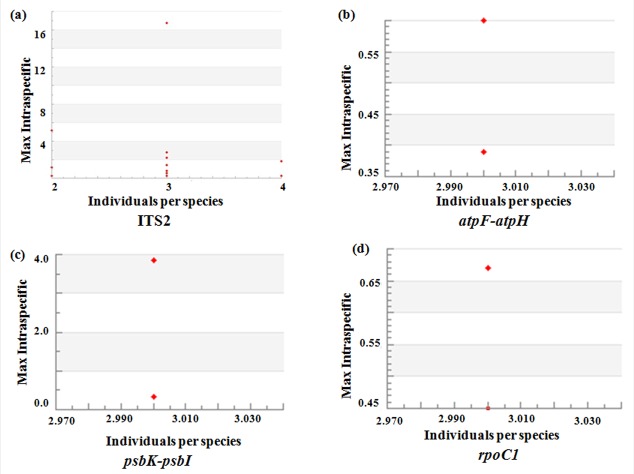
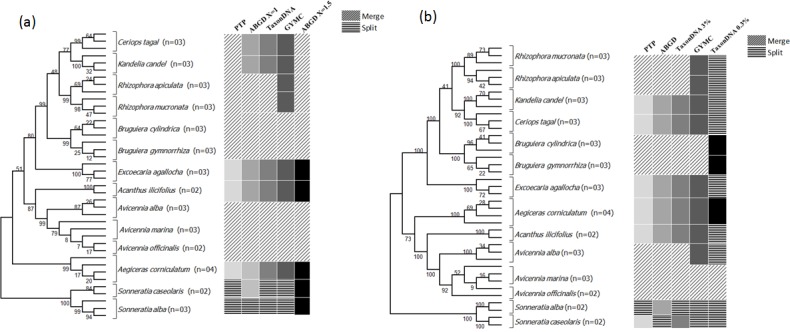
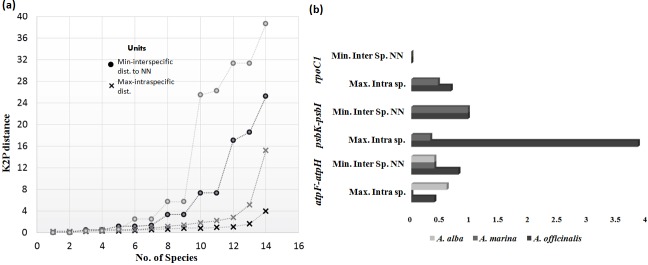
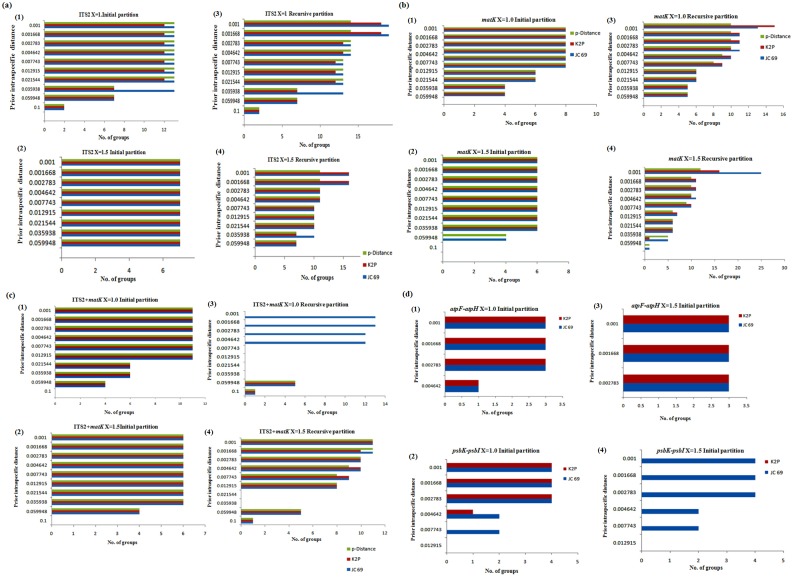
The plant DNA barcoding is a complex and requires more than one marker(s) as compared to animal barcoding. Mangroves are diverse estuarine ecosystem prevalent in the tropical and subtropical zone, but anthropogenic activity turned them into the vulnerable ecosystem. There is a need to build a molecular reference library of mangrove plant species based on molecular barcode marker along with morphological characteristics. In this study, we tested the core plant barcode (rbcL and matK) and four promising complementary barcodes (ITS2, psbK-psbI, rpoC1 and atpF-atpH) in 14 mangroves species belonging to 5 families from West Coast India. Data analysis was performed based on barcode gap analysis, intra- and inter-specific genetic distance, Automated Barcode Gap Discovery (ABGD), TaxonDNA (BM, BCM), Poisson Tree Processes (PTP) and General Mixed Yule-coalescent (GMYC). matK+ITS2 marker based on GMYC method resolved 57.14% of mangroves species and TaxonDNA, ABGD, and PTP discriminated 42.85% of mangrove species. With a single locus analysis, ITS2 exhibited the higher discriminatory power (87.82%) and combinations of matK + ITS2 provided the highest discrimination success (89.74%) rate except for Avicennia genus. Further, we explored 3 additional markers (psbK-psbI, rpoC1, and atpF-atpH) for Avicennia genera (A. alba, A. officinalis and A. marina) and atpF-atpH locus was able to discriminate three species of Avicennia genera. Our analysis underscored the efficacy of matK + ITS2 markers along with atpF-atpH as the best combination for mangrove identification in West Coast India regions.
与动物条形码相比,植物DNA条形码更为复杂,需要不止一个标记。红树林是热带和亚热带地区常见的多样化河口生态系统,但人为活动使其变成了脆弱生态系统。有必要基于分子条形码标记并结合形态特征建立红树林植物物种的分子参考文库。在本研究中,我们对印度西海岸5个科的14种红树林物种测试了核心植物条形码(rbcL和matK)以及四个有前景的补充条形码(ITS2、psbK-psbI、rpoC1和atpF-atpH)。基于条形码间隙分析、种内和种间遗传距离、自动条形码间隙发现(ABGD)、TaxonDNA(BM、BCM)、泊松树过程(PTP)和广义混合尤尔-凝聚(GMYC)进行数据分析。基于GMYC方法的matK+ITS2标记解析了57.14%的红树林物种,TaxonDNA、ABGD和PTP区分了42.85%的红树林物种。单基因座分析时,ITS2表现出更高的鉴别力(87.82%),除了白骨壤属外,matK+ITS2组合提供了最高的鉴别成功率(89.74%)。此外,我们针对白骨壤属(白灰莉、药用白骨壤和白骨壤)探索了另外3个标记(psbK-psbI、rpoC1和atpF-atpH),atpF-atpH基因座能够区分白骨壤属的三个物种。我们的分析强调了matK+ITS2标记以及atpF-atpH作为印度西海岸地区红树林鉴定最佳组合的有效性。