Institute for International Programs, Johns Hopkins Bloomberg School of Public Health, Baltimore, MD, USA.
Trop Med Int Health. 2013 Oct;18(10):1231-9. doi: 10.1111/tmi.12167. Epub 2013 Aug 1.
Few developing countries have the accurate civil registration systems needed to track progress in child survival. However, the health information systems in most of these countries do record facility births and deaths, at least in principle. We used data from two districts of Malawi to test a method for monitoring child mortality based on adjusting health facility records for incomplete coverage.
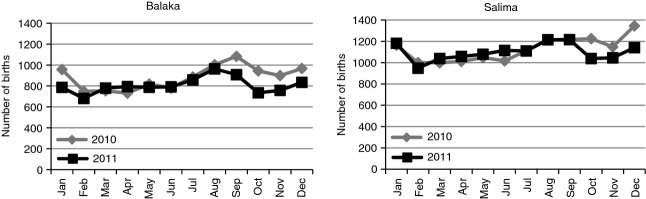
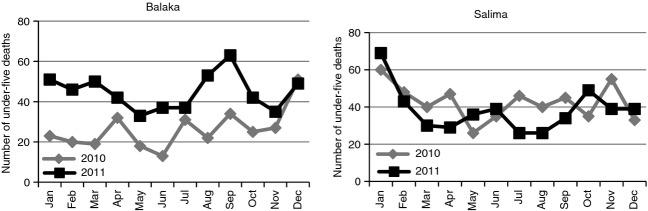
Trained researchers collected reports of monthly births and deaths among children younger than 5 years from all health facilities in Balaka and Salima districts of Malawi in 2010-2011. We estimated the proportion of births and deaths occurring in health facilities, respectively, from the 2010 Demographic and Health Survey and a household mortality survey conducted between October 2011 and February 2012. We used these proportions to adjust the health facility data to estimate the actual numbers of births and deaths. The survey also provided 'gold-standard' measures of under-five mortality.
Annual under-five mortality rates generated by adjusting health facility data were between 35% and 65% of those estimated by the gold-standard survey in Balaka, and 46% and 50% in Salima for four overlapping 12-month periods in 2010-2011. The ratios of adjusted health facility rates to gold-standard rates increased sharply over the four periods in Balaka, but remained relatively stable in Salima.
Even in Malawi, where high proportions of births and deaths occur in health facilities compared with other countries in sub-Saharan Africa, routine Health Management Information Systems data on births and deaths cannot be used at present to estimate annual trends in under-five mortality.
很少有发展中国家拥有准确的民事登记系统来跟踪儿童生存方面的进展。然而,这些国家中的大多数卫生信息系统至少原则上记录了设施内的出生和死亡情况。我们使用马拉维两个地区的数据,测试了一种基于调整卫生机构记录以弥补覆盖不足的方法来监测儿童死亡率。
训练有素的研究人员于 2010-2011 年从马拉维的巴拉卡和萨利马地区的所有卫生机构收集了 5 岁以下儿童每月出生和死亡的报告。我们分别根据 2010 年人口与健康调查和 2011 年 10 月至 2012 年 2 月期间进行的家庭死亡率调查,估算了出生和死亡分别发生在卫生机构的比例。我们使用这些比例来调整卫生机构数据,以估计实际的出生和死亡人数。该调查还提供了五岁以下儿童死亡率的“金标准”衡量标准。
调整卫生机构数据生成的五岁以下儿童年死亡率在巴拉卡为金标准调查估计值的 35%至 65%之间,在萨利马为 46%至 50%,在 2010-2011 年四个重叠的 12 个月期间。巴拉卡的四个时期内,调整后的卫生机构比率与金标准比率的比值急剧上升,但在萨利马保持相对稳定。
即使在马拉维,与撒哈拉以南非洲其他国家相比,卫生机构内的出生和死亡比例较高,但目前仍不能使用常规的卫生管理信息系统数据来估计五岁以下儿童死亡率的年度趋势。