Gurley Emily S, Hegde Sonia T, Hossain Kamal, Sazzad Hossain M S, Hossain M Jahangir, Rahman Mahmudur, Sharker M A Yushuf, Salje Henrik, Islam M Saiful, Epstein Jonathan H, Khan Salah U, Kilpatrick A Marm, Daszak Peter, Luby Stephen P
Emerg Infect Dis. 2017 Sep;23(9):1446-1453. doi: 10.3201/eid2309.161922.
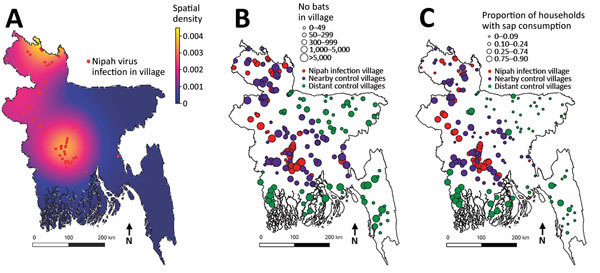
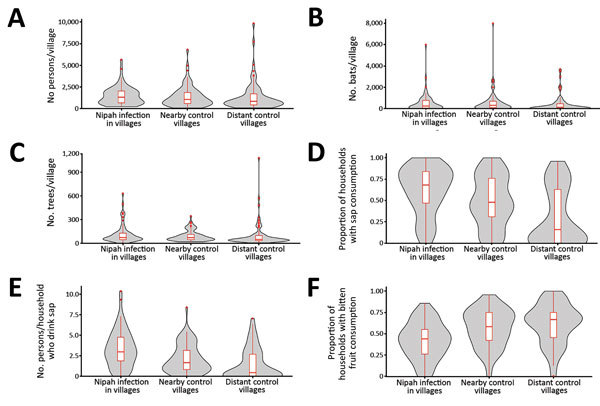
Preventing emergence of new zoonotic viruses depends on understanding determinants for human risk. Nipah virus (NiV) is a lethal zoonotic pathogen that has spilled over from bats into human populations, with limited person-to-person transmission. We examined ecologic and human behavioral drivers of geographic variation for risk of NiV infection in Bangladesh. We visited 60 villages during 2011-2013 where cases of infection with NiV were identified and 147 control villages. We compared case villages with control villages for most likely drivers for risk of infection, including number of bats, persons, and date palm sap trees, and human date palm sap consumption behavior. Case villages were similar to control villages in many ways, including number of bats, persons, and date palm sap trees, but had a higher proportion of households in which someone drank sap. Reducing human consumption of sap could reduce virus transmission and risk for emergence of a more highly transmissible NiV strain.
预防新型人畜共患病毒的出现取决于对人类风险决定因素的了解。尼帕病毒(NiV)是一种致命的人畜共患病原体,已从蝙蝠传播到人类群体,人际传播有限。我们研究了孟加拉国尼帕病毒感染风险地理变异的生态和人类行为驱动因素。在2011年至2013年期间,我们走访了60个发现尼帕病毒感染病例的村庄以及147个对照村庄。我们将病例村与对照村在最可能的感染风险驱动因素方面进行了比较,包括蝙蝠数量、人口数量、椰枣树数量以及人类食用椰枣汁的行为。病例村在许多方面与对照村相似,包括蝙蝠数量、人口数量和椰枣树数量,但饮用椰枣汁的家庭比例更高。减少人类对椰枣汁的消费可以减少病毒传播以及出现更具传播性的尼帕病毒株的风险。