Jamal Fauzia, Shivam Pushkar, Kumari Sarita, Singh Manish Kumar, Sardar Abul Hasan, Murugesan Selvasankar, Narayan Shyam, Gupta Anil Kumar, Pandey Krishna, Das V N R, Ali Vahab, Bimal Sanjiva, Das Pradeep, Singh Shubhankar K
Department of Microbiology, Rajendra Memorial Research Institute of Medical Sciences, Patna, India.
Department of Molecular Biology, Rajendra Memorial Research Institute of Medical Sciences, Patna, India.
PLoS One. 2017 Aug 18;12(8):e0182474. doi: 10.1371/journal.pone.0182474. eCollection 2017.
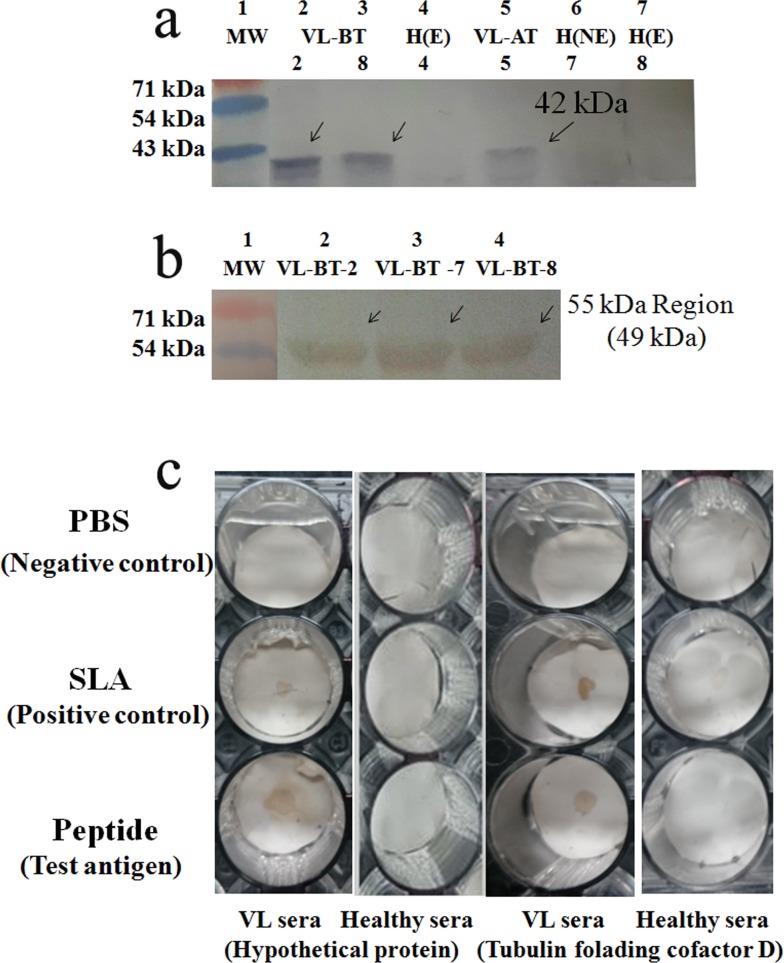
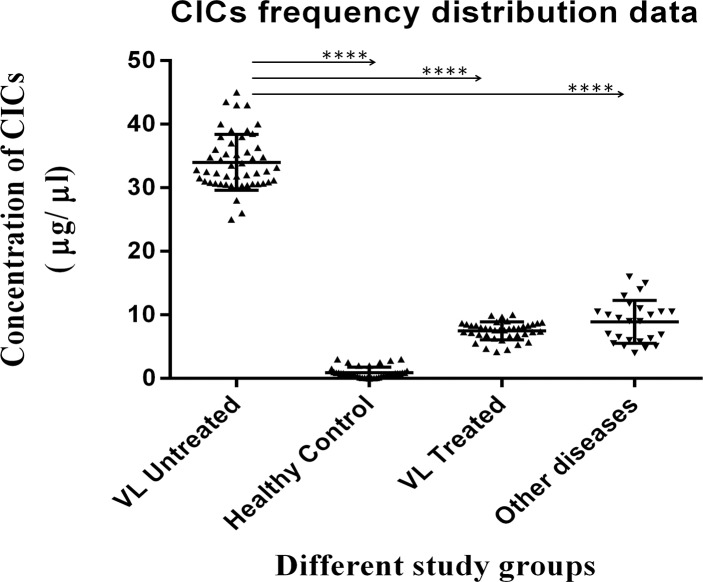
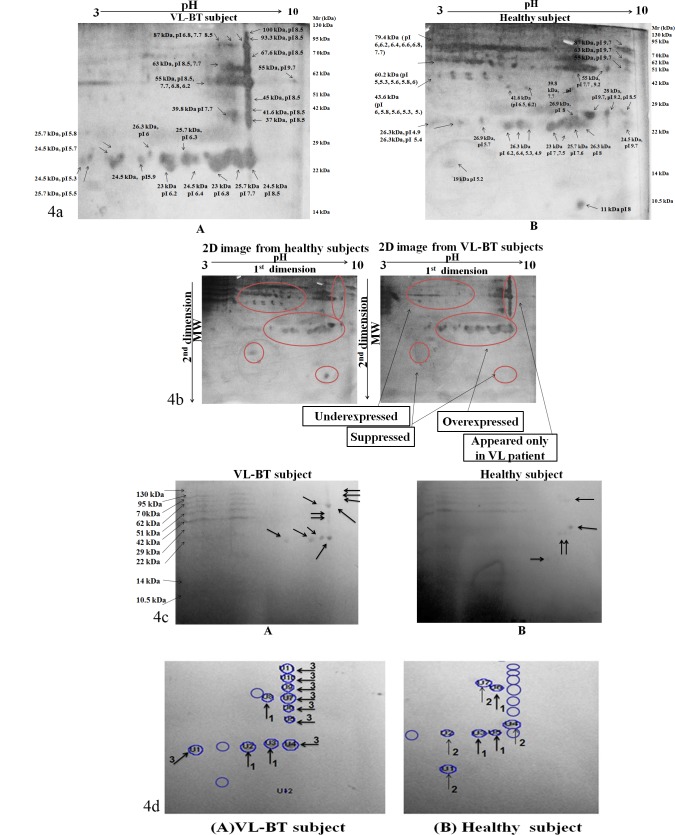
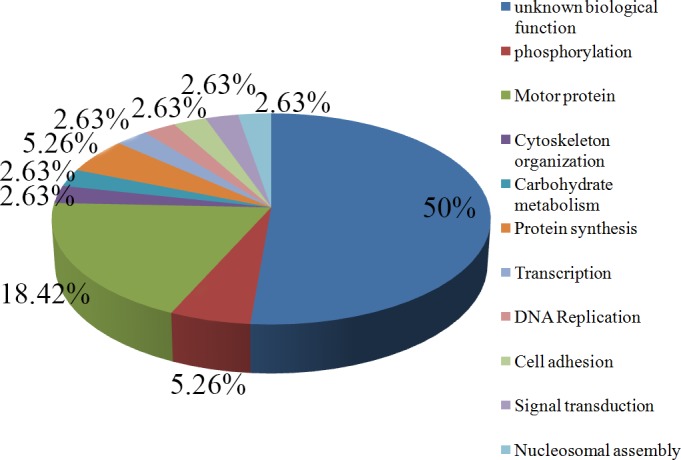
The unreliability of most of the existing antibody-based diagnostic kits to discriminate between active and treated VL cases, relapse situation and reinfection are a major hurdle in controlling the cases of Kala-azar in an endemic area. An antigen targeted diagnostic approaches can be an attractive strategy to overcome these problems. Hence, this study was focused on identifying the Leishmania antigens, lies in circulating immune complex (CICs), can be used for diagnostic as well as prognostic purposes. The present study was conducted on peripheral blood samples of 115 human subjects, based on isolation of CICs. The SDS-PAGE patterns showed an up-regulated expression of 55 kDa and 23 kDa fractions in an antigens obtained from CICs of all clinical and parasitologically proven untreated visceral leishmaniasis patients before treatment (VL-BT), which ensured absolute sensitivity. However, light expressions of these bands were observed in some VL treated cases. To ascertain the prognostic value, 2D expression profiles of circulating antigens were carried out, which revealed 3 upregulated and 12 induced immunoreactive spots. Out of these, ten prominent spots were excised and subjected for enzymatic digestion to generate peptides. Mass spectrometry (MS) analysis successfully explored 20 peptides derived from kinase, kinesin, acetyl Co-A carboxylase, dynein heavy chains (cytoplasmic and axonemal/flagellar), 60S ribosomal protein, nucleoporin protein, RNA polymeraseII, protease gp63, tubulin, DNA polymerase epsilon subunit, GTP-binding protein and tyrosyl-methionyl t-RNA synthetase-like protein and 19 hypothetical protein of unknown function. Presence of L. donovani proteins in circulating antigens were further validated using anti-Ld actin and anti-α tubulin antibody. Besides, MS derived peptides confirmed its reactivity with patients' sera. Therefore, these shortlisted potential antigens can be explored as antigen-based diagnostic as well as prognostic kit.
大多数现有的基于抗体的诊断试剂盒在区分活动性和已治疗的内脏利什曼病病例、复发情况和再感染方面的不可靠性,是在流行地区控制黑热病病例的一个主要障碍。一种针对抗原的诊断方法可能是克服这些问题的有吸引力的策略。因此,本研究的重点是鉴定存在于循环免疫复合物(CIC)中的利什曼原虫抗原,这些抗原可用于诊断和预后目的。本研究基于CIC的分离,对115名人类受试者的外周血样本进行了检测。SDS-PAGE图谱显示,在所有临床和寄生虫学证实的未经治疗的内脏利什曼病患者治疗前(VL-BT)的CIC获得的抗原中,55 kDa和23 kDa组分的表达上调,这确保了绝对敏感性。然而,在一些接受治疗的VL病例中观察到这些条带的表达较弱。为了确定其预后价值,对循环抗原进行了二维表达谱分析,结果显示有3个上调和12个诱导的免疫反应斑点。其中,切除了10个突出的斑点并进行酶切以产生肽段。质谱(MS)分析成功鉴定出20种肽段,分别来自激酶、驱动蛋白、乙酰辅酶A羧化酶、动力蛋白重链(细胞质和轴丝/鞭毛)、60S核糖体蛋白、核孔蛋白、RNA聚合酶II、蛋白酶gp63、微管蛋白、DNA聚合酶ε亚基、GTP结合蛋白和酪氨酰-甲硫氨酰-tRNA合成酶样蛋白,以及19种功能未知的假设蛋白。使用抗杜氏利什曼原虫肌动蛋白和抗α微管蛋白抗体进一步验证了循环抗原中杜氏利什曼原虫蛋白的存在。此外,MS衍生的肽段证实了其与患者血清的反应性。因此,这些入围的潜在抗原可作为基于抗原的诊断和预后试剂盒进行探索。