Haque Ashraful, Engel Jessica, Teichmann Sarah A, Lönnberg Tapio
QIMR Berghofer Medical Research Institute, Herston, Brisbane, Queensland, 4006, Australia.
Wellcome Trust Sanger Institute, Wellcome Genome Campus, Hinxton, Cambridge, CB10 1SA, UK.
Genome Med. 2017 Aug 18;9(1):75. doi: 10.1186/s13073-017-0467-4.
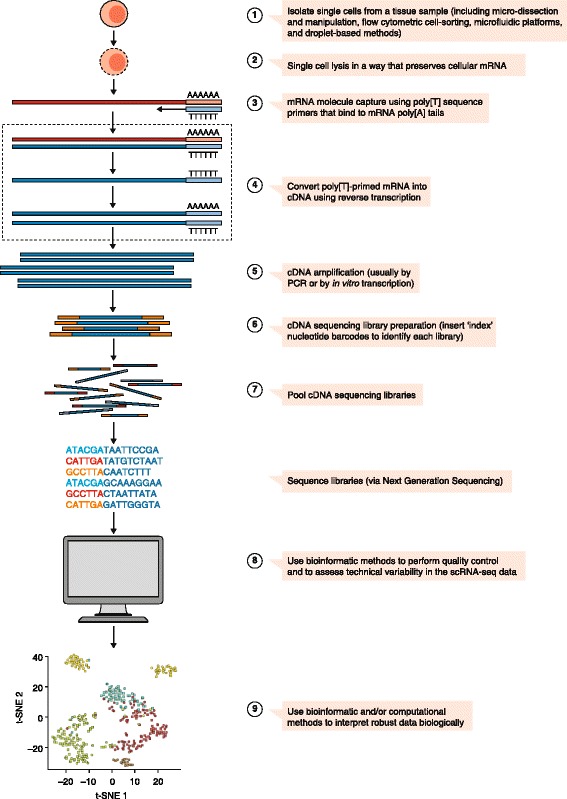
RNA sequencing (RNA-seq) is a genomic approach for the detection and quantitative analysis of messenger RNA molecules in a biological sample and is useful for studying cellular responses. RNA-seq has fueled much discovery and innovation in medicine over recent years. For practical reasons, the technique is usually conducted on samples comprising thousands to millions of cells. However, this has hindered direct assessment of the fundamental unit of biology-the cell. Since the first single-cell RNA-sequencing (scRNA-seq) study was published in 2009, many more have been conducted, mostly by specialist laboratories with unique skills in wet-lab single-cell genomics, bioinformatics, and computation. However, with the increasing commercial availability of scRNA-seq platforms, and the rapid ongoing maturation of bioinformatics approaches, a point has been reached where any biomedical researcher or clinician can use scRNA-seq to make exciting discoveries. In this review, we present a practical guide to help researchers design their first scRNA-seq studies, including introductory information on experimental hardware, protocol choice, quality control, data analysis and biological interpretation.
RNA测序(RNA-seq)是一种用于检测和定量分析生物样品中信使RNA分子的基因组方法,对研究细胞反应很有用。近年来,RNA测序推动了医学领域的诸多发现与创新。出于实际原因,该技术通常在包含数千到数百万个细胞的样本上进行。然而,这阻碍了对生物学基本单位——细胞的直接评估。自2009年发表首篇单细胞RNA测序(scRNA-seq)研究以来,开展了更多此类研究,大多由在湿实验室单细胞基因组学、生物信息学和计算方面具备独特技能的专业实验室进行。然而,随着scRNA-seq平台的商业可得性不断提高,以及生物信息学方法的迅速成熟,如今任何生物医学研究人员或临床医生都能利用scRNA-seq做出令人兴奋的发现。在本综述中,我们提供了一份实用指南,以帮助研究人员设计他们的首个scRNA-seq研究,包括有关实验硬件、方案选择、质量控制、数据分析和生物学解释的介绍性信息。