Hao Yi, Cao Xiaoqian, Ma Chuanxin, Zhang Zetian, Zhao Na, Ali Arbab, Hou Tianqi, Xiang Zhiqian, Zhuang Jian, Wu Sijie, Xing Baoshan, Zhang Zhao, Rui Yukui
Beijing Key Laboratory of Farmland Soil Pollution Prevention and Remediation, College of Resources and Environmental Sciences, China Agricultural UniversityBeijing, China.
Beijing Key Laboratory of Development and Quality Control of Ornamental Crops, Department of Ornamental Horticulture, China Agricultural UniversityBeijing, China.
Front Plant Sci. 2017 Aug 2;8:1332. doi: 10.3389/fpls.2017.01332. eCollection 2017.
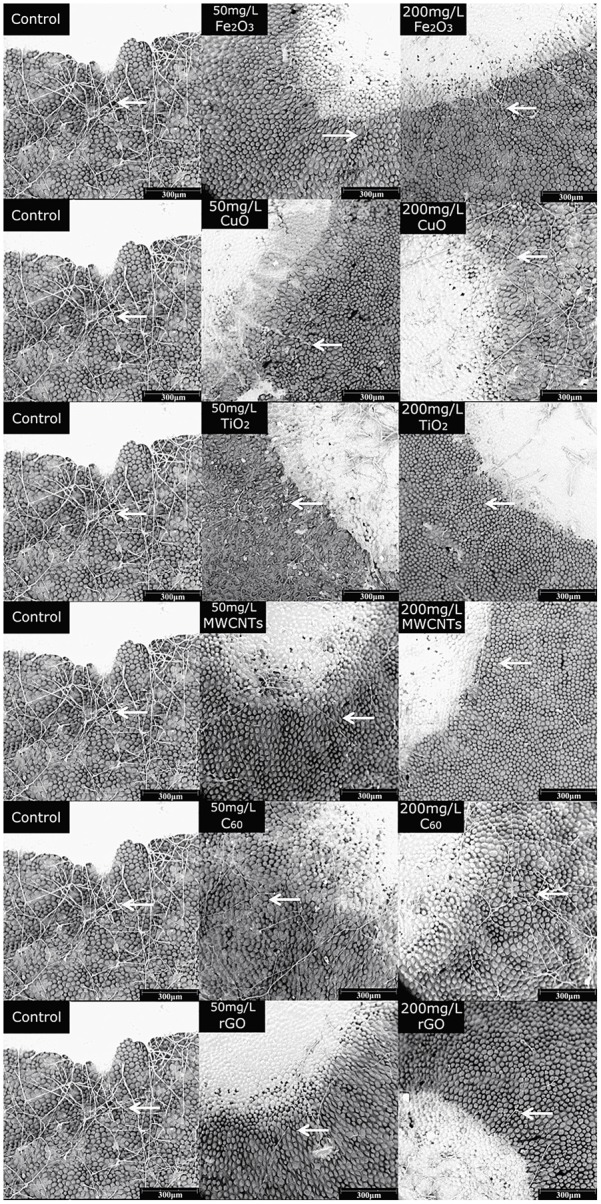
Nanoparticles (NPs) have great potential for use in the fields of biomedicine, building materials, and environmental protection because of their antibacterial properties. However, there are few reports regarding the antifungal activities of NPs on plants. In this study, we evaluated the antifungal roles of NPs against , which is a notorious worldwide fungal pathogen. Three common carbon nanomaterials, multi-walled carbon nanotubes, fullerene, and reduced graphene oxide, and three commercial metal oxidant NPs, copper oxide (CuO) NPs, ferric oxide (FeO) NPs, and titanium oxides (TiO) NPs, were independently added to water-agar plates at 50 and 200-mg/L concentrations. Detached rose petals were inoculated with spores of and co-cultured with each of the six nanomaterials. The sizes of the lesions on infected rose petals were measured at 72 h after inoculation, and the growth of fungi on the rose petals was observed by scanning electron microscopy. The six NPs inhibited the growth of , but different concentrations had different effects: 50 mg/L of fullerene and CuO NPs showed the strongest antifungal properties among the treatments, while 200 mg/L of CuO and FeO showed no significant antifungal activities. Thus, NPs may have antifungal activities that prevent infections in plants, and they could be used as antifungal agents during the growth and post-harvesting of roses and other flowers.
纳米颗粒(NPs)因其抗菌特性在生物医学、建筑材料和环境保护领域具有巨大的应用潜力。然而,关于纳米颗粒对植物的抗真菌活性的报道却很少。在本研究中,我们评估了纳米颗粒对一种全球臭名昭著的真菌病原体[此处原文缺失具体病原体名称]的抗真菌作用。三种常见的碳纳米材料,多壁碳纳米管、富勒烯和还原氧化石墨烯,以及三种商业金属氧化物纳米颗粒,氧化铜(CuO)纳米颗粒、氧化铁(FeO)纳米颗粒和氧化钛(TiO)纳米颗粒,分别以50毫克/升和200毫克/升的浓度添加到水琼脂平板中。将离体玫瑰花瓣接种[此处原文缺失具体病原体名称]的孢子,并与六种纳米材料分别共培养。在接种后72小时测量感染玫瑰花瓣上病斑的大小,并通过扫描电子显微镜观察玫瑰花瓣上真菌的生长情况。六种纳米颗粒均抑制了[此处原文缺失具体病原体名称]的生长,但不同浓度的效果不同:在各处理中,50毫克/升的富勒烯和CuO纳米颗粒显示出最强的抗真菌特性,而200毫克/升的CuO和FeO则未显示出显著的抗真菌活性。因此,纳米颗粒可能具有预防植物感染[此处原文缺失具体病原体名称]的抗真菌活性,并且它们可在玫瑰和其他花卉的生长及收获后用作抗真菌剂。