Shivaraj S M, Deshmukh Rupesh, Bhat Javaid A, Sonah Humira, Bélanger Richard R
National Research Centre on Plant BiotechnologyNew Delhi, India.
Département de Phytologie-Faculté des Sciences de l'Agriculture et de l'Alimentation, Université Laval, QuébecQC, Canada.
Front Plant Sci. 2017 Aug 3;8:1334. doi: 10.3389/fpls.2017.01334. eCollection 2017.
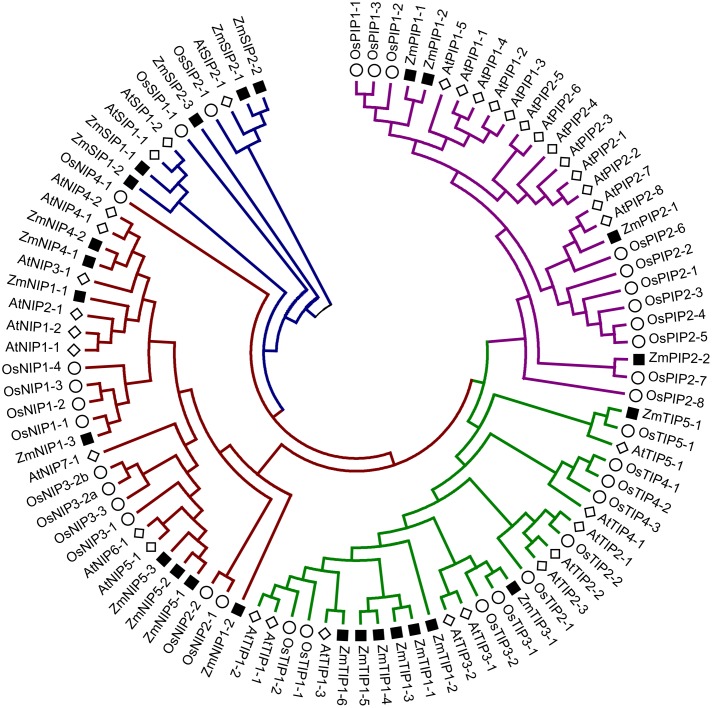
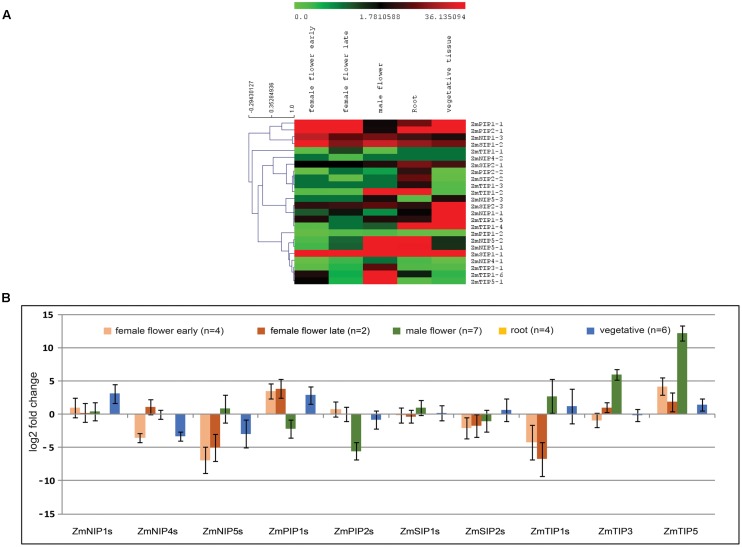
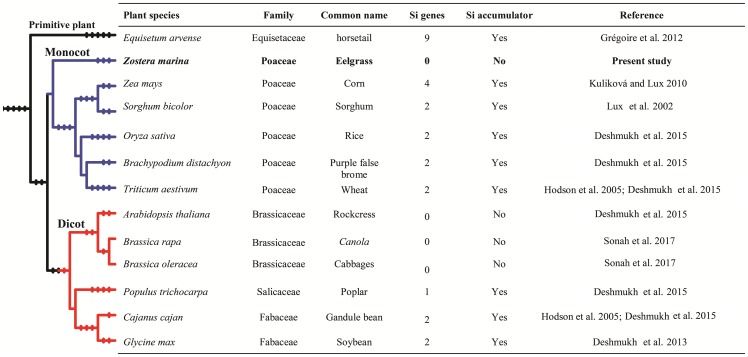
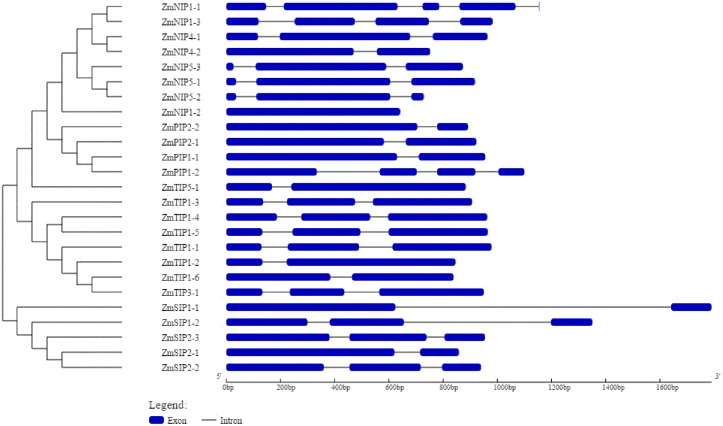
Aquaporins (AQPs) are a class of integral membrane proteins involved in the transport of water and many other small solutes. The AQPs have been extensively studied in many land species obtaining water and nutrients from the soil, but their distribution and evolution have never been investigated in aquatic plant species, where solute assimilation is mostly through the leaves. In this regard, identification of AQPs in the genome of L. (eelgrass), an aquatic ecological model species could reveal important differences underlying solute uptake between land and aquatic species. In the present study, genome-wide analysis led to the identification of 25 AQPs belonging to four subfamilies, plasma membrane intrinsic proteins (PIPs), tonoplast intrinsic proteins (TIPs), nodulin 26-like intrinsic proteins (NIPs), small basic intrinsic proteins (SIPs) in eelgrass. As in other monocots, the XIP subfamily was found to be absent from the eelgrass genome. Further classification of subfamilies revealed a unique distribution pattern, namely the loss of the NIP2 (NIP-III) subgroup, which is known for silicon (Si) transport activity and ubiquitously present in monocot species. This finding has great importance, since the eelgrass population stability in natural niche is reported to be associated with Si concentrations in water. In addition, analysis of available RNA-seq data showed evidence of expression in 24 out of the 25 AQPs across four different tissues such as root, vegetative tissue, male flower and female flower. In contrast to land plants, higher expression of PIPs was observed in shoot compared to root tissues. This is likely explained by the unique plant architecture of eelgrass where most of the nutrients and water are absorbed by shoot rather than root tissues. Similarly, higher expression of the TIP1 and TIP5 families was observed specifically in male flowers suggesting a role in pollen maturation. This genome-wide analysis of AQP distribution, evolution and expression dynamics can find relevance in understanding the adaptation of aquatic and land species to their respective environments.
水通道蛋白(AQPs)是一类参与水和许多其他小分子溶质运输的整合膜蛋白。在许多从土壤中获取水分和养分的陆地物种中,水通道蛋白已得到广泛研究,但在溶质同化主要通过叶片进行的水生植物物种中,其分布和进化从未被研究过。在这方面,在水生生态模式物种鳗草的基因组中鉴定水通道蛋白,可能揭示陆地和水生物种在溶质吸收方面的重要差异。在本研究中,全基因组分析鉴定出鳗草中属于四个亚家族的25种水通道蛋白,即质膜内在蛋白(PIPs)、液泡膜内在蛋白(TIPs)、结节蛋白26样内在蛋白(NIPs)、小碱性内在蛋白(SIPs)。与其他单子叶植物一样,鳗草基因组中未发现XIP亚家族。亚家族的进一步分类揭示了一种独特的分布模式,即NIP2(NIP-III)亚组的缺失,该亚组以硅(Si)运输活性而闻名,普遍存在于单子叶植物物种中。这一发现具有重要意义,因为据报道,鳗草在自然生态位中的种群稳定性与水中的硅浓度有关。此外,对现有RNA测序数据的分析表明,25种水通道蛋白中有24种在根、营养组织、雄花和雌花等四种不同组织中表达。与陆地植物不同,在茎中观察到PIPs的表达高于根组织。这可能是由于鳗草独特的植物结构,其中大部分养分和水分是由茎而不是根组织吸收的。同样,在雄花中特别观察到TIP1和TIP5家族的高表达,表明其在花粉成熟中起作用。这种对水通道蛋白分布、进化和表达动态的全基因组分析,对于理解水生和陆地物种对各自环境的适应性具有重要意义。