Pandey Piyush, Ge Yufeng, Stoerger Vincent, Schnable James C
Department of Biological Systems Engineering, University of Nebraska-LincolnLincoln, NE, United States.
Agricultural Research Division, University of Nebraska-LincolnLincoln, NE, United States.
Front Plant Sci. 2017 Aug 3;8:1348. doi: 10.3389/fpls.2017.01348. eCollection 2017.
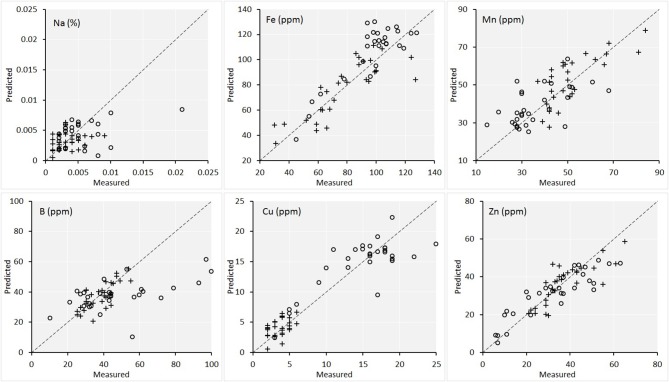
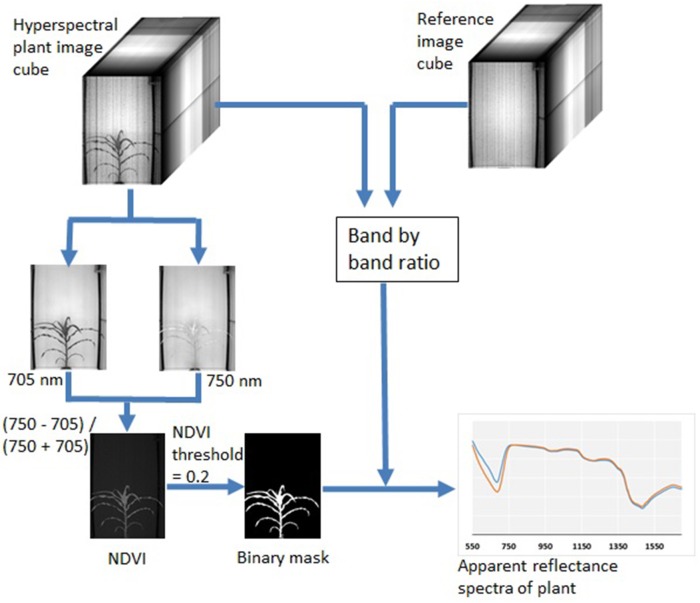
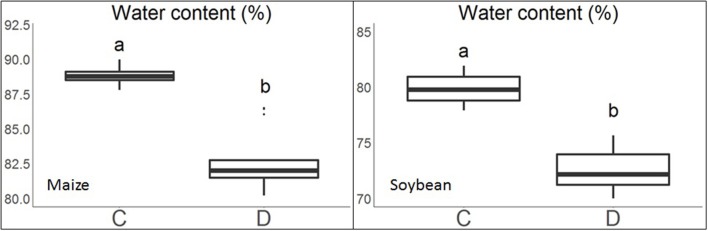
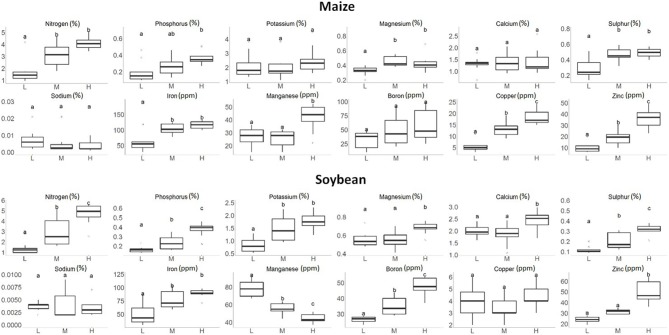
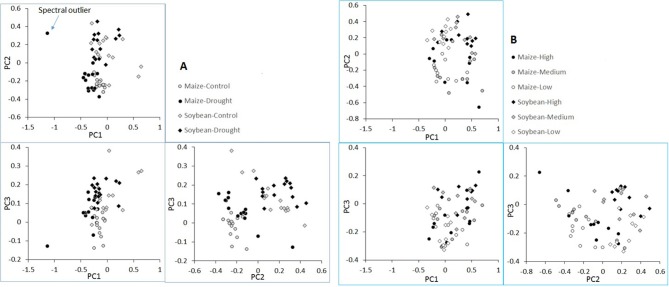
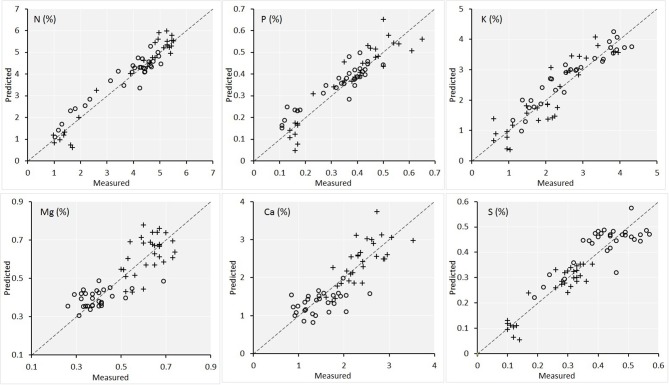
Image-based high-throughput plant phenotyping in greenhouse has the potential to relieve the bottleneck currently presented by phenotypic scoring which limits the throughput of gene discovery and crop improvement efforts. Numerous studies have employed automated RGB imaging to characterize biomass and growth of agronomically important crops. The objective of this study was to investigate the utility of hyperspectral imaging for quantifying chemical properties of maize and soybean plants . These properties included leaf water content, as well as concentrations of macronutrients nitrogen (N), phosphorus (P), potassium (K), magnesium (Mg), calcium (Ca), and sulfur (S), and micronutrients sodium (Na), iron (Fe), manganese (Mn), boron (B), copper (Cu), and zinc (Zn). Hyperspectral images were collected from 60 maize and 60 soybean plants, each subjected to varying levels of either water deficit or nutrient limitation stress with the goal of creating a wide range of variation in the chemical properties of plant leaves. Plants were imaged on an automated conveyor belt system using a hyperspectral imager with a spectral range from 550 to 1,700 nm. Images were processed to extract reflectance spectrum from each plant and partial least squares regression models were developed to correlate spectral data with chemical data. Among all the chemical properties investigated, water content was predicted with the highest accuracy [ = 0.93 and RPD (Ratio of Performance to Deviation) = 3.8]. All macronutrients were also quantified satisfactorily ( from 0.69 to 0.92, RPD from 1.62 to 3.62), with N predicted best followed by P, K, and S. The micronutrients group showed lower prediction accuracy ( from 0.19 to 0.86, RPD from 1.09 to 2.69) than the macronutrient groups. Cu and Zn were best predicted, followed by Fe and Mn. Na and B were the only two properties that hyperspectral imaging was not able to quantify satisfactorily ( < 0.3 and RPD < 1.2). This study suggested the potential usefulness of hyperspectral imaging as a high-throughput phenotyping technology for plant chemical traits. Future research is needed to test the method more thoroughly by designing experiments to vary plant nutrients individually and cover more plant species, genotypes, and growth stages.
温室中基于图像的高通量植物表型分析有潜力缓解目前由表型评分所造成的瓶颈,表型评分限制了基因发现和作物改良工作的通量。许多研究已采用自动RGB成像来表征具有重要农艺价值作物的生物量和生长情况。本研究的目的是探究高光谱成像在量化玉米和大豆植株化学性质方面的效用。这些性质包括叶片含水量,以及大量营养素氮(N)、磷(P)、钾(K)、镁(Mg)、钙(Ca)和硫(S)的浓度,还有微量营养素钠(Na)、铁(Fe)、锰(Mn)、硼(B)、铜(Cu)和锌(Zn)的浓度。从60株玉米和60株大豆植株采集了高光谱图像,每株植株都遭受了不同程度的水分亏缺或养分限制胁迫,目的是在植物叶片的化学性质上创造出广泛的变化。使用光谱范围为550至1700 nm的高光谱成像仪在自动传送带系统上对植株进行成像。对图像进行处理以提取每株植物的反射光谱,并建立偏最小二乘回归模型,将光谱数据与化学数据相关联。在所有研究的化学性质中,含水量的预测精度最高[校正决定系数 = 0.93,性能与偏差比(RPD)= 3.8]。所有大量营养素也都得到了令人满意的量化(校正决定系数从0.69到0.92,RPD从1.62到3.62),其中氮的预测最佳,其次是磷、钾和硫。微量营养素组的预测精度低于大量营养素组(校正决定系数从0.19到0.86,RPD从1.09到2.69)。铜和锌的预测最佳,其次是铁和锰。钠和硼是高光谱成像无法令人满意地量化的仅有的两个性质(校正决定系数 < 0.3,RPD < 1.2)。本研究表明高光谱成像作为一种用于植物化学性状的高通量表型分析技术具有潜在的实用性。未来需要通过设计单独改变植物养分并涵盖更多植物物种、基因型和生长阶段的实验来更全面地测试该方法。