• 文献检索
  • 文档翻译
  • 深度研究
  • 学术资讯
  • Suppr Zotero 插件Zotero 插件
  • 邀请有礼
  • 套餐&价格
  • 历史记录
应用&插件
Suppr Zotero 插件Zotero 插件浏览器插件Mac 客户端Windows 客户端微信小程序
定价
高级版会员购买积分包购买API积分包
服务
文献检索文档翻译深度研究API 文档MCP 服务
关于我们
关于 Suppr公司介绍联系我们用户协议隐私条款
关注我们

Suppr 超能文献

核心技术专利:CN118964589B侵权必究
粤ICP备2023148730 号-1Suppr @ 2026

文献检索

告别复杂PubMed语法,用中文像聊天一样搜索,搜遍4000万医学文献。AI智能推荐,让科研检索更轻松。

立即免费搜索

文件翻译

保留排版,准确专业,支持PDF/Word/PPT等文件格式,支持 12+语言互译。

免费翻译文档

深度研究

AI帮你快速写综述,25分钟生成高质量综述,智能提取关键信息,辅助科研写作。

立即免费体验

清除行为与神经性厌食症女性患者主观睡眠质量受损有关:一项前瞻性观察研究。

Purging behaviors relate to impaired subjective sleep quality in female patients with anorexia nervosa: a prospective observational study.

作者信息

Tanahashi Tokusei, Kawai Keisuke, Tatsushima Keita, Saeki Chihiro, Wakabayashi Kunie, Tamura Naho, Ando Tetsuya, Ishikawa Toshio

机构信息

Department of Psychosomatic Medicine, Kohnodai Hospital, National Center for Global Health and Medicine, 1-7-1 Kohnodai, Ichikawa, Chiba 272-8516 Japan.

Department of Psychosomatic Medicine, Saiseikai Fukuoka General Hospital, 1-3-46 Tenjin, Chuo-ku, Fukuoka 810-0001 Japan.

出版信息

Biopsychosoc Med. 2017 Aug 16;11:22. doi: 10.1186/s13030-017-0107-7. eCollection 2017.

DOI:10.1186/s13030-017-0107-7
PMID:28824707
原文链接:https://pmc.ncbi.nlm.nih.gov/articles/PMC5558764/
Abstract

BACKGROUND

We examined how purging behaviors relate to subjective sleep quality and sleep patterns and how symptoms of disordered eating behaviors relate to global sleep quality in female patients with anorexia nervosa (AN).

METHODS

Participants were new consecutive female inpatients with a primary diagnosis of AN admitted to the Department of Psychosomatic Medicine at Kohnodai Hospital between June 26 and December 25, 2015. We recorded patients' habitual eating behaviors, laxative overuse, or uretic misuse, and administered the Japanese versions of the Pittsburgh Sleep Quality Index (PSQI-J) and Center for Epidemiologic Studies Depression Scale. Raw PSQI-J data were used to determine sleep patterns (sleep-onset time, wake-up time, and sleep duration). To examine how purging behaviors related to sleep quality, we compared variables between AN restricting type (ANr) and AN binge-eating/purging type (ANbp). Spearman's rank correlation analysis was used to examine which potential factors influence global PSQI-J score.

RESULTS

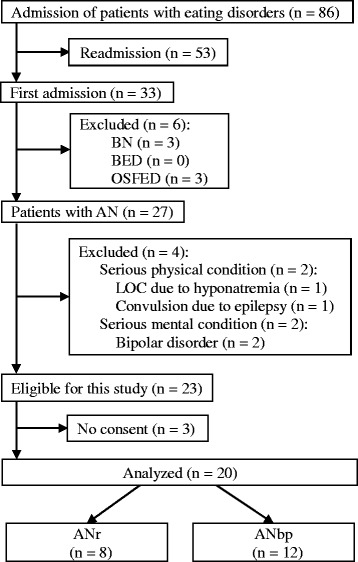
Participants were 20 patients, of whom 12 had ANbp. Two ANr patients (25%) had global PSQI-J scores greater than 5, compared to 9 ANbp patients (75%;  < 0.05). Circadian rhythm disruption and abnormal sleep duration were significantly greater in ANbp patients than in ANr patients ( < 0.05). Global PSQI-J was significantly correlated with a diagnosis of ANbp ( = 0.525;  < 0.05), vomiting ( = 0.561;  < 0.05), and duration of illness ( = 0.536;  < 0.05).

CONCLUSIONS

ANbp patients had worse global sleep quality and greater disrupted sleep than did ANr patients. This suggests that treatments focusing on sleep would be useful, especially for ANbp patients. Furthermore, vomiting and duration of illness should be considered essential factors related to impaired global sleep quality.

TRIAL REGISTRATION

Not applicable.

摘要

背景

我们研究了清除行为与主观睡眠质量和睡眠模式之间的关系,以及饮食失调行为症状与神经性厌食症(AN)女性患者整体睡眠质量之间的关系。

方法

参与者为2015年6月26日至12月25日期间连续入住小田医院身心医学科、初步诊断为AN的新入院女性患者。我们记录了患者的习惯性饮食行为、泻药过度使用或利尿剂滥用情况,并使用了匹兹堡睡眠质量指数日语版(PSQI-J)和流行病学研究中心抑郁量表。原始PSQI-J数据用于确定睡眠模式(入睡时间、起床时间和睡眠时间)。为了研究清除行为与睡眠质量之间的关系,我们比较了AN限制型(ANr)和AN暴饮暴食/清除型(ANbp)之间的变量。采用Spearman等级相关分析来研究哪些潜在因素会影响整体PSQI-J评分。

结果

参与者为20名患者,其中12名患有ANbp。两名ANr患者(25%)的整体PSQI-J评分大于5,而9名ANbp患者(75%;P<0.05)。ANbp患者的昼夜节律紊乱和异常睡眠时间明显高于ANr患者(P<0.05)。整体PSQI-J与ANbp诊断(r=0.525;P<0.05)、呕吐(r=0.561;P<0.05)和病程(r=0.536;P<0.05)显著相关。

结论

ANbp患者的整体睡眠质量比ANr患者更差,睡眠干扰更大。这表明专注于睡眠的治疗将是有用的,尤其是对于ANbp患者。此外,呕吐和病程应被视为与整体睡眠质量受损相关的重要因素。

试验注册

不适用。

https://cdn.ncbi.nlm.nih.gov/pmc/blobs/db69/5558764/cfd9a727d2f1/13030_2017_107_Fig1_HTML.jpg

相似文献

1
Purging behaviors relate to impaired subjective sleep quality in female patients with anorexia nervosa: a prospective observational study.清除行为与神经性厌食症女性患者主观睡眠质量受损有关:一项前瞻性观察研究。
Biopsychosoc Med. 2017 Aug 16;11:22. doi: 10.1186/s13030-017-0107-7. eCollection 2017.
2
Neurocognitive Impairments Are More Severe in the Binge-Eating/Purging Anorexia Nervosa Subtype Than in the Restricting Subtype.与限制型神经性厌食症亚型相比,暴饮暴食/清除型神经性厌食症亚型的神经认知障碍更为严重。
Front Psychiatry. 2018 Apr 16;9:138. doi: 10.3389/fpsyt.2018.00138. eCollection 2018.
3
Investigation of factors associated to crossover from anorexia nervosa restricting type (ANR) and anorexia nervosa binge-purging type (ANBP) to bulimia nervosa and comparison of bulimia nervosa patients with or without previous ANR or ANBP.探讨从神经性厌食症限制型(ANR)和神经性贪食症暴食-清泻型(ANBP)向神经性贪食症转变的相关因素,并比较有或无既往 ANR 或 ANBP 的神经性贪食症患者。
Compr Psychiatry. 2011 Jan-Feb;52(1):56-62. doi: 10.1016/j.comppsych.2010.05.002. Epub 2010 Jul 1.
4
Network analysis of specific psychopathology and psychiatric symptoms in patients with anorexia nervosa.网络分析神经性厌食症患者特定精神病理学和精神症状。
Eur Eat Disord Rev. 2019 Jan;27(1):24-33. doi: 10.1002/erv.2633. Epub 2018 Jul 31.
5
The Gut Microbiome and Metabolomics Profiles of Restricting and Binge-Purging Type Anorexia Nervosa.限制型与暴食-清除型神经性厌食症的肠道微生物组和代谢组学特征。
Nutrients. 2021 Feb 4;13(2):507. doi: 10.3390/nu13020507.
6
Differences in Cortisol Awakening Response between Binge-Purging and Restrictive Patients with Anorexia Nervosa.贪食-清泻型和限制型神经性厌食症患者皮质醇觉醒反应的差异。
Eur Eat Disord Rev. 2017 Jan;25(1):13-18. doi: 10.1002/erv.2485. Epub 2016 Oct 27.
7
Seasonal BMI differences between restrictive and purging anorexia nervosa subtypes.限制型与清除型神经性厌食亚型患者的季节性 BMI 差异。
Int J Eat Disord. 2015 Jan;48(1):35-41. doi: 10.1002/eat.22357. Epub 2014 Oct 18.
8
A comparison of food-based decision-making between restricting and binge-eating/purging subtypes of anorexia nervosa.限制型与暴食-清除型神经性厌食障碍患者基于食物的决策比较。
Int J Eat Disord. 2020 Oct;53(10):1751-1756. doi: 10.1002/eat.23359. Epub 2020 Aug 12.
9
Continuous glucose monitoring for detection of glycemic variability, hypoglycemia, and hyperglycemia in women with eating disorders.连续血糖监测用于检测饮食失调女性的血糖变异性、低血糖和高血糖。
Biopsychosoc Med. 2022 Oct 27;16(1):22. doi: 10.1186/s13030-022-00251-4.
10
Habitual starvation and provocative behaviors: two potential routes to extreme suicidal behavior in anorexia nervosa.习惯性饥饿和挑衅行为:神经性厌食症中两种导致极端自杀行为的潜在途径。
Behav Res Ther. 2010 Jul;48(7):634-45. doi: 10.1016/j.brat.2010.03.016. Epub 2010 Mar 24.

引用本文的文献

1
Sleep disturbances in anorexia nervosa.神经性厌食症中的睡眠障碍。
Eur Eat Disord Rev. 2025 Mar;33(2):318-342. doi: 10.1002/erv.3148. Epub 2024 Oct 23.
2
Assessment of the renal function of patients with anorexia nervosa.神经性厌食症患者的肾功能评估。
Biopsychosoc Med. 2024 Sep 29;18(1):19. doi: 10.1186/s13030-024-00316-6.
3
Engagement in binge eating and fasting associated with poorer sleep quality in an online sample of adults.在一个成年人在线样本中,暴饮暴食和禁食与较差的睡眠质量有关。

本文引用的文献

1
Sleep and Eating Disorders.睡眠与饮食失调。
Curr Psychiatry Rep. 2016 Oct;18(10):92. doi: 10.1007/s11920-016-0728-8.
2
Subjective Sleep Quality as a Possible Mediator in the Relationship between Personality Traits and Depressive Symptoms in Middle-Aged Adults.主观睡眠质量作为中年成年人性格特质与抑郁症状关系的潜在中介因素
PLoS One. 2016 Jun 10;11(6):e0157238. doi: 10.1371/journal.pone.0157238. eCollection 2016.
3
The role of complementary and alternative medicine in the treatment of eating disorders: A systematic review.
J Eat Disord. 2024 Jun 10;12(1):76. doi: 10.1186/s40337-024-01028-6.
4
Fear of COVID-19, insomnia, and eating disorder symptoms among Iranian college students.伊朗大学生对新冠病毒的恐惧、失眠及饮食失调症状
J Affect Disord Rep. 2023 Jul;13:100601. doi: 10.1016/j.jadr.2023.100601. Epub 2023 May 20.
5
Associations of smartphone addiction, chronotype, sleep quality, and risk of eating disorders among university students: A cross-sectional study from Sharjah/United Arab Emirates.大学生中智能手机成瘾、昼夜节律类型、睡眠质量与饮食失调风险的关联:来自阿联酋沙迦的一项横断面研究
Heliyon. 2023 Jan 9;9(1):e12882. doi: 10.1016/j.heliyon.2023.e12882. eCollection 2023 Jan.
6
A systematic review with meta-analyses of the relationship between recurrent binge eating and sleep parameters.一项关于复发性暴饮暴食与睡眠参数之间关系的系统评价及荟萃分析。
Int J Obes (Lond). 2023 Mar;47(3):145-164. doi: 10.1038/s41366-022-01250-9. Epub 2022 Dec 29.
7
Sleep disturbances in anorexia nervosa subtypes in adolescence.青少年神经性厌食症亚型中的睡眠障碍。
Eat Weight Disord. 2021 Aug;26(6):1845-1852. doi: 10.1007/s40519-020-01033-z. Epub 2020 Oct 6.
8
Correction to: Purging behaviors relate to impaired subjective sleep quality in female patients with anorexia nervosa: a prospective observational study.对《清除行为与神经性厌食症女性患者主观睡眠质量受损的关系:一项前瞻性观察研究》的更正
Biopsychosoc Med. 2018 Mar 15;12:5. doi: 10.1186/s13030-018-0124-1. eCollection 2018.
补充和替代医学在饮食失调治疗中的作用:一项系统综述。
Eat Behav. 2016 Apr;21:179-88. doi: 10.1016/j.eatbeh.2016.03.002. Epub 2016 Mar 6.
4
Electrolyte and acid-base abnormalities associated with purging behaviors.与清除行为相关的电解质和酸碱异常。
Int J Eat Disord. 2016 Mar;49(3):311-8. doi: 10.1002/eat.22503. Epub 2016 Feb 15.
5
Sleep disturbances compared to traditional risk factors for diabetes development: Systematic review and meta-analysis.与传统的糖尿病发展风险因素相比,睡眠障碍:系统评价和荟萃分析。
Sleep Med Rev. 2016 Dec;30:11-24. doi: 10.1016/j.smrv.2015.10.002. Epub 2015 Oct 21.
6
The Impact of Nocturnal Hypoglycemia on Sleep in Subjects With Type 2 Diabetes.2 型糖尿病患者夜间低血糖对睡眠的影响。
Diabetes Care. 2015 Nov;38(11):2151-7. doi: 10.2337/dc15-0907. Epub 2015 Sep 25.
7
Recent Advances in Developmental and Risk Factor Research on Eating Disorders.饮食失调的发育与风险因素研究的最新进展
Curr Psychiatry Rep. 2015 Jun;17(6):42. doi: 10.1007/s11920-015-0585-x.
8
Persistence of poor sleep predicts the severity of the clinical condition after 6months of standard treatment in patients with eating disorders.
Eat Behav. 2015 Aug;18:16-9. doi: 10.1016/j.eatbeh.2015.03.003. Epub 2015 Mar 27.
9
Psychiatric co-morbidity in women presenting across the continuum of disordered eating.患有饮食失调症的女性中的精神共病情况。
Eat Behav. 2014 Dec;15(4):686-93. doi: 10.1016/j.eatbeh.2014.08.023.
10
Self-reported sleep duration and weight-control strategies among U.S. high school students.美国高中生的自我报告睡眠时间和体重控制策略。
Sleep. 2013 Aug 1;36(8):1139-45. doi: 10.5665/sleep.2872.