Westgarth Carri, Christley Robert M, Marvin Garry, Perkins Elizabeth
Department of Epidemiology and Population Health, Institute of Infection and Global Health, University of Liverpool, Liverpool L69 7ZX, UK.
Institute of Veterinary Science, University of Liverpool, Liverpool L69 7ZX, UK.
Int J Environ Res Public Health. 2017 Aug 19;14(8):936. doi: 10.3390/ijerph14080936.
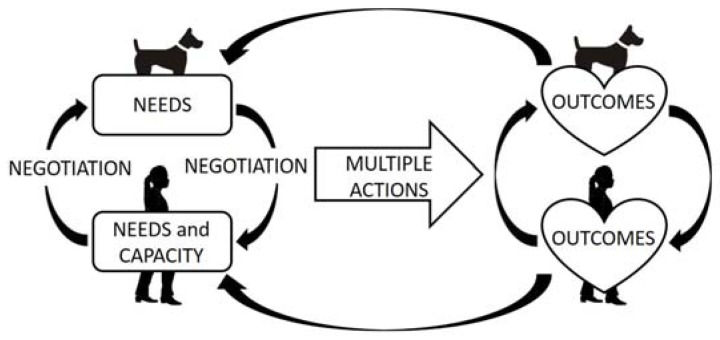
Dog walking is a popular everyday physical activity. Dog owners are generally more active than non-owners, but some rarely walk with their dog. The strength of the dog-owner relationship is known to be correlated with dog walking, and this qualitative study investigates why. Twenty-six interviews were combined with autoethnography of dog walking experiences. Dog walking was constructed as "for the dog", however, owners represented their dog's needs in a way which aligned with their own. Central to the construction of need was perceptions of dog personality and behaviour. Owners reported deriving positive outcomes from dog walking, most notably, feelings of "happiness", but these were "contingent" on the perception that their dogs were enjoying the experience. Owner physical activity and social interaction were secondary bonuses but rarely motivating. Perceptions and beliefs of owners about dog walking were continually negotiated, depending on how the needs of the owner and dog were constructed at that time. Complex social interactions with the "significant other" of a pet can strongly motivate human health behaviour. Potential interventions to promote dog walking need to account for this complexity and the effect of the dog-owner relationship on owner mental wellbeing.
遛狗是一项广受欢迎的日常体育活动。狗主人通常比非狗主人更活跃,但有些主人很少与他们的狗一起散步。众所周知,主人与狗之间关系的紧密程度与遛狗行为相关,本定性研究旨在探究其原因。研究结合了26次访谈以及对遛狗经历的自我民族志研究。遛狗被视为“为了狗”,然而,主人表达他们狗狗需求的方式却与自身需求相一致。需求构建的核心是对狗的个性和行为的认知。主人报告称从遛狗中获得了积极的结果,最显著的是“快乐”的感觉,但这些感觉“取决于”他们认为自己的狗享受这段经历的认知。主人的身体活动和社交互动是次要的额外收获,但很少成为动力。主人对遛狗的认知和信念会不断进行协商,这取决于当时主人和狗的需求是如何构建的。与宠物这个“重要他人”的复杂社会互动能够有力地激发人类的健康行为。促进遛狗的潜在干预措施需要考虑到这种复杂性以及主人与狗的关系对主人心理健康的影响。