Wilkes Justin G, Alexander Matthew S, Cullen Joseph J
Departments of Surgery and Radiation Oncology, University of Iowa Carver College of Medicine, Iowa City, IA 52245, USA.
Veterans Affairs Medical Center, Iowa City, IA 52245, USA.
Antioxidants (Basel). 2017 Aug 19;6(3):66. doi: 10.3390/antiox6030066.
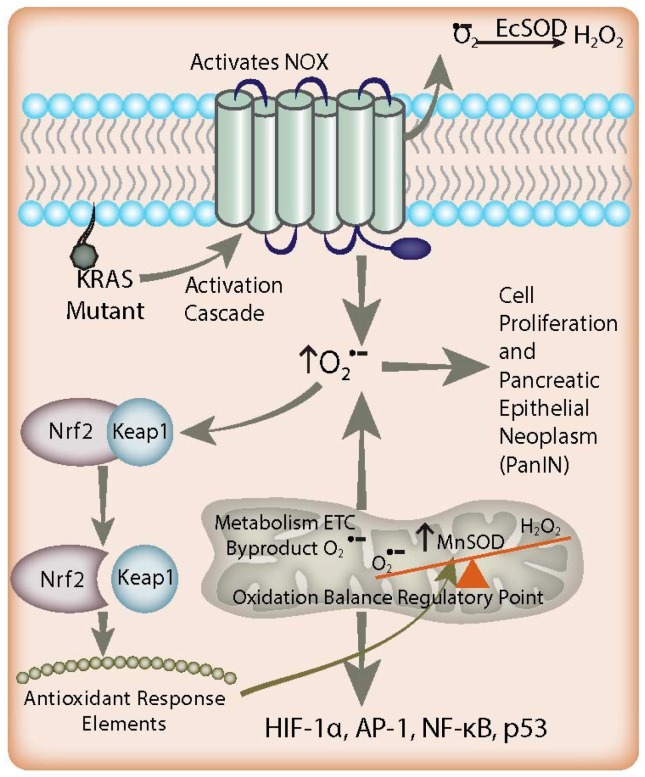
The incidence of pancreatic cancer is increasing as the population ages but treatment advancements continue to lag far behind. The majority of pancreatic cancer patients have a K- oncogene mutation causing a shift in the redox state of the cell, favoring malignant proliferation. This mutation is believed to lead to nicotinamide adenine dinucleotide phosphate (NADPH) oxidase activation and superoxide overproduction, generating tumorigenic behavior. Superoxide dismutases (SODs) have been studied for their ability to manage the oxidative state of the cell by dismuting superoxide and inhibiting signals for pancreatic cancer growth. In particular, manganese superoxide dismutase has clearly shown importance in cell cycle regulation and has been found to be abnormally low in pancreatic cancer cells as well as the surrounding stromal tissue. Likewise, extracellular superoxide dismutase expression seems to favor suppression of pancreatic cancer growth. With an increased understanding of the redox behavior of pancreatic cancer and key regulators, new treatments are being developed with specific targets in mind. This review summarizes what is known about superoxide dismutases in pancreatic cancer and the most current treatment strategies to be advanced from this knowledge.
随着人口老龄化,胰腺癌的发病率正在上升,但治疗进展仍远远滞后。大多数胰腺癌患者存在K-癌基因突变,导致细胞氧化还原状态发生改变,有利于恶性增殖。据信这种突变会导致烟酰胺腺嘌呤二核苷酸磷酸(NADPH)氧化酶激活和超氧化物过量产生,从而产生致瘤行为。超氧化物歧化酶(SODs)因其通过歧化超氧化物和抑制胰腺癌生长信号来调节细胞氧化状态的能力而受到研究。特别是,锰超氧化物歧化酶在细胞周期调控中已明确显示出重要性,并且在胰腺癌细胞以及周围基质组织中发现其水平异常低。同样,细胞外超氧化物歧化酶的表达似乎有利于抑制胰腺癌生长。随着对胰腺癌氧化还原行为和关键调节因子的认识不断增加,正在开发针对特定靶点的新治疗方法。本综述总结了关于胰腺癌中超氧化物歧化酶的已知信息以及基于这些知识推进的最新治疗策略。