Martins Sara, Montiel-Jorda Alvaro, Cayrel Anne, Huguet Stéphanie, Roux Christine Paysant-Le, Ljung Karin, Vert Grégory
Institute for Integrative Biology of the Cell (I2BC), CNRS/CEA/Univ. Paris Sud, Université Paris-Saclay, 91198, Gif-sur-Yvette, France.
Institute of Plant Sciences Paris-Saclay IPS2, CNRS, INRA, Université Paris-Sud, Université Evry, Université Paris-Saclay, Bâtiment 630, 91405, Orsay, France.
Nat Commun. 2017 Aug 21;8(1):309. doi: 10.1038/s41467-017-00355-4.
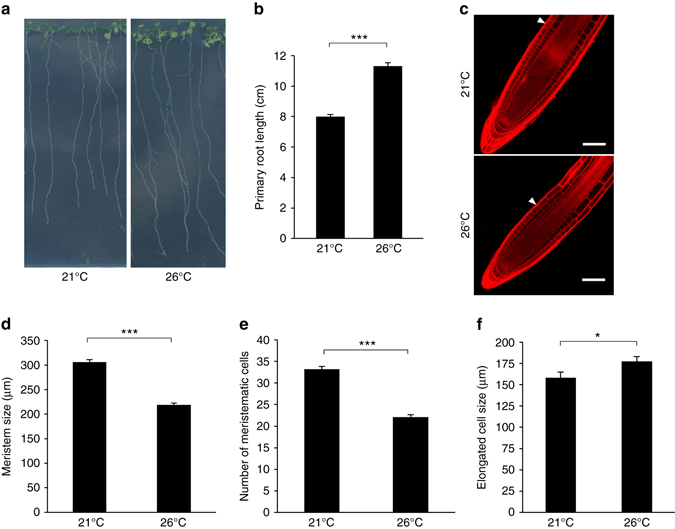
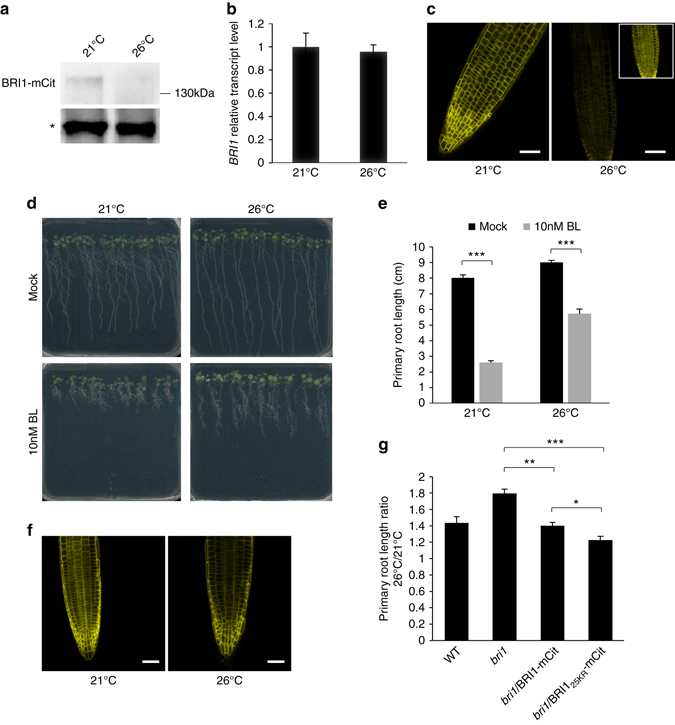
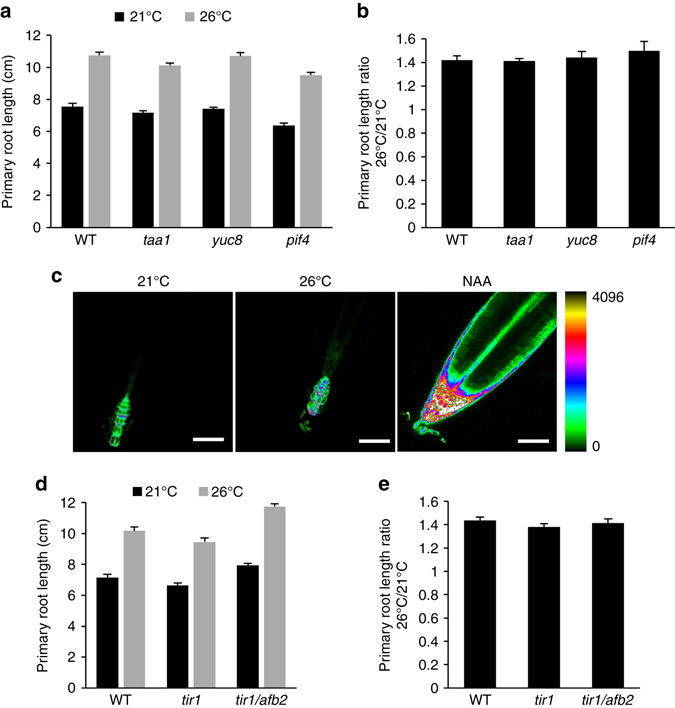
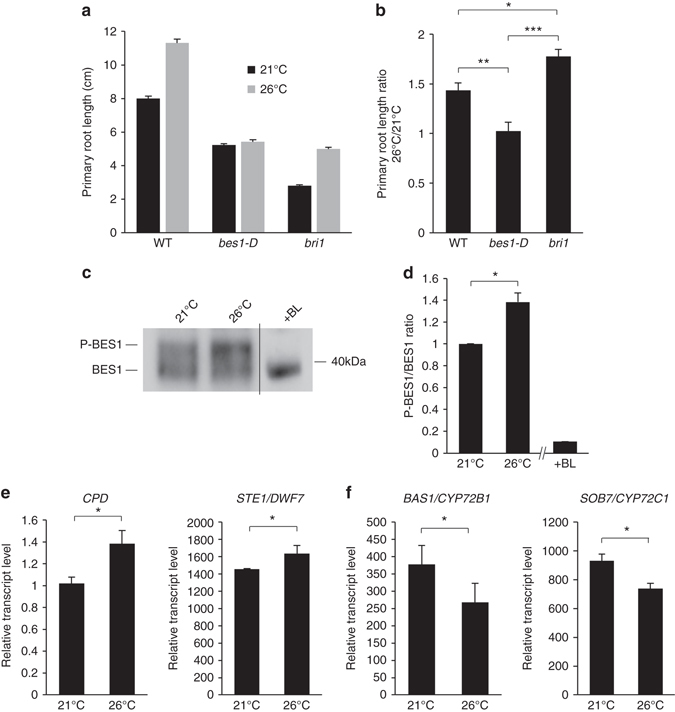
Due to their sessile nature, plants have to cope with and adjust to their fluctuating environment. Temperature elevation stimulates the growth of Arabidopsis aerial parts. This process is mediated by increased biosynthesis of the growth-promoting hormone auxin. How plant roots respond to elevated ambient temperature is however still elusive. Here we present strong evidence that temperature elevation impinges on brassinosteroid hormone signaling to alter root growth. We show that elevated temperature leads to increased root elongation, independently of auxin or factors known to drive temperature-mediated shoot growth. We further demonstrate that brassinosteroid signaling regulates root responses to elevated ambient temperature. Increased growth temperature specifically impacts on the level of the brassinosteroid receptor BRI1 to downregulate brassinosteroid signaling and mediate root elongation. Our results establish that BRI1 integrates temperature and brassinosteroid signaling to regulate root growth upon long-term changes in environmental conditions associated with global warming.Moderate heat stimulates the growth of Arabidopsis shoots in an auxin-dependent manner. Here, Martins et al. show that elevated ambient temperature modifies root growth by reducing the BRI1 brassinosteroid-receptor protein level and downregulating brassinosteroid signaling.
由于植物固着生长的特性,它们必须应对并适应不断变化的环境。温度升高会刺激拟南芥地上部分的生长。这一过程是由促进生长的激素生长素生物合成增加介导的。然而,植物根系如何响应环境温度升高仍不清楚。在此,我们提供了有力证据,表明温度升高会影响油菜素内酯激素信号传导,从而改变根系生长。我们发现,温度升高会导致根伸长增加,这与生长素或已知驱动温度介导的地上部分生长的因素无关。我们进一步证明,油菜素内酯信号传导调节根系对环境温度升高的响应。生长温度升高会特别影响油菜素内酯受体BRI1的水平,从而下调油菜素内酯信号传导并介导根伸长。我们的结果表明,BRI1整合温度和油菜素内酯信号传导,以在与全球变暖相关的环境条件长期变化时调节根系生长。适度高温以生长素依赖的方式刺激拟南芥地上部分的生长。在此,马丁斯等人表明,环境温度升高通过降低BRI1油菜素内酯受体蛋白水平和下调油菜素内酯信号传导来改变根系生长。