Di Palma Elena, Tepedino Michele, Chimenti Claudio, Tartaglia Gianluca M, Sforza Chiarella
DDS, PhD, Department of Biotechnological and Applied Clinical Sciences, University of L'Aquila, Italy.
Professor, Department of Biotechnological and Applied Clinical Sciences, University of L'Aquila, Italy.
J Clin Exp Dent. 2017 Jul 1;9(7):e886-e891. doi: 10.4317/jced.53986. eCollection 2017 Jul.
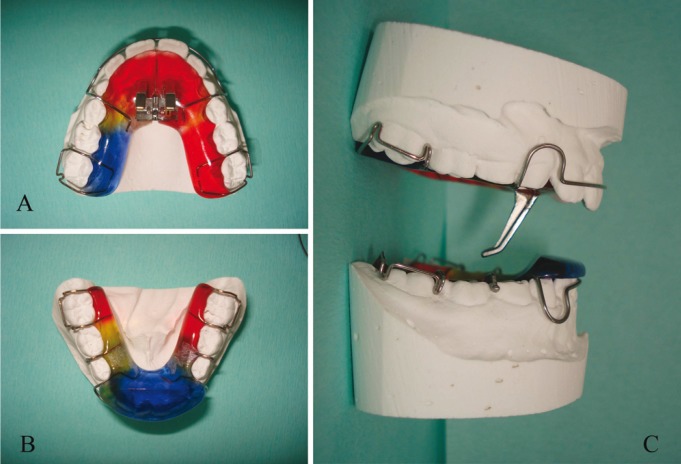
The purpose of this study was to examine surface electromyographic (sEMG) activity of masticatory muscles before and after functional orthopaedic therapy with Sander appliance.
Ten adolescents (5 girls, 5 boys) with an Angle Class II, division I malocclusion, 9-13 years old, were submitted to sEMG before and after functional orthopaedic therapy. To verify the neuromuscular equilibrium, the standardized EMG activities of right and left masseter and anterior temporal muscles were recorded during maximum voluntary clench, and analysed calculating: POC (index of the symmetric distribution of the muscular activity determined by the occlusion); TC (index of presence of mandibular torque) and Ac (index suggesting the position of occlusal barycentre). The total muscular activity was also calculated. Pre- and post- functional therapy data were compared with Wilcoxon Signed-Rank Test.
Before treatment, all subjects had a good neuromuscular equilibrium, which was not altered by treatment.
sEMG evaluations allow to quantify the impact of occlusion on masticatory muscle activity and to control that the functional orthopaedic therapy maintain a good muscular coordination. Functional appliance, Sander appliance, electromyography, masticatory muscles.
本研究旨在探讨使用桑德矫治器进行功能性正畸治疗前后咀嚼肌的表面肌电图(sEMG)活动情况。
选取10名年龄在9至13岁、安氏II类1分类错牙合畸形的青少年(5名女孩,5名男孩),在功能性正畸治疗前后进行sEMG检查。为验证神经肌肉平衡,在最大自主紧咬时记录左右咬肌和颞前肌的标准化肌电图活动,并通过计算分析:POC(由咬合确定的肌肉活动对称分布指数);TC(下颌扭矩存在指数)和Ac(提示咬合重心位置的指数)。还计算了总肌肉活动。采用Wilcoxon符号秩检验比较功能性治疗前后的数据。
治疗前,所有受试者均具有良好的神经肌肉平衡,治疗后未发生改变。
sEMG评估可量化咬合对咀嚼肌活动的影响,并控制功能性正畸治疗维持良好的肌肉协调性。功能性矫治器、桑德矫治器、肌电图、咀嚼肌。