Bryce Caleb M, Wilmers Christopher C, Williams Terrie M
Department of Ecology & Evolutionary Biology, University of California, Santa Cruz, CA, United States of America.
Botswana Predator Conservation Trust, Maun, Botswana.
PeerJ. 2017 Aug 17;5:e3701. doi: 10.7717/peerj.3701. eCollection 2017.
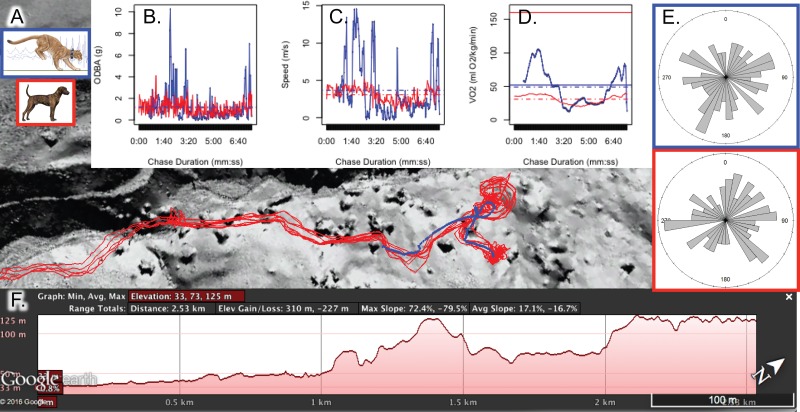
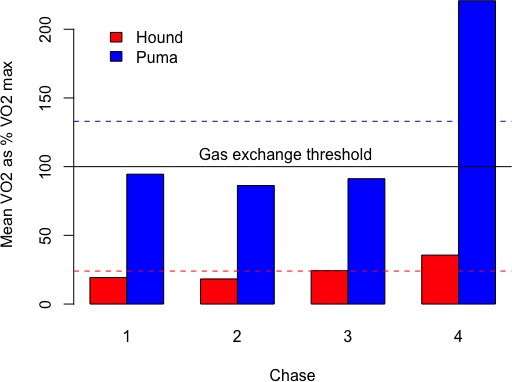
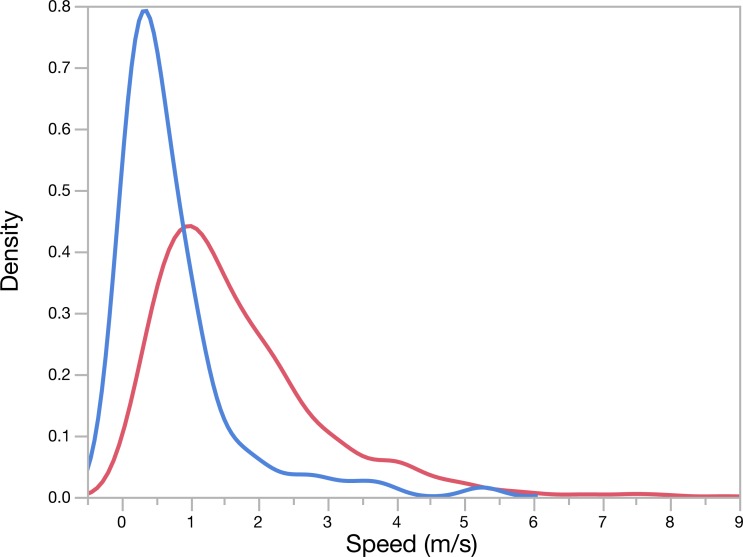
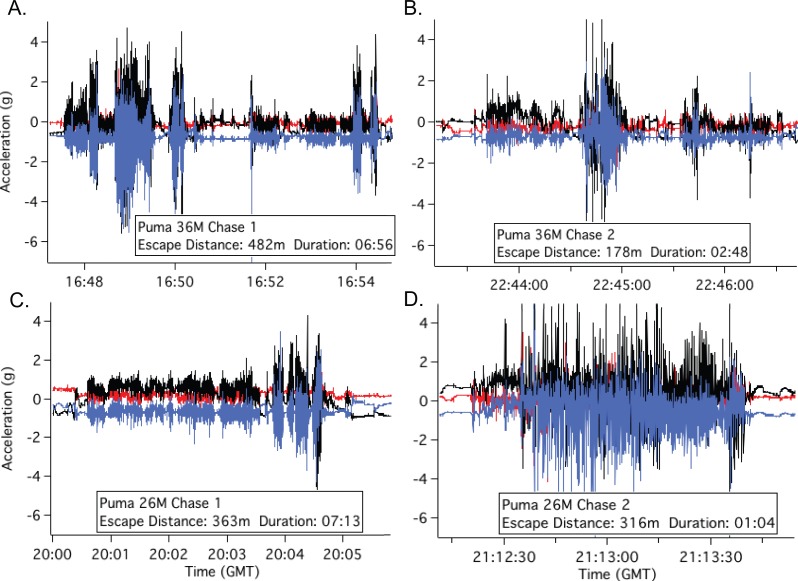
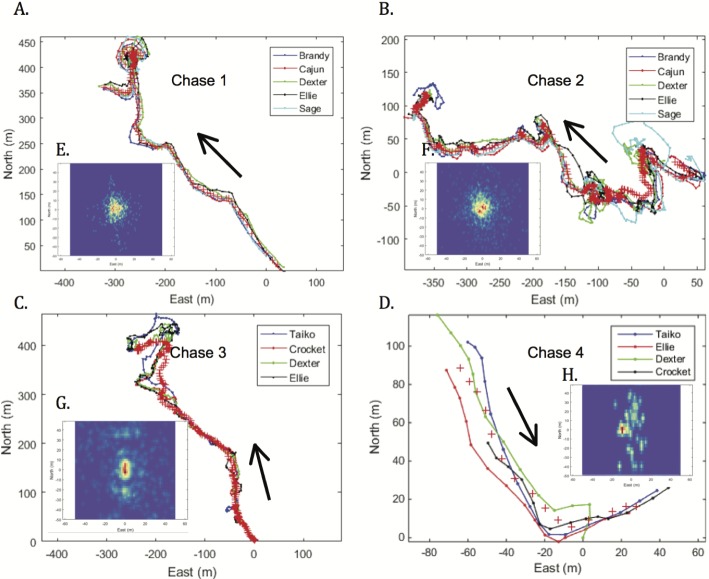
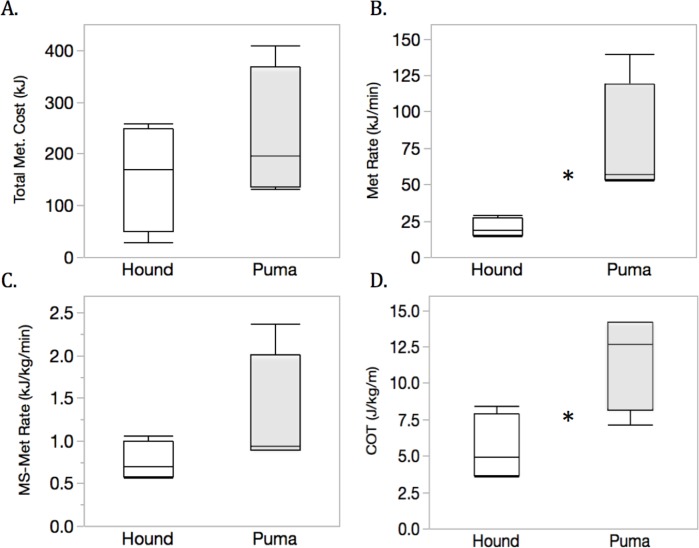
Quantification of fine-scale movement, performance, and energetics of hunting by large carnivores is critical for understanding the physiological underpinnings of trophic interactions. This is particularly challenging for wide-ranging terrestrial canid and felid predators, which can each affect ecosystem structure through distinct hunting modes. To compare free-ranging pursuit and escape performance from group-hunting and solitary predators in unprecedented detail, we calibrated and deployed accelerometer-GPS collars during predator-prey chase sequences using packs of hound dogs (, 26 kg, = 4-5 per chase) pursuing simultaneously instrumented solitary pumas (, 60 kg, = 2). We then reconstructed chase paths, speed and turning angle profiles, and energy demands for hounds and pumas to examine performance and physiological constraints associated with cursorial and cryptic hunting modes, respectively. Interaction dynamics revealed how pumas successfully utilized terrain (e.g., fleeing up steep, wooded hillsides) as well as evasive maneuvers (e.g., jumping into trees, running in figure-8 patterns) to increase their escape distance from the overall faster hounds (avg. 2.3× faster). These adaptive strategies were essential to evasion in light of the mean 1.6× higher mass-specific energetic costs of the chase for pumas compared to hounds (mean: 0.76 1.29 kJ kg min, respectively). On an instantaneous basis, escapes were more costly for pumas, requiring exercise at ≥90% of predicted [Formula: see text] and consuming as much energy per minute as approximately 5 min of active hunting. Our results demonstrate the marked investment of energy for evasion by a large, solitary carnivore and the advantage of dynamic maneuvers to postpone being overtaken by group-hunting canids.
量化大型食肉动物精细尺度的运动、捕猎表现和能量消耗,对于理解营养级相互作用的生理基础至关重要。这对于活动范围广泛的陆生犬科和猫科食肉动物来说尤其具有挑战性,它们各自通过不同的捕猎方式影响生态系统结构。为以前所未有的细节比较自由放养的群居捕猎和独居食肉动物的追捕与逃脱表现,我们在捕食者 - 猎物追逐过程中,使用一群猎犬(平均体重26千克,每次追逐4 - 5只)同时追捕两只佩戴仪器的独居美洲狮(平均体重60千克)时,校准并部署了加速度计 - GPS项圈。然后,我们重建了追逐路径、速度和转弯角度曲线,以及猎犬和美洲狮的能量需求,以分别研究与追逐式和隐匿式捕猎方式相关的表现和生理限制。相互作用动态揭示了美洲狮如何成功利用地形(例如,逃上陡峭的树木繁茂的山坡)以及规避动作(例如,跳到树上,以8字形奔跑)来增加它们与总体速度更快的猎犬(平均快2.3倍)之间的逃脱距离。鉴于美洲狮追逐时的单位质量能量成本平均比猎犬高1.6倍(平均分别为0.76和1.29千焦/千克/分钟),这些适应性策略对于逃避至关重要。在瞬间,美洲狮的逃脱成本更高,需要以≥预测[公式:见正文]的90%进行运动,每分钟消耗的能量与大约5分钟的主动捕猎相当。我们的结果表明,大型独居食肉动物为逃避投入了大量能量,以及动态策略对于推迟被群居捕猎的犬科动物追上的优势。