Wild Timm A, Wilbs Georg, Dechmann Dina K N, Kohles Jenna E, Linek Nils, Mattingly Sierra, Richter Nina, Sfenthourakis Spyros, Nicolaou Haris, Erotokritou Elena, Wikelski Martin
Department of Migration, Max Planck Institute of Animal Behavior, 78315, Radolfzell, Germany.
Department of Biology, University of Konstanz, 78464, Konstanz, Germany.
Mov Ecol. 2024 Oct 28;12(1):71. doi: 10.1186/s40462-024-00512-7.
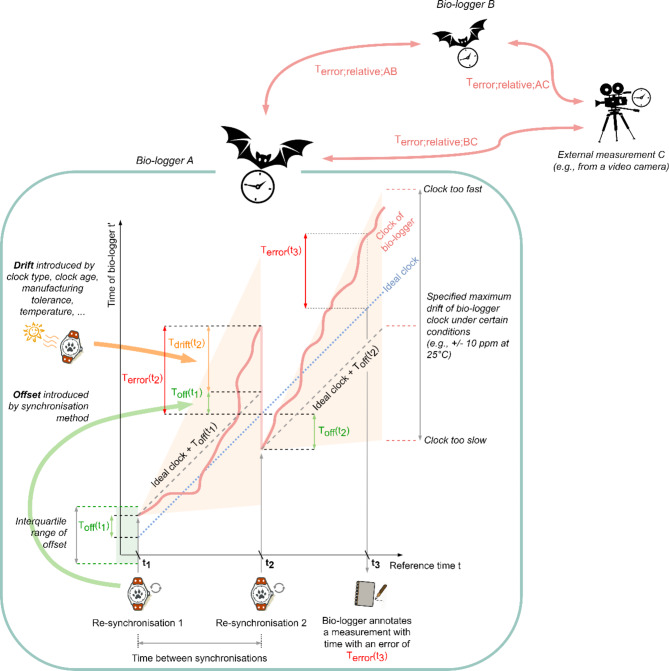
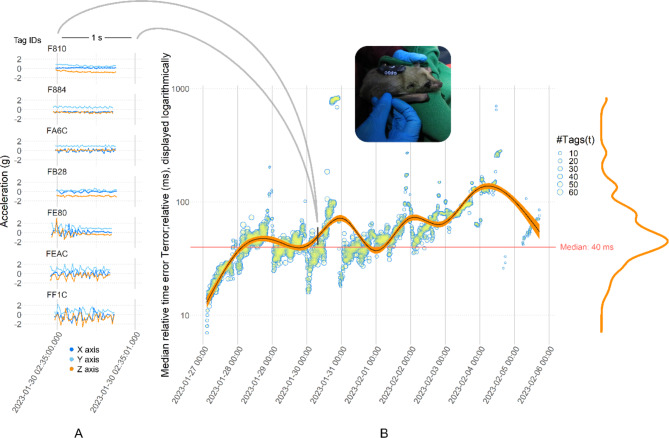
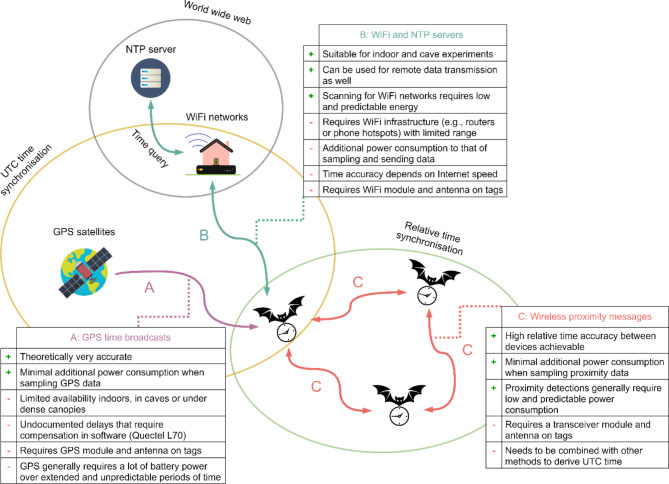
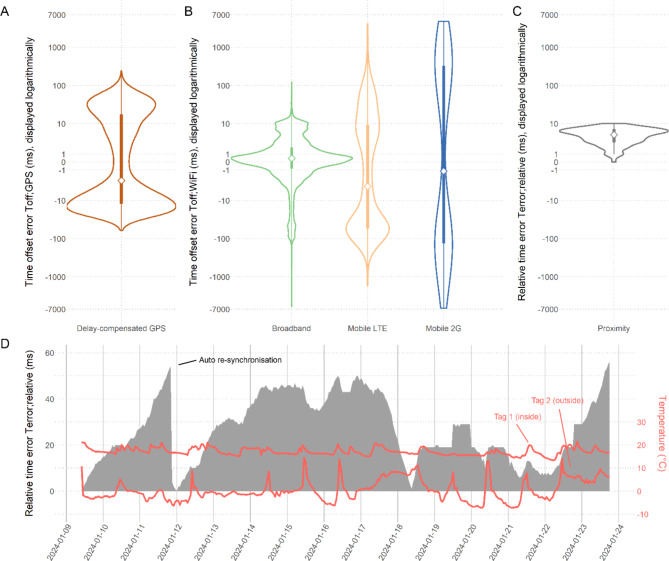
Time-synchronised data streams from bio-loggers are becoming increasingly important for analysing and interpreting intricate animal behaviour including split-second decision making, group dynamics, and collective responses to environmental conditions. With the increased use of AI-based approaches for behaviour classification, time synchronisation between recording systems is becoming an essential challenge. Current solutions in bio-logging rely on manually removing time errors during post processing, which is complex and typically does not achieve sub-second timing accuracies.We first introduce an error model to quantify time errors, then optimise three wireless methods for automated onboard time (re)synchronisation on bio-loggers (GPS, WiFi, proximity messages). The methods can be combined as required and, when coupled with a state-of-the-art real time clock, facilitate accurate time annotations for all types of bio-logging data without need for post processing. We analyse time accuracy of our optimised methods in stationary tests and in a case study on 99 Egyptian fruit bats (Rousettus aegyptiacus). Based on the results, we offer recommendations for projects that require high time synchrony.During stationary tests, our low power synchronisation methods achieved median time accuracies of 2.72 / 0.43 ms (GPS / WiFi), compared to UTC time, and relative median time accuracies of 5 ms between tags (wireless proximity messages). In our case study with bats, we achieved a median relative time accuracy of 40 ms between tags throughout the entire 10-day duration of tag deployment. Using only one automated resynchronisation per day, permanent UTC time accuracies of ≤ 185 ms can be guaranteed in 95% of cases over a wide temperature range between 0 and 50 °C. Accurate timekeeping required a minimal battery capacity, operating in the nano- to microwatt range.Time measurements on bio-loggers, similar to other forms of sensor-derived data, are prone to errors and so far received little scientific attention. Our combinable methods offer a means to quantify time errors and autonomously correct them at the source (i.e., on bio-loggers). This approach facilitates sub-second comparisons of simultaneously recorded time series data across multiple individuals and off-animal devices such as cameras or weather stations. Through automated resynchronisations on bio-loggers, long-term sub-second accurate timestamps become feasible, even for life-time studies on animals. We contend that our methods have potential to greatly enhance the quality of ecological data, thereby improving scientific conclusions.
来自生物记录器的时间同步数据流对于分析和解释复杂的动物行为变得越来越重要,这些行为包括瞬间决策、群体动态以及对环境条件的集体反应。随着基于人工智能的行为分类方法的使用增加,记录系统之间的时间同步正成为一项至关重要的挑战。生物记录领域目前的解决方案依赖于在后期处理中手动消除时间误差,这一过程复杂且通常无法达到亚秒级的计时精度。我们首先引入一个误差模型来量化时间误差,然后优化三种用于生物记录器自动机载时间(重新)同步的无线方法(全球定位系统、WiFi、近距离消息)。这些方法可以根据需要进行组合,并且当与最先进的实时时钟结合使用时,无需后期处理就能为所有类型的生物记录数据提供准确的时间标注。我们在静态测试以及对99只埃及果蝠(埃及果蝠)的案例研究中分析了我们优化方法的时间准确性。基于这些结果,我们为需要高时间同步性的项目提供了建议。在静态测试中,与协调世界时相比,我们的低功耗同步方法实现了2.72 / 0.43毫秒(全球定位系统 / WiFi)的中位时间准确性,以及标签之间5毫秒的相对中位时间准确性(无线近距离消息)。在我们对蝙蝠的案例研究中,在标签部署的整个10天期间,我们在标签之间实现了40毫秒的中位相对时间准确性。每天仅使用一次自动重新同步,在0至50摄氏度的宽温度范围内,95%的情况下可以保证永久协调世界时的准确性≤185毫秒。准确的计时需要最小的电池容量,在纳瓦到微瓦范围内运行。生物记录器上的时间测量与其他形式的传感器衍生数据类似,容易出现误差,并且迄今为止很少受到科学关注。我们的可组合方法提供了一种量化时间误差并在源头(即在生物记录器上)自动纠正它们的手段。这种方法便于对多个个体以及相机或气象站等动物外部设备同时记录的时间序列数据进行亚秒级比较。通过生物记录器上的自动重新同步,即使对于动物的终身研究,长期的亚秒级准确时间戳也变得可行。我们认为我们的方法有潜力极大地提高生态数据的质量,从而改进科学结论。