Panigrahi Jitendriya, Gantait Saikat, Patel Illa C
Department of Biotechnology, Shri A. N. Patel P. G. Institute, Anand, Gujarat 388001 India.
All India Coordinated Research Project on Groundnut, Directorate of Research, Bidhan Chandra Krishi Viswavidyalaya, Kalyani, Nadia, West Bengal 741235 India.
3 Biotech. 2017 Oct;7(5):280. doi: 10.1007/s13205-017-0882-7. Epub 2017 Aug 16.
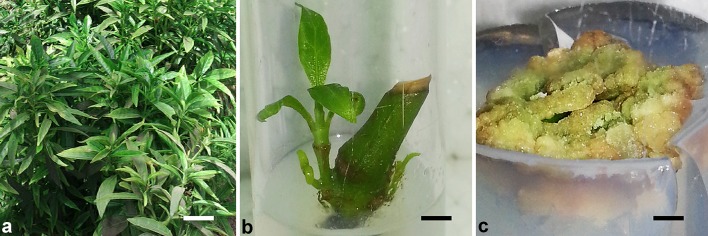
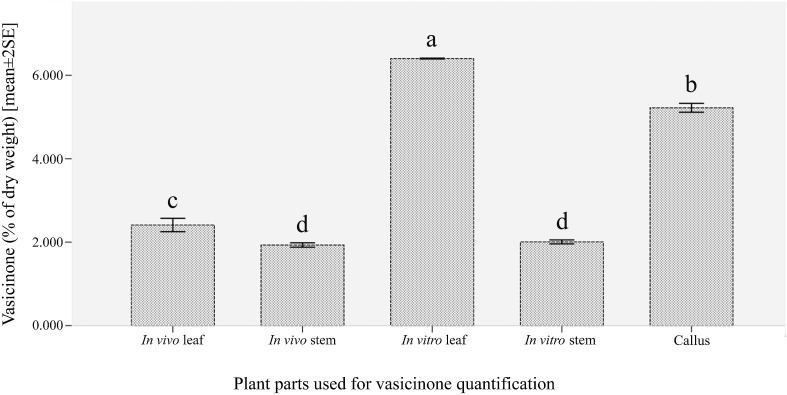
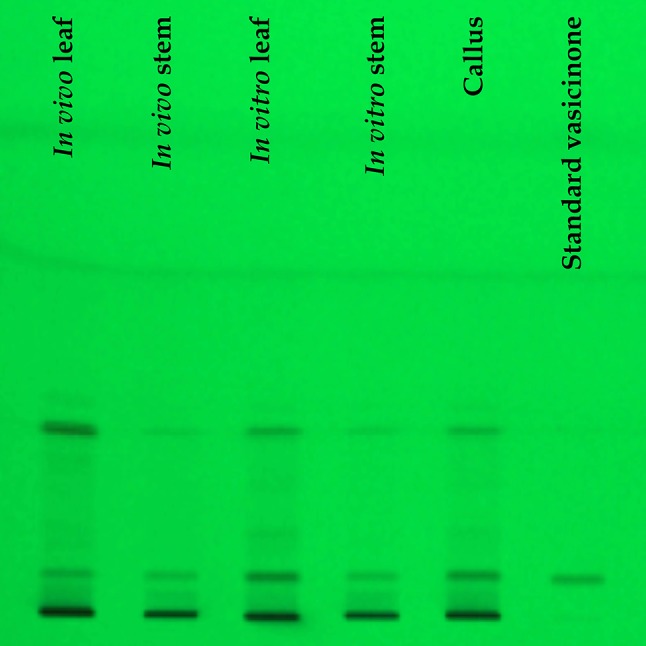
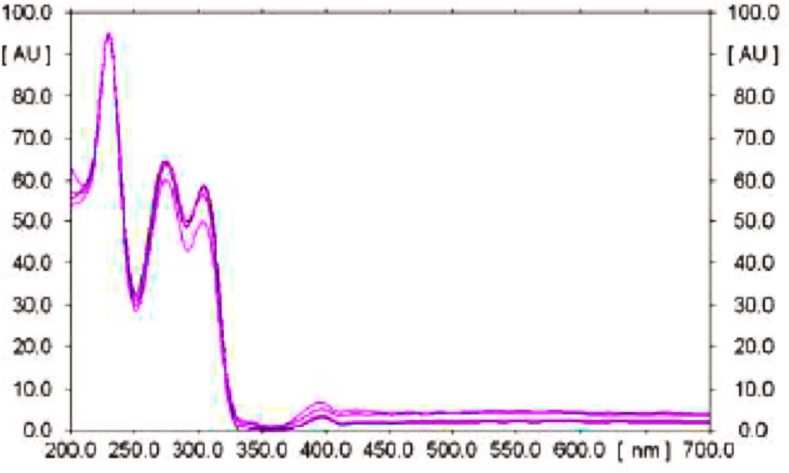
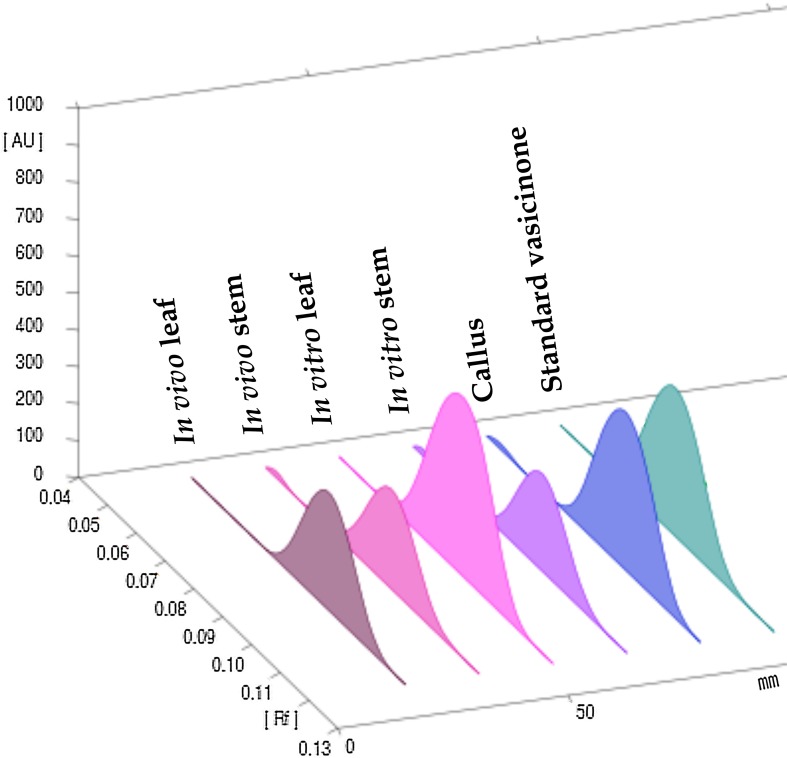
The present study documents a simultaneous production and comparative assessment of extracted vasicinone from in vivo (leaves and stems) and in vitro (leaves, stems and calli) plant parts of Nees, a well-known medicinal plant. High-performance thin layer chromatography (HPTLC) analysis of the above-mentioned plant parts, collected at their 60-day-old growth stage, was performed via methanolic extraction and with the aid of toluene:butanol:butyl acetate (9:0.5:0.5; ) solvent system. The method was validated with the help of aluminium sheet precoated with silica gel 60 F TLC plates, following the ICH guidelines in order to maintain accuracy, precision and repeatability. Correlation coefficient, limit of detection and limit of quantification values were found to be reasonable. The outcome revealed a linearity that ranged between 2 and 6 µg/spot. During the comparison of estimated vasicinone quantity from in vivo and in vitro plant parts, it was evident that in vitro samples produced relatively higher vasicinone than that of the in vivo counterparts. Maximum vasicinone (6.402 ± 0.010% of dry weight) production was quantified from in vitro leaves followed by calli (5.222 ± 0.092% of dry weight) and in vitro stems (2.007 ± 0.041% of dry weight). On the other hand, in vivo leaves and stems produced comparatively lower quantities of vasicinone (2.412 ± 0.139 and 1.933 ± 0.046% of dry weight, respectively) suggesting the in vitro clonal propagation as a superior approach in comparison to in vivo propagation. Nonetheless, simultaneous production from both the sources (in vivo and in vitro plant parts) provides a new avenue for augmented production of vasicinone.
本研究记录了从著名药用植物Nees的体内(叶和茎)和体外(叶、茎和愈伤组织)植物部分同时提取瓦西酮并进行比较评估的过程。对上述在60天生长阶段采集的植物部分进行高效薄层色谱(HPTLC)分析,采用甲醇提取,并借助甲苯:丁醇:乙酸丁酯(9:0.5:0.5; )溶剂系统。该方法借助预涂硅胶60 F TLC板的铝板,按照国际协调会议(ICH)指南进行验证,以确保准确性、精密度和可重复性。发现相关系数、检测限和定量限值合理。结果显示线性范围在2至6微克/斑点之间。在比较体内和体外植物部分估计的瓦西酮含量时,很明显体外样品产生的瓦西酮相对高于体内对应部分。体外叶中瓦西酮产量最高(占干重的6.402±0.010%),其次是愈伤组织(占干重的5.222±0.092%)和体外茎(占干重的2.007±0.041%)。另一方面,体内叶和茎产生的瓦西酮量相对较低(分别占干重的2.412±0.139%和1.933±0.046%),这表明与体内繁殖相比,体外克隆繁殖是一种更优的方法。尽管如此,从两种来源(体内和体外植物部分)同时生产为增加瓦西酮产量提供了一条新途径。