Faculty of Engineering and Science, University of Greenwich, Central Avenue, Chatham Maritime, Kent, ME4 4TB, UK.
Drug Deliv Transl Res. 2018 Dec;8(6):1790-1796. doi: 10.1007/s13346-017-0422-3.
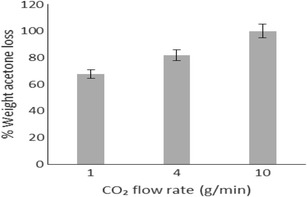
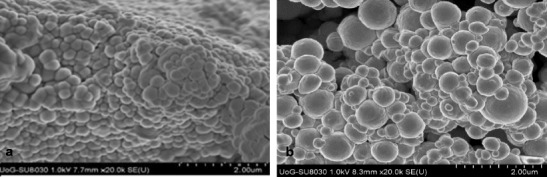
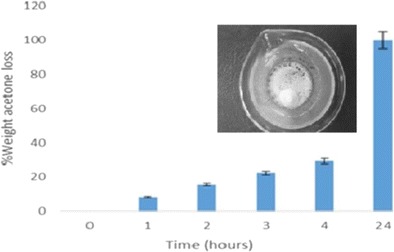
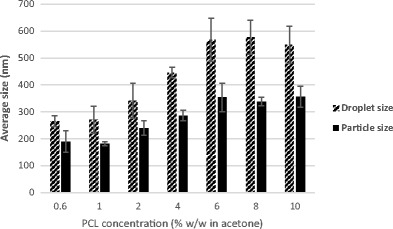
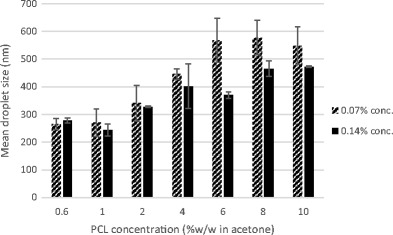
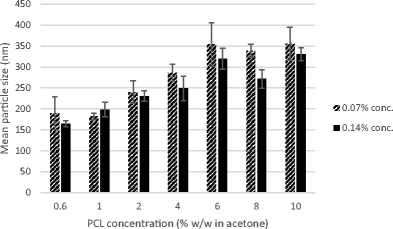
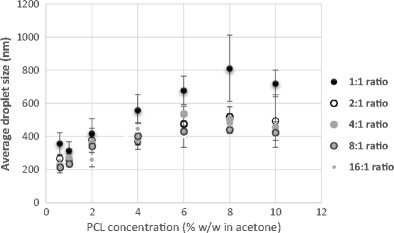
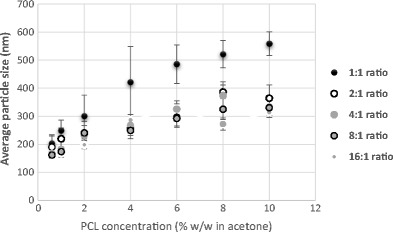
Polycaprolactone (PCL) nanoparticles were produced via supercritical fluid extraction of emulsions (SFEE) using supercritical carbon dioxide (scCO). The efficiency of the scCO extraction was investigated and compared to that of solvent extraction at atmospheric pressure. The effects of process parameters including polymer concentration (0.6-10% w/w in acetone), surfactant concentration (0.07 and 0.14% w/w) and polymer-to-surfactant weight ratio (1:1-16:1 w/w) on the particle size and surface morphology were also investigated. Spherical PCL nanoparticles with mean particle sizes between 190 and 350 nm were obtained depending on the polymer concentration, which was the most important factor where increase in the particle size was directly related to total polymer content in the formulation. Nanoparticles produced were analysed using dynamic light scattering and scanning electron microscopy. The results indicated that SFEE can be applied for the preparation of PCL nanoparticles without agglomeration and in a comparatively short duration of only 1 h.
聚己内酯(PCL)纳米粒子通过超临界二氧化碳(scCO₂)的乳液的超临界流体萃取(SFEE)制备。研究了 scCO₂萃取的效率,并与常压下溶剂萃取的效率进行了比较。还研究了工艺参数对粒径和表面形貌的影响,包括聚合物浓度(在丙酮中的 0.6-10% w/w)、表面活性剂浓度(0.07 和 0.14% w/w)和聚合物与表面活性剂重量比(1:1-16:1 w/w)。根据聚合物浓度,得到了粒径在 190-350nm 之间的球形 PCL 纳米粒子,这是最重要的因素,粒径的增加与制剂中总聚合物含量直接相关。使用动态光散射和扫描电子显微镜分析了所制备的纳米粒子。结果表明,SFEE 可用于制备无团聚的 PCL 纳米粒子,且在仅 1 小时的较短时间内即可完成。