Kioko Mary T, Pertet Anne M
Department of Community Health, Great Lakes University.
Afr J Prim Health Care Fam Med. 2017 Jul 31;9(1):e1-e7. doi: 10.4102/phcfm.v9i1.1343.
Antiretroviral (ARV) adherence of ≥ 95% is recommended for suppressing HIV. However, studies have shown that the ≥ 95% recommended level is rarely achieved.
This cross-sectional community-based study sought to assess factors contributing to ARV drug adherence among adults living with HIV or AIDS.
The study was conducted in a rural community in Machakos County, Kenya.
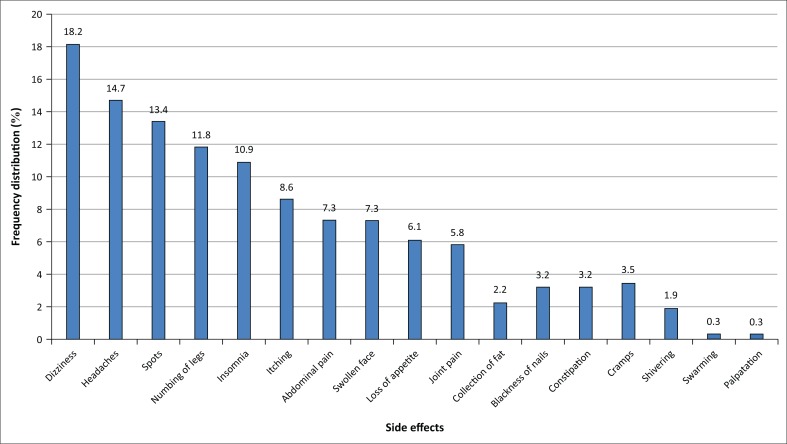
The questions used for the study were adapted from the Patient Medicine Adherence Questionnaire (PMAQ), a tool grounded in the Health Belief Model. Adherence to ARV was measured using self-reports and pill counts. The perception social support was measured with a 5-point Likert scale, whereas the type and the number of side effects experienced were recorded using 'yes' and 'no' questions. We used the chi-square test to test associations and binary logistic regression to assess factors explaining dose adherence to ARV.
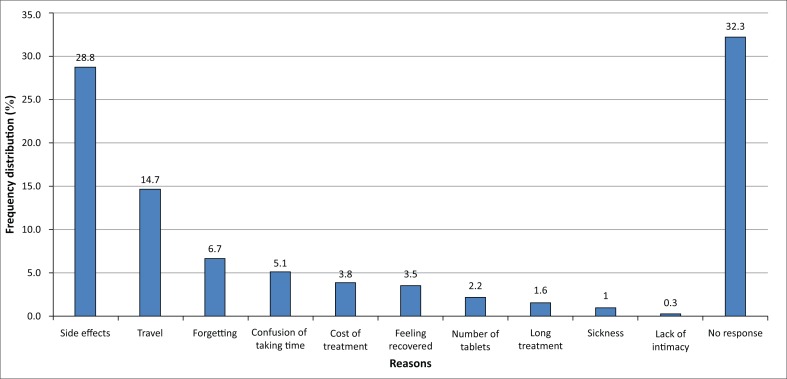
The levels of adherence of 86% using self-reports were significantly higher (p < 0.001) than the pill count of 58.6%. The immediate family was rated high in providing social support (3.7 ± 0.6) followed by social support groups (3.1 ± 0.8). A binary logistic regression analysis was conducted to predict ARV adherence (adherent, non-adherent) using social support, side effects and marital status as explanatory variables. The Wald criterion demonstrated that marital status (p = 0.019) and burden of side effects (p ≤ 0.001) made a significant contribution to the prediction of ARV adherence.
The burden of side effects and being a divorcee are primary predictors of ARV adherence.
抗逆转录病毒(ARV)药物依从性达到≥95%被推荐用于抑制艾滋病毒。然而,研究表明很少能达到推荐的≥95%的水平。
这项基于社区的横断面研究旨在评估影响艾滋病毒或艾滋病成年患者抗逆转录病毒药物依从性的因素。
该研究在肯尼亚马查科斯县的一个农村社区进行。
本研究使用的问题改编自基于健康信念模型的患者药物依从性问卷(PMAQ)。通过自我报告和药丸计数来衡量抗逆转录病毒药物的依从性。使用5点李克特量表来衡量感知到的社会支持,而使用“是”和“否”问题记录所经历的副作用类型和数量。我们使用卡方检验来检验相关性,并使用二元逻辑回归来评估解释抗逆转录病毒药物剂量依从性的因素。
自我报告的依从水平为86%,显著高于药丸计数的58.6%(p<0.001)。直系亲属在提供社会支持方面得分较高(3.7±0.6),其次是社会支持团体(3.1±0.8)。进行二元逻辑回归分析,以社会支持、副作用和婚姻状况作为解释变量来预测抗逆转录病毒药物的依从性(依从、不依从)。Wald准则表明,婚姻状况(p = 0.019)和副作用负担(p≤0.001)对预测抗逆转录病毒药物的依从性有显著贡献。
副作用负担和离婚是抗逆转录病毒药物依从性的主要预测因素。