Alkhaldi Ghadah, Modrow Kerstin, Hamilton Fiona, Pal Kingshuk, Ross Jamie, Murray Elizabeth
Community Health Sciences Department, College of Applied Medical Sciences, King Saud University, Riyadh, Saudi Arabia.
eHealth Unit, Research Department of Primary Care and Population Health, University College London, London, United Kingdom.
Interact J Med Res. 2017 Aug 22;6(2):e14. doi: 10.2196/ijmr.6952.
Engagement with digital health interventions (DHIs) may be regarded as a prerequisite for the intervention to achieve positive health or behavior change outcomes. One method employed to promote engagement is the use of prompts such as emails and text messages. However, little is known about the characteristics of prompts that promote engagement. This study explored the association between the content and delivery mode of prompts and the users' engagement with HeLP-Diabetes (Healthy Living for People with type 2 Diabetes), a DHI that aimed to promote self-management in adults with type 2 diabetes.
The objective of this study was to identify the characteristics of prompts, specifically the content and delivery mode, which were associated with increased engagement.
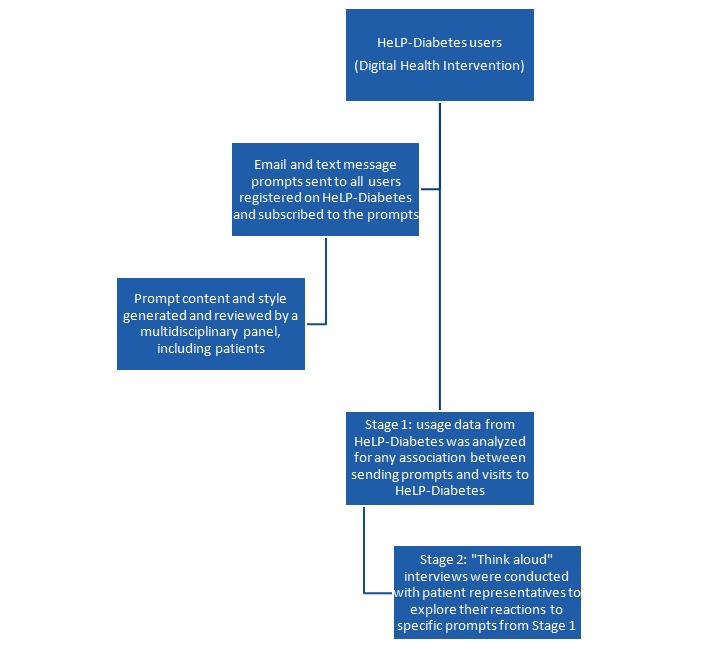
This was a mixed-methods study. Email and text message prompts were sent to the registered users of HeLP-Diabetes. Use of the intervention was recorded and examined to identify which email and text message prompts were associated with subsequent visits to the DHI. Characteristics of prompts that were identified as particularly effective or ineffective were explored through think-aloud interviews with the participants.
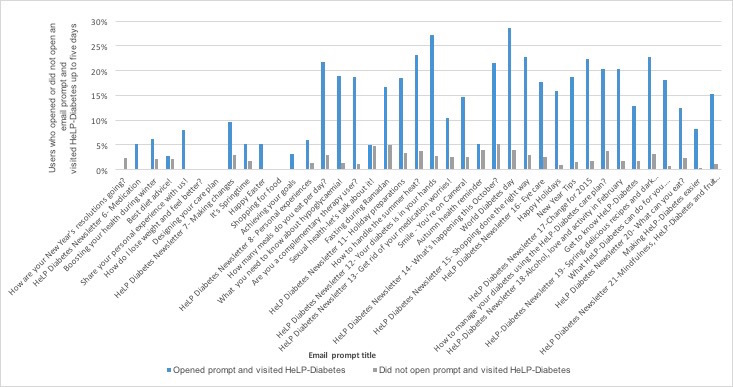
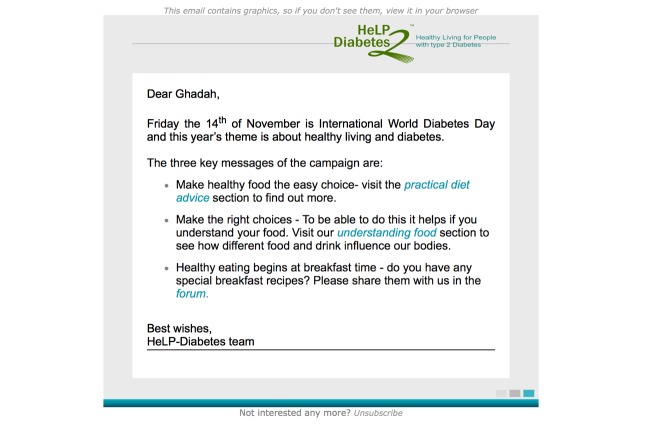
Of a total of 39 email prompts, 49% (19/39) prompts showed a significant association with subsequent visits to the DHI. However, none of the text message prompts were associated with subsequent visits to the DHI. Furthermore, think-aloud interviews were carried out with 6 experienced participants with type 2 diabetes. The findings suggest that these participants preferred email prompts that were clear, relatively short, and empowering; used nondirective advice; included health professional references; were visually appealing; and contained news and updates.
The findings of this study contribute to the existing evidence supporting the role of email prompts in promoting and maintaining engagement with DHIs. This study described the content of prompts that may be engaging. However, the results should be interpreted with caution, as prompts may be context-specific interventions and the results may not be generalizable across other DHIs or other types of interventions targeting self-management of type 2 diabetes.
参与数字健康干预(DHI)可能被视为干预措施实现积极健康或行为改变结果的先决条件。用于促进参与的一种方法是使用诸如电子邮件和短信之类的提示。然而,对于促进参与的提示的特征知之甚少。本研究探讨了提示的内容和传递方式与用户参与HeLP-糖尿病(2型糖尿病患者的健康生活)之间的关联,HeLP-糖尿病是一种旨在促进2型糖尿病成年人自我管理的数字健康干预措施。
本研究的目的是确定与参与度增加相关的提示特征,特别是内容和传递方式。
这是一项混合方法研究。向HeLP-糖尿病的注册用户发送电子邮件和短信提示。记录并检查干预措施的使用情况,以确定哪些电子邮件和短信提示与随后访问数字健康干预措施相关。通过与参与者进行出声思考访谈,探索被确定为特别有效或无效的提示的特征。
在总共39条电子邮件提示中,49%(19/39)的提示与随后访问数字健康干预措施显示出显著关联。然而,没有一条短信提示与随后访问数字健康干预措施相关。此外,对6名有经验的2型糖尿病参与者进行了出声思考访谈。结果表明,这些参与者更喜欢清晰、相对简短且具有激励性的电子邮件提示;使用非指导性建议;包含健康专业参考;视觉上有吸引力;并包含新闻和更新。
本研究的结果有助于现有证据支持电子邮件提示在促进和维持对数字健康干预措施的参与方面的作用。本研究描述了可能具有吸引力的提示内容。然而,结果应谨慎解释,因为提示可能是针对具体情境的干预措施,结果可能无法推广到其他数字健康干预措施或其他针对2型糖尿病自我管理的干预类型。