Zwicker Stephanie, Lira-Junior Ronaldo, Höög Charlotte, Almer Sven, Boström Elisabeth A
Department of Dental Medicine, Division of Periodontology, Karolinska Institutet, Alfred Nobels Allé 8, SE-141 52 Huddinge, Sweden.
Department of Medicine, Solna, Karolinska Institutet, SE-171 76 Stockholm, Sweden.
Int J Mol Sci. 2017 Aug 22;18(8):1827. doi: 10.3390/ijms18081827.
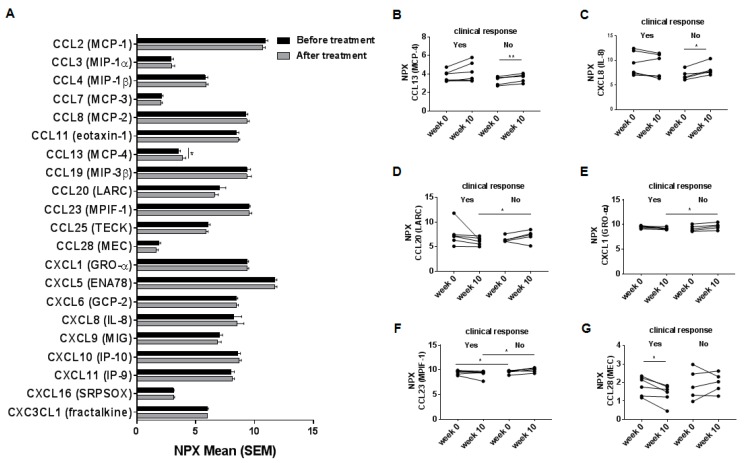
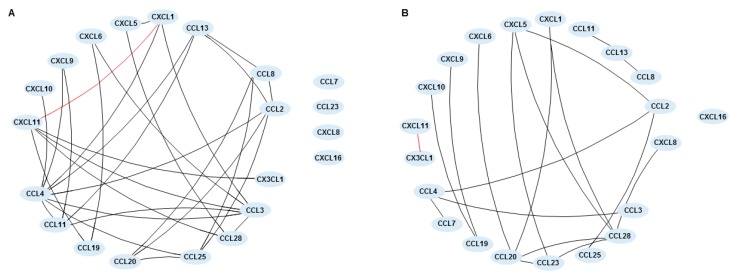
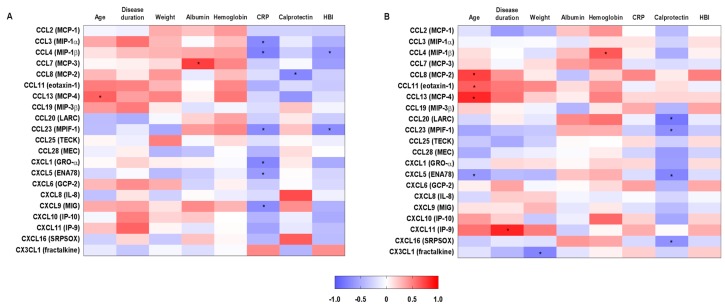
Vedolizumab, a gut-specific biological treatment for inflammatory bowel disease (IBD), is an antibody that binds to the α₄β₇ integrin and blocks T-cell migration into intestinal mucosa. We aimed to investigate chemokine levels in serum of IBD-patients treated with vedolizumab. In this pilot study, we included 11 IBD patients (8 Crohn's disease, 3 ulcerative colitis) previously non-respondent to anti-tumor necrosis factor (TNF)-agents. Patients received vedolizumab at week 0, 2 and 6 and were evaluated for clinical efficacy at week 10. Clinical characteristics and routine laboratory parameters were obtained and patients were classified as responders or non-responders. Expression of 21 chemokines in serum was measured using Proximity Extension Assay and related to clinical outcome. At week 10, 6 out of 11 patients had clinically responded. Overall expression of CCL13 increased after treatment. In non-responders, expression of CCL13 and CXCL8 increased after treatment, and CCL20 and CXCL1 expressions were higher compared to responders. In responders, CCL28 decreased after treatment. C-reactive protein (CRP) correlated negatively with 6 chemokines before therapy, but not after therapy. Systemic CCL13 expression increases in IBD-patients after vedolizumab therapy and several chemokine levels differ between responders and non-responders. An increased CCL13-level when starting vedolizumab treatment, might indicate potential prognostic value of measuring chemokine levels when starting therapy with vedolizumab. This study provides new information on modulation of systemic chemokine levels after vedolizumab treatment.
维多珠单抗是一种用于治疗炎症性肠病(IBD)的肠道特异性生物制剂,它是一种能与α₄β₇整合素结合并阻止T细胞迁移至肠黏膜的抗体。我们旨在研究接受维多珠单抗治疗的IBD患者血清中的趋化因子水平。在这项初步研究中,我们纳入了11例先前对抗肿瘤坏死因子(TNF)药物无反应的IBD患者(8例克罗恩病,3例溃疡性结肠炎)。患者在第0、2和6周接受维多珠单抗治疗,并在第10周评估临床疗效。获取临床特征和常规实验室参数,并将患者分为反应者或无反应者。使用邻位延伸分析测定血清中21种趋化因子的表达,并将其与临床结果相关联。在第10周时,11例患者中有6例出现临床反应。治疗后CCL13的总体表达增加。在无反应者中,治疗后CCL13和CXCL8的表达增加,且CCL20和CXCL1的表达高于反应者。在反应者中,治疗后CCL28降低。治疗前C反应蛋白(CRP)与6种趋化因子呈负相关,但治疗后无此相关性。维多珠单抗治疗后IBD患者的全身CCL13表达增加,反应者和无反应者之间的几种趋化因子水平存在差异。开始使用维多珠单抗治疗时CCL13水平升高,可能表明在开始维多珠单抗治疗时测量趋化因子水平具有潜在的预后价值。本研究提供了关于维多珠单抗治疗后全身趋化因子水平调节的新信息。