Gebhardt Christiane
Max Planck Institute for Plant Breeding Research, Cologne, Germany.
Front Genet. 2023 Jul 25;14:1197206. doi: 10.3389/fgene.2023.1197206. eCollection 2023.
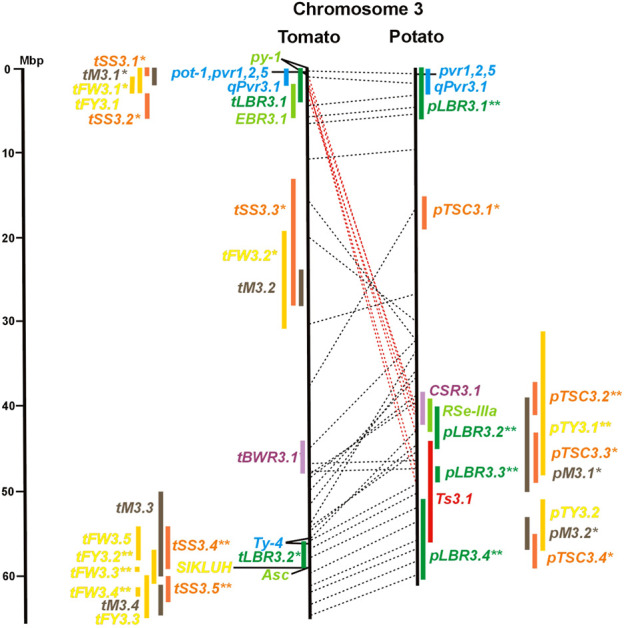
Potato, tomato, pepper, and eggplant are worldwide important crop and vegetable species of the Solanaceae family. Molecular linkage maps of these plants have been constructed and used to map qualitative and quantitative traits of agronomic importance. This research has been undertaken with the vision to identify the molecular basis of agronomic characters on the one hand, and on the other hand, to assist the selection of improved varieties in breeding programs by providing DNA-based markers that are diagnostic for specific agronomic characters. Since 2011, whole genome sequences of tomato and potato became available in public databases. They were used to combine the results of several hundred mapping and map-based cloning studies of phenotypic characters between 1988 and 2022 in physical maps of the twelve tomato and potato chromosomes. The traits evaluated were qualitative and quantitative resistance to pathogenic oomycetes, fungi, bacteria, viruses, nematodes, and insects. Furthermore, quantitative trait loci for yield and sugar content of tomato fruits and potato tubers and maturity or earliness were physically mapped. Cloned genes for pathogen resistance, a few genes underlying quantitative trait loci for yield, sugar content, and maturity, and several hundred candidate genes for these traits were included in the physical maps. The comparison between the physical chromosome maps revealed, in addition to known intrachromosomal inversions, several additional inversions and translocations between the otherwise highly collinear tomato and potato genomes. The integration of the positional information from independent mapping studies revealed the colocalization of qualitative and quantitative loci for resistance to different types of pathogens, called resistance hotspots, suggesting a similar molecular basis. Synteny between potato and tomato with respect to genomic positions of quantitative trait loci was frequently observed, indicating eventual similarity between the underlying genes.
马铃薯、番茄、辣椒和茄子是茄科在全球范围内重要的农作物和蔬菜品种。这些植物的分子连锁图谱已经构建完成,并用于定位具有重要农艺性状的质量性状和数量性状。开展这项研究一方面是为了确定农艺性状的分子基础,另一方面是通过提供对特定农艺性状具有诊断性的基于DNA的标记,协助育种计划中改良品种的选择。自2011年以来,番茄和马铃薯的全基因组序列已在公共数据库中公开。它们被用于将1988年至2022年间数百项关于表型性状的定位和基于图谱的克隆研究结果整合到12条番茄和马铃薯染色体的物理图谱中。所评估的性状包括对致病卵菌、真菌、细菌、病毒、线虫和昆虫的定性和定量抗性。此外,还对番茄果实和马铃薯块茎的产量、糖含量以及成熟度或早熟性的数量性状位点进行了物理定位。物理图谱中包含了抗病克隆基因、一些产量、糖含量和成熟度数量性状位点的潜在基因,以及数百个这些性状的候选基因。除了已知的染色体内倒位外,物理染色体图谱之间的比较还揭示了在其他方面高度共线的番茄和马铃薯基因组之间的一些额外倒位和易位。来自独立定位研究位置信息的整合揭示了对不同类型病原体抗性的质量性状位点和数量性状位点的共定位,即抗性热点,这表明存在相似的分子基础。经常观察到马铃薯和番茄在数量性状位点基因组位置方面的同线性,这表明潜在基因最终具有相似性。