Mohamed Nurulasmak, Saddki Norkhafizah, Yusoff Azizah, Mat Jelani Anilawati
School of Dental Sciences, Universiti Sains Malaysia, Health Campus, 16150, Kubang Kerian, Kelantan, Malaysia.
Department of Medicine, Hospital Raja Perempuan Zainab II, 15586, Kota Bharu, Kelantan, Malaysia.
BMC Oral Health. 2017 Aug 22;17(1):119. doi: 10.1186/s12903-017-0409-y.
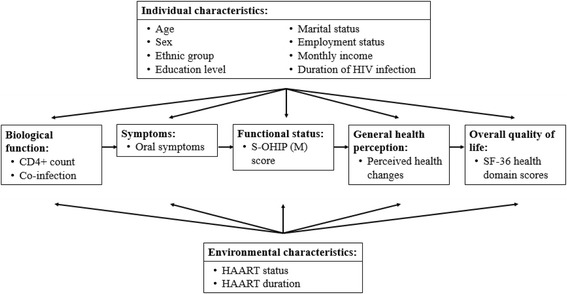
Health-related quality of life (HRQOL) is a multidimensional construct that refers to an individual's self-perceived well-being. This study used the revised Wilson and Cleary HRQOL model to investigate the associations among oral symptoms, oral health-related quality of life (OHRQOL), and HRQOL of people living with HIV/AIDS (PLWHA) in Malaysia.
A total of 121 PLWHA receiving medical care in Kota Bharu (Kelantan, Malaysia) participated in this cross-sectional study. The Malay version of the short Oral Health Impact Profile (S-OHIP(M)) and the Malay version of the 36-item Medical Outcome Study Short Form (SF-36) were used to assess OHRQOL and HRQOL, respectively. A higher S-OHIP(M) score indicates greater oral impact and worse OHRQOL; a higher SF-36 score indicates better HRQOL. An additional structured self-administered questionnaire was used to obtain other variables of interest from the participants.
Most participants had at least one oral symptom (69.4%), and the most common oral symptom was a cavitated tooth (55.4%). The prevalence of oral impacts was 33.9%, and the mean S-OHIP(M) score was 8.8 (SD = 7.92). The mean S-OHIP(M) score was significantly higher in participants who had toothaches, cavitated teeth, gum abscesses, and bad breath. In addition, participants with lower S-OHIP(M) scores had significantly higher scores in all SF-36 domains.
Our study provides evidence for an association among oral symptoms, OHRQOL, and HRQOL in PLWHA from Malaysia. In particular, the presence of oral symptoms was significantly associated with more severe oral impacts and poorer OHRQOL. The presence of less severe oral impacts was associated with a better HRQOL.
健康相关生活质量(HRQOL)是一个多维概念,指个体的自我感知幸福感。本研究采用修订后的威尔逊和克利里HRQOL模型,调查马来西亚人类免疫缺陷病毒/艾滋病(HIV/AIDS)感染者(PLWHA)的口腔症状、口腔健康相关生活质量(OHRQOL)和HRQOL之间的关联。
共有121名在马来西亚吉兰丹州哥打巴鲁接受医疗护理的PLWHA参与了这项横断面研究。分别使用马来语版的简短口腔健康影响概况(S-OHIP(M))和马来语版的36项医学结局研究简表(SF-36)来评估OHRQOL和HRQOL。S-OHIP(M)得分越高表明口腔影响越大,OHRQOL越差;SF-36得分越高表明HRQOL越好。另外使用一份结构化的自填问卷从参与者那里获取其他感兴趣的变量。
大多数参与者至少有一种口腔症状(69.4%),最常见的口腔症状是龋齿(55.4%)。口腔影响的患病率为33.9%,S-OHIP(M)的平均得分为8.8(标准差=7.92)。有牙痛、龋齿、牙龈脓肿和口臭的参与者的S-OHIP(M)平均得分显著更高。此外,S-OHIP(M)得分较低的参与者在所有SF-36领域的得分显著更高。
我们的研究为马来西亚PLWHA的口腔症状、OHRQOL和HRQOL之间的关联提供了证据。特别是,口腔症状的存在与更严重的口腔影响和更差的OHRQOL显著相关。不太严重的口腔影响的存在与更好的HRQOL相关。