Choi Sae Kyung, Lee Guisera, Kim Yeon Hee, Park In Yang, Ko Hyun Sun, Shin Jong Chul
Department of Obstetrics and Gynecology, College of Medicine, The Catholic University of Korea, 222, Banpo-daero, Seocho-gu, Seoul, 06591, Republic of Korea.
Reprod Biol Endocrinol. 2017 Aug 22;15(1):67. doi: 10.1186/s12958-017-0280-3.
The World Health Organization (WHO) international body mass index (BMI) cut-off points defining pre-pregnancy BMI categories in the Institute of Medicine (IOM) guidelines are not directly applicable to Asians. We aimed to define the optimal gestational weight gain (GWG) for the Korean population based on Asia-specific BMI categories.
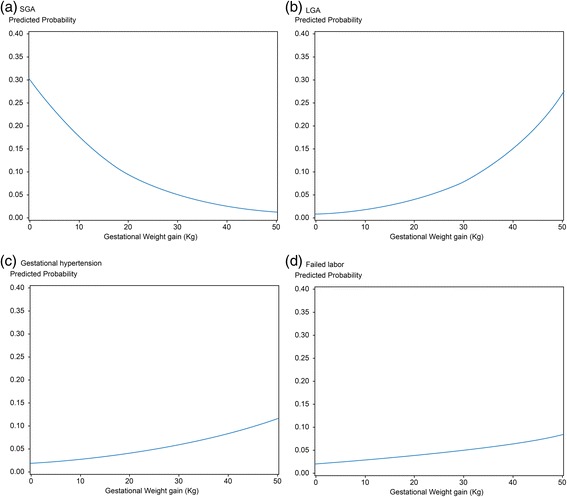
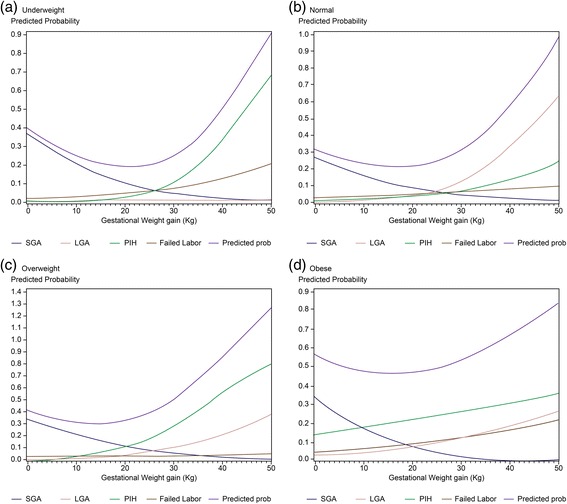
Data from 2702 live singleton deliveries in three tertiary centers between 2010 and 2011 were analyzed retrospectively. A multivariable logistic regression analysis was conducted to determine the lowest aggregated risk of composite perinatal outcomes based on Asia-specific BMI categories. The perinatal outcomes included gestational hypertensive disorder, emergency cesarean section, and fetal size for gestational age. In each BMI category, the GWG value corresponding to the lowest aggregated risk was defined as the optimal GWG.
Among the study population, 440 (16.3%) were underweight (BMI < 18.5), 1459 (54.0%) were normal weight (18.5 ≤ BMI < 23), 392 (14.5%) were overweight (23 ≤ BMI < 25) and 411 (15.2%) were obese (BMI ≥ 25). The optimal GWG by Asia-specific BMI category was 20.8 kg (range, 16.7 to 24.7) for underweight, 16.6 kg (11.5 to 21.5) for normal weight, 13.1 kg (8.0 to 17.7) for overweight, and 14.4 kg (7.5 to 21.9) for obese.
Considerably higher and wider optimal GWG ranges than recommended by IOM are found in our study in order to avoid adverse perinatal outcomes. Revised IOM recommendations for GWG could be considered for Korean women according to Asian BMI categories. Further prospective studies are needed in order to determine the optimal GWG for the Korean population.
世界卫生组织(WHO)国际身体质量指数(BMI)切点在医学研究所(IOM)指南中用于定义孕前BMI类别,但并不直接适用于亚洲人。我们旨在基于亚洲特定的BMI类别确定韩国人群的最佳孕期体重增加量(GWG)。
回顾性分析2010年至2011年间三个三级中心2702例单胎活产的数据。进行多变量逻辑回归分析,以确定基于亚洲特定BMI类别的复合围产期结局的最低总体风险。围产期结局包括妊娠期高血压疾病、急诊剖宫产和胎儿大小与孕周的关系。在每个BMI类别中,将对应最低总体风险的GWG值定义为最佳GWG。
在研究人群中,440例(16.3%)体重过轻(BMI<18.5),1459例(54.0%)体重正常(18.5≤BMI<23),392例(14.5%)超重(23≤BMI<25),411例(15.2%)肥胖(BMI≥25)。亚洲特定BMI类别的最佳GWG,体重过轻者为20.8千克(范围16.7至24.7),体重正常者为16.6千克(11.5至21.5),超重者为13.1千克(8.0至17.7),肥胖者为14.4千克(7.5至21.9)。
在我们的研究中发现,为避免不良围产期结局,最佳GWG范围比IOM推荐的要高得多且更宽。对于韩国女性,可根据亚洲BMI类别考虑修订后的IOM关于GWG的建议。为确定韩国人群的最佳GWG,还需要进一步的前瞻性研究。