Department of Obstetrics, Beijing Obstetrics and Gynecology Hospital, Beijing Maternal and Child Health Care Hospital, Capital Medical University, Beijing, China.
School of General Practice and Continuing Education, Capital Medical University, Beijing, China.
Glob Health Action. 2023 Dec 31;16(1):2213494. doi: 10.1080/16549716.2023.2213494.
The 2009 Institute of Medicine (IOM) gestational weight gain (GWG) guidelines were initially developed for pregnant women in the United States.
This study aimed to investigate whether the IOM guidelines were suitable for pregnant Chinese women.
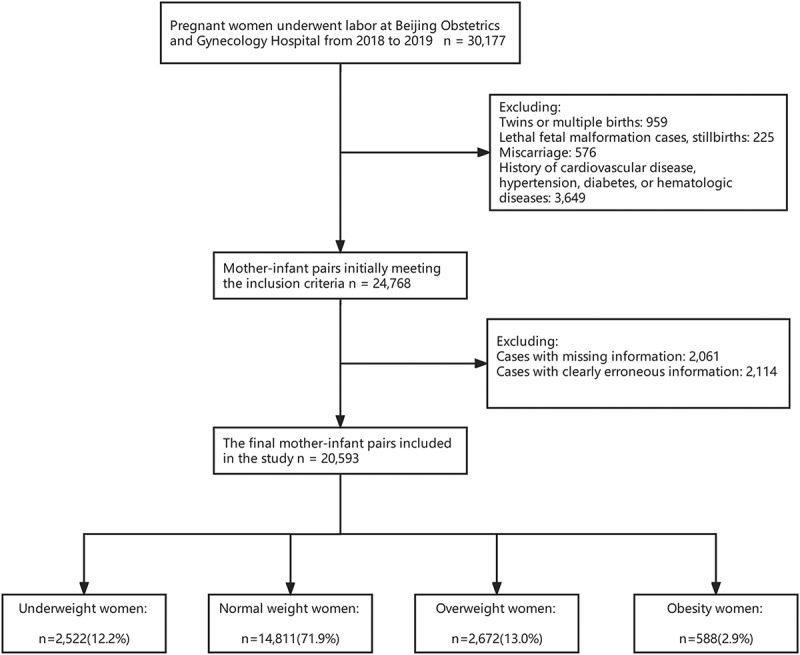
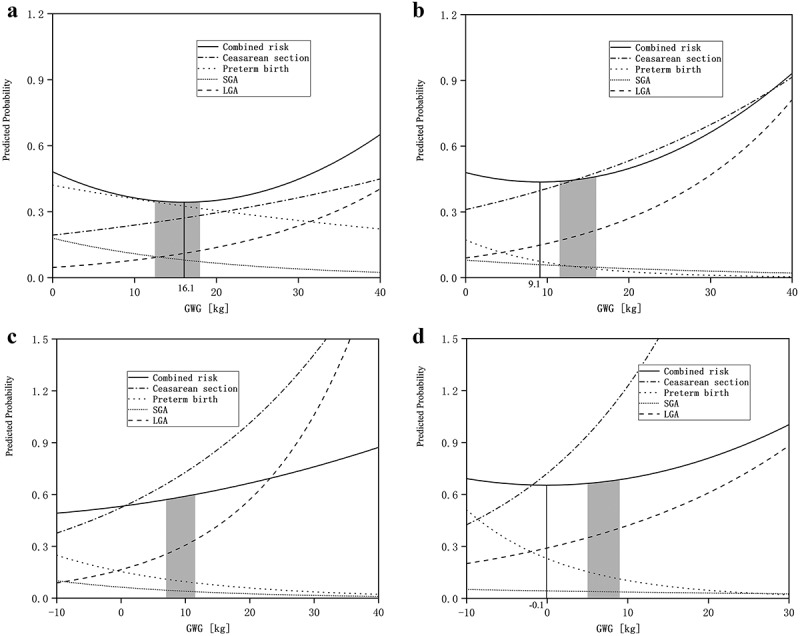
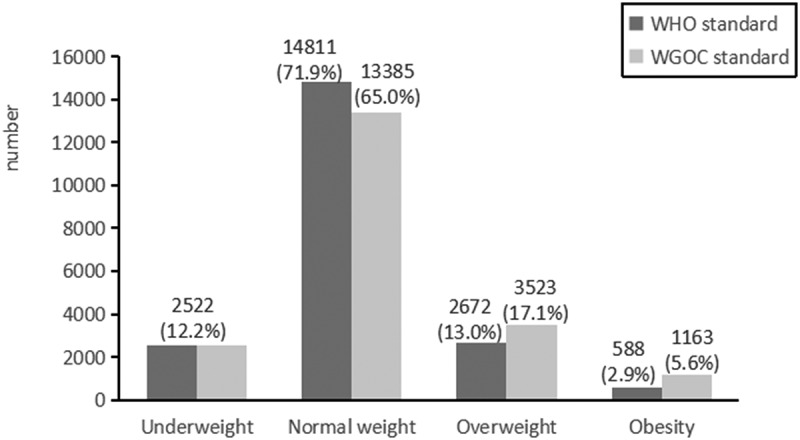
A retrospective cohort study comprising 20,593 singleton pregnant women was conducted at the Beijing Obstetrics and Gynaecology Hospital (1 January 2018 to 31 December 2019). Applicability was evaluated by comparing the GWG corresponding to the lowest point of the predicted composite risk curve with the 2009 IOM GWG Guidelines. The IOM Guidelines serve as the standard for the GWG categories and the pre-pregnancy body mass index. An exponential function model was used to fit the weight gain during pregnancy and the probability of caesarean section, preterm birth, small for gestational age, and large for gestational age. A quadratic function model was used to fit the combined probability of the above-mentioned adverse pregnancy outcomes. The applicability of the IOM guidelines was evaluated by comparing the weights corresponding to the lowest predicted probability with the GWG range recommended by the IOM guidelines.
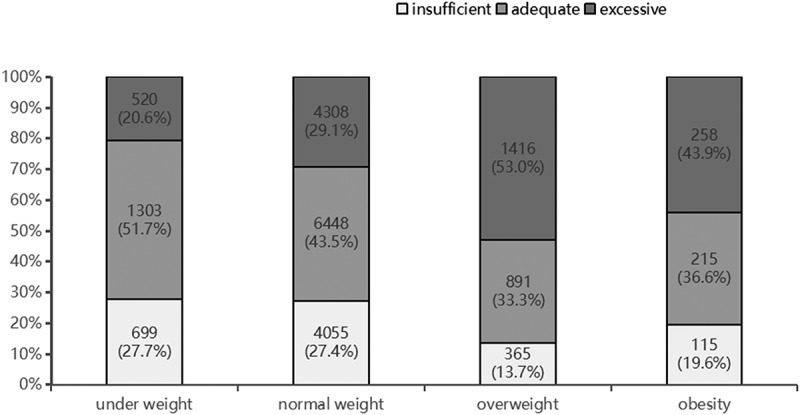
According to the 2009 IOM GWG Guidelines, 43% of the women achieved adequate weight, almost 32% gained excessive weight, and 25% gained inadequate weight. The GWG range proposed by the IOM included the lowest predicted probability value for underweight women and exceeded the lowest predicted probability for normal weight, overweight, and obese women.
The 2009 IOM guidelines were suitable for Chinese women whose pre-pregnancy body mass index was classified as underweight. The guidelines were not suitable for normal, overweight, or obese pre-pregnancy body mass index classifications. Therefore, based on the above evidence, the 2009 IOM guidelines are not suitable for all Chinese women.
2009 年美国医学研究所(IOM)的妊娠体重增加(GWG)指南最初是为美国孕妇制定的。
本研究旨在探讨 IOM 指南是否适用于中国孕妇。
本回顾性队列研究纳入了 20593 名单胎妊娠的孕妇,在北京妇产医院进行(2018 年 1 月 1 日至 2019 年 12 月 31 日)。通过比较预测复合风险曲线最低点对应的 GWG 与 2009 年 IOM GWG 指南,评估适用性。IOM 指南为 GWG 类别和孕前体重指数的标准。采用指数函数模型拟合孕期体重增加和剖宫产、早产、小于胎龄儿和大于胎龄儿的概率。采用二次函数模型拟合上述不良妊娠结局的综合概率。通过比较与 IOM 指南推荐的 GWG 范围对应的最低预测概率的体重,评估 IOM 指南的适用性。
根据 2009 年 IOM GWG 指南,43%的女性体重增加适当,几乎 32%的女性体重增加过多,25%的女性体重增加不足。IOM 提出的 GWG 范围包括了低体重女性的最低预测概率值,超过了正常体重、超重和肥胖女性的最低预测概率。
2009 年 IOM 指南适用于孕前体重指数被分类为低体重的中国女性。该指南不适用于正常、超重或肥胖的孕前体重指数分类。因此,基于上述证据,2009 年 IOM 指南并不适用于所有中国女性。