Fu Hongxia, Jiang Yan, Yang Darren, Scheiflinger Friedrich, Wong Wesley P, Springer Timothy A
Program in Cellular and Molecular Medicine, Boston Children's Hospital, Boston, MA, 02115, USA.
Department of Biological Chemistry and Molecular Pharmacology, Harvard Medical School, Boston, MA, 02115, USA.
Nat Commun. 2017 Aug 23;8(1):324. doi: 10.1038/s41467-017-00230-2.
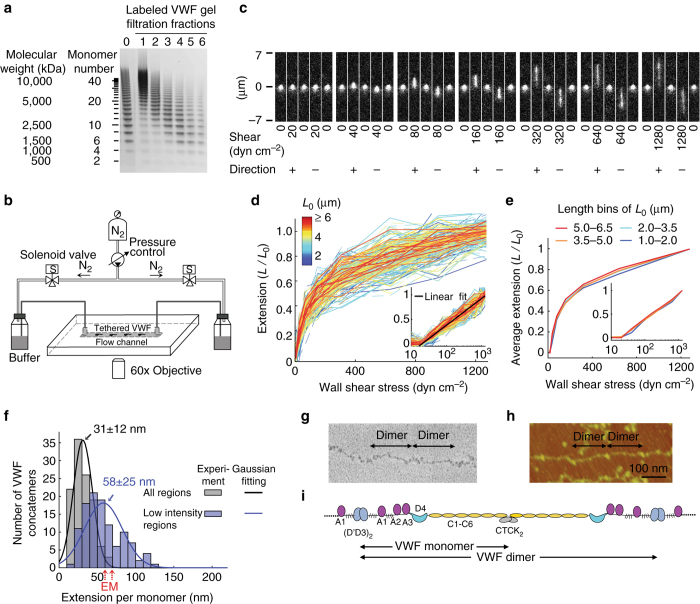
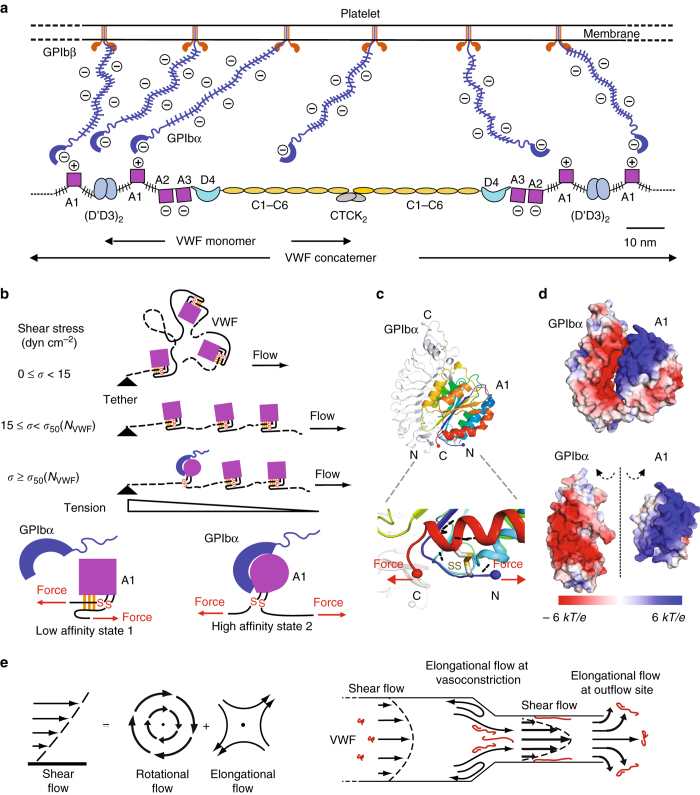
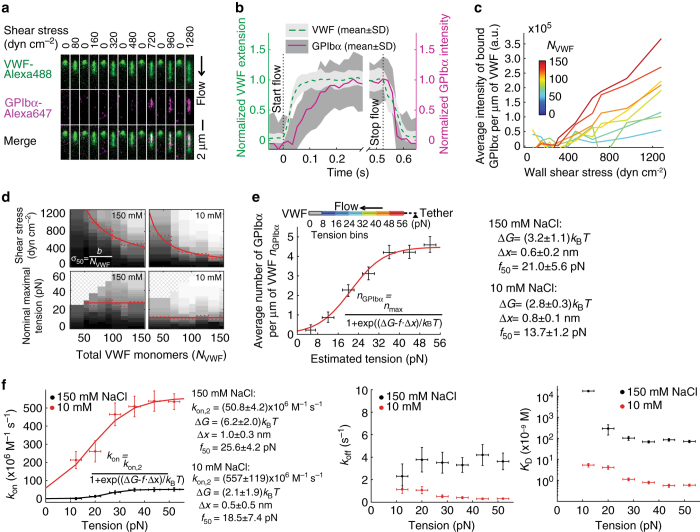
Von Willebrand factor, an ultralarge concatemeric blood protein, must bind to platelet GPIbα during bleeding to mediate hemostasis, but not in the normal circulation to avoid thrombosis. Von Willebrand factor is proposed to be mechanically activated by flow, but the mechanism remains unclear. Using microfluidics with single-molecule imaging, we simultaneously monitored reversible Von Willebrand factor extension and binding to GPIbα under flow. We show that Von Willebrand factor is activated through a two-step conformational transition: first, elongation from compact to linear form, and subsequently, a tension-dependent local transition to a state with high affinity for GPIbα. High-affinity sites develop only in upstream regions of VWF where tension exceeds ~21 pN and depend upon electrostatic interactions. Re-compaction of Von Willebrand factor is accelerated by intramolecular interactions and increases GPIbα dissociation rate. This mechanism enables VWF to be locally activated by hydrodynamic force in hemorrhage and rapidly deactivated downstream, providing a paradigm for hierarchical mechano-regulation of receptor-ligand binding.Von Willebrand factor (VWF) is a blood protein involved in clotting and is proposed to be activated by flow, but the mechanism is unknown. Here the authors show that VWF is first converted from a compact to linear form by flow, and is subsequently activated to bind GPIbα in a tension-dependent manner.
血管性血友病因子(Von Willebrand factor)是一种超大型的串联血液蛋白,在出血时必须与血小板糖蛋白Ibα(GPIbα)结合以介导止血,但在正常循环中则不然,以避免血栓形成。有人提出血管性血友病因子可被血流机械激活,但其机制仍不清楚。利用微流控技术和单分子成像,我们在流动条件下同时监测了血管性血友病因子的可逆伸展及其与GPIbα的结合。我们发现血管性血友病因子通过两步构象转变被激活:首先,从紧密形式伸长为线性形式,随后,依赖张力的局部转变为对GPIbα具有高亲和力的状态。高亲和力位点仅在血管性血友病因子(VWF)的上游区域形成,那里的张力超过约21皮牛(pN),且依赖于静电相互作用。血管性血友病因子的重新压缩通过分子内相互作用加速,并增加GPIbα的解离速率。这种机制使血管性血友病因子能够在出血时被流体动力局部激活,并在下游迅速失活,为受体-配体结合的分级机械调节提供了一个范例。血管性血友病因子(VWF)是一种参与凝血的血液蛋白,有人提出它可被血流激活,但其机制尚不清楚。在这里,作者表明血管性血友病因子首先通过血流从紧密形式转变为线性形式,随后以依赖张力的方式被激活以结合GPIbα。